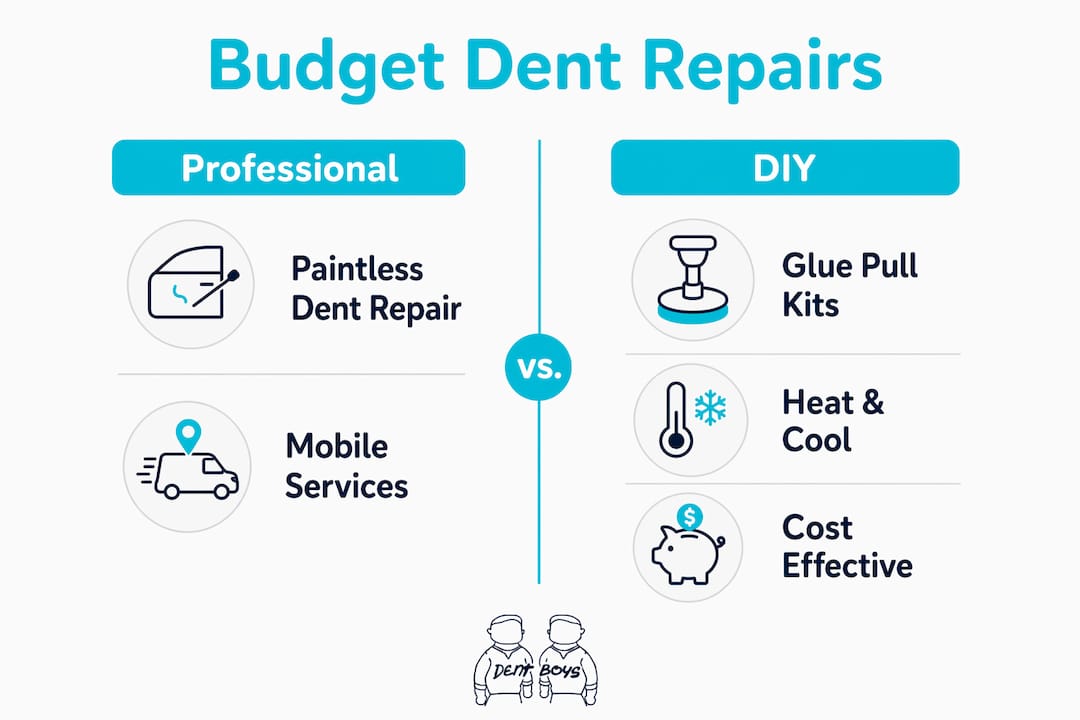
Budget car dent solutions are affordable methods to remove minor vehicle dents without paying full body shop prices. Paintless dent repair (PDR), DIY glue pull kits, and mobile repair services cover most minor damage at a fraction of traditional costs. A standard body shop repair for a small dent can run $500 or more, while PDR and DIY alternatives bring that number down sharply. Your car can look factory-fresh again without draining your wallet.
What are the most effective budget dent repair methods?
The three main budget methods are PDR, DIY kits, and mobile repair services. Each fits a different dent type, budget, and skill level.
Paintless dent repair (PDR)
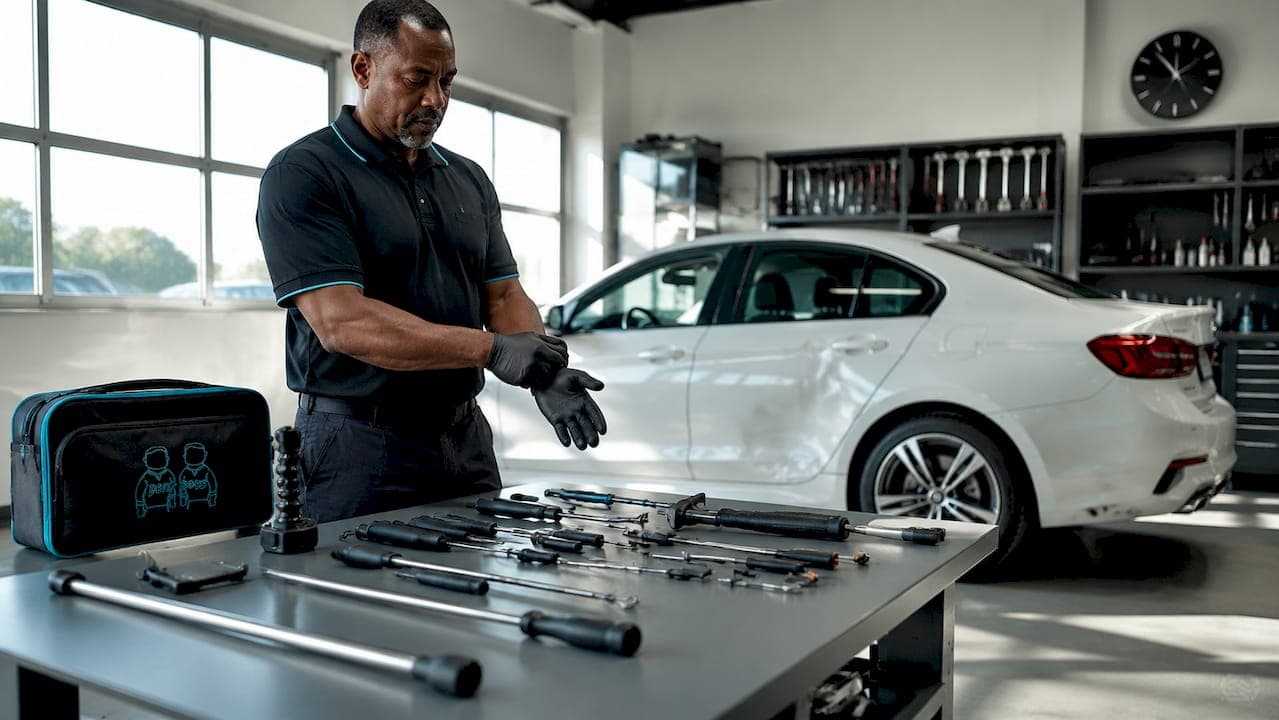
PDR is the gold standard for affordable car dent repair. A technician uses specialized metal rods and picks to push a dent back from behind the panel without touching the paint. PDR for minor dents costs $75–$350 and takes 1–3 hours. A traditional body shop charges $500–$1,000 for the same job and keeps your car for 3–7 days. PDR also preserves factory paint and resale value, which body shop fill-and-repaint methods cannot match.
DIY dent repair kits
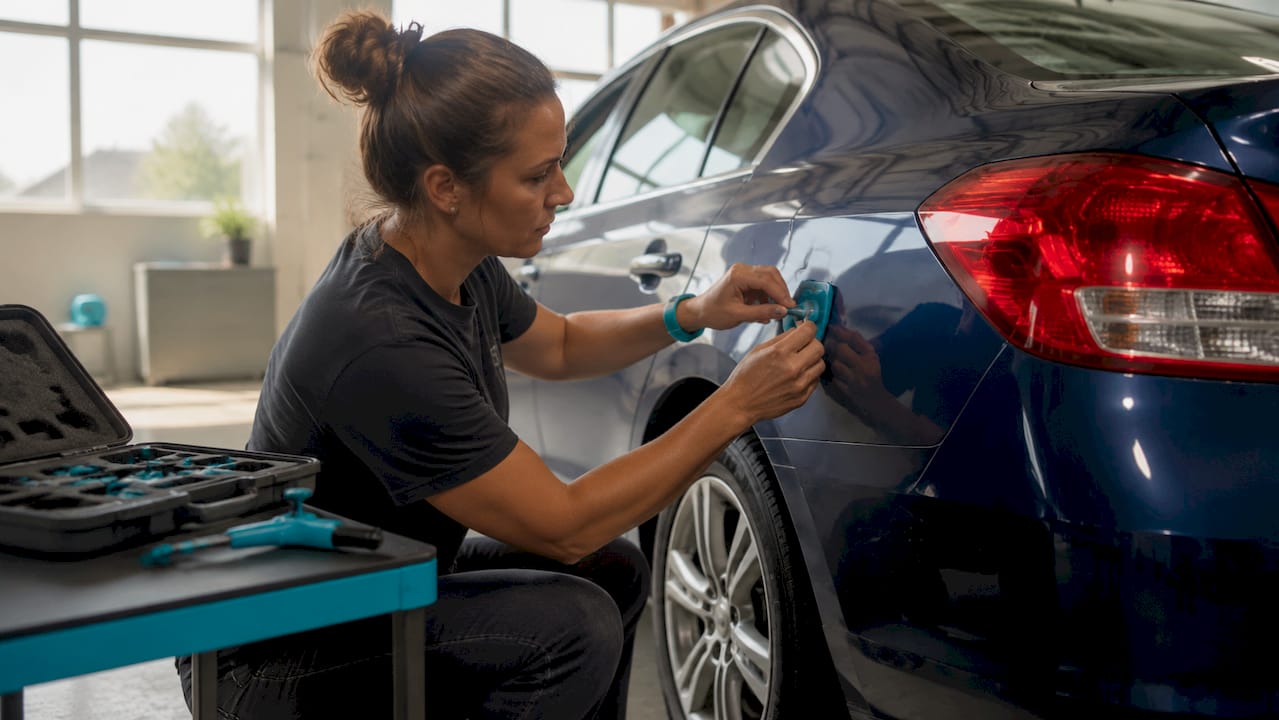
DIY kits are the cheapest entry point for cost-effective dent fixing. Glue pull kits and heat/cool methods cost $15–$60 and can remove many small dents without damaging original paint. The repair takes roughly 1–2 hours if you work carefully. DIY is best for shallow dents on steel panels with intact paint. Dents with sharp creases, paint cracking, or damage near panel edges need professional attention.
Mobile dent repair services
Mobile services bring a PDR technician to your driveway or office. Minor repairs finish in 1–3 hours with no overnight drop-off required. Pricing is competitive with shop-based PDR, and you save time by skipping the trip. For busy car owners, mobile repair is one of the best budget dent services available.
| Method | Typical Cost | Turnaround | Best For |
|---|---|---|---|
| DIY kit | $15–$60 | 1–2 hours | Tiny, shallow dents, steel panels |
| PDR (shop) | $75–$350 | 1–3 hours | Minor to moderate dents, intact paint |
| Mobile PDR | $75–$350 | 1–3 hours | Convenience, same-day repair |
| Body shop | $500–$1,000+ | 3–7 days | Deep dents, paint damage, creases |
Pro Tip: Get at least two quotes before booking any repair. Prices for the same dent can vary by $100 or more between shops.
What tools do you need for DIY dent repair?
The right tools make DIY repair safer and more effective. Buying a cheap, incomplete kit wastes money and risks paint damage.
Here are the core supplies you need:
- Glue gun and pulling tabs: The backbone of any glue pull kit. Tabs attach to the dent surface; the gun heats the adhesive. Kits with multiple tab sizes handle different dent shapes.
- Plastic trim removal tools: Used to push dents from behind when panel access exists. Metal tools scratch surrounding surfaces, so plastic is the only safe choice.
- Hair dryer or heat gun: Warms the metal to increase flexibility before pulling. A standard hair dryer works for most small dents.
- Compressed air can or dry ice: Applied immediately after heating to create a rapid temperature change that helps shallow dents pop back.
- Microfiber cloths and panel cleaner: A clean, grease-free surface is required before any adhesive will bond properly.
- Safety glasses and gloves: Compressed air and hot glue both carry injury risk if mishandled.
| Tool | Estimated Cost | Role |
|---|---|---|
| Glue pull kit (tabs + gun) | $20–$45 | Primary pulling method |
| Plastic trim tools | $8–$15 | Push from behind |
| Hair dryer | $10–$25 | Heat application |
| Compressed air can | $5–$10 | Rapid cooling |
| Panel cleaner + cloths | $5–$12 | Surface prep |
Pro Tip: Buy a kit from a recognized automotive brand rather than the cheapest unbranded option. Better adhesive tabs release cleanly and reduce the risk of pulling paint.
How to fix car dents cheaply: step-by-step DIY methods
Two techniques cover most small DIY repairs: the heat and cool method and the glue pull method. Read through both before starting so you pick the right one for your dent.
Heat and cool method
This works best on small, shallow dents where the paint is fully intact and the metal has some flex.
- Clean the area. Wash and dry the dented panel completely. Any dirt or wax will interfere with heat transfer.
- Apply heat. Hold a hair dryer 4–6 inches from the dent. Move it in slow circles for 1–2 minutes. The metal should feel warm, not hot.
- Apply cold immediately. Spray compressed air (held upside down to release cold gas) or press dry ice directly onto the center of the dent for 30–60 seconds.
- Listen and watch. A small pop often signals the dent releasing. If nothing happens after two attempts, stop. Repeated heating and cooling can stress the paint.
- Assess the result. Small, round dents respond well. Elongated or sharp-edged dents rarely pop back fully with this method.
The heat and cool method is low cost and safe for small dents with intact paint, but results are not guaranteed on every dent shape.
Glue pull method
Use this when the dent has no backside access, such as on door panels or quarter panels.
- Clean the surface. Use panel cleaner and a microfiber cloth. The adhesive will not bond to a dirty or oily surface.
- Select the right tab. Match the tab size to the dent. A tab that is too small concentrates pull force and can create a high spot in the center.
- Apply glue and attach the tab. Use the hot glue gun to coat the tab, then press it firmly onto the dent center. Wait 2–3 minutes for the glue to set fully.
- Pull slowly and steadily. Use the slide hammer or T-bar puller from your kit. Pull straight out, not at an angle. Sudden jerks create new damage.
- Remove the tab. Twist gently to release. Use adhesive remover to clean any glue residue from the panel.
- Evaluate and repeat if needed. Large dents may need 2–3 pulls with slightly different tab placements to level out.
Glue pull does not work well on plastic bumpers or panels that have been repainted. Aftermarket paint bonds differently than factory finish and can lift with the tab. If your panel has any prior repaint work, skip DIY and go straight to a professional.
Common mistakes to avoid:
- Rushing the glue cure time before pulling
- Using metal tools near painted surfaces
- Attempting DIY on dents with any paint cracking or chipping
- Skipping surface prep
How to choose a professional budget dent repair service
Choosing the wrong shop costs more in the long run. A shop that gives a blind quote over the phone without seeing the dent is a red flag. Accurate pricing requires a visual inspection of dent depth, location, and paint condition. Photos help, but an in-person or photo-based estimate is the minimum standard.
Aluminum panels need special attention
Many newer vehicles use aluminum body panels. Aluminum work-hardens when manipulated incorrectly. Unqualified repairs on aluminum can make a dent harder or impossible to fix without body filler later. Shops that use induction heating tools are equipped to handle aluminum safely. Ask directly whether the shop has experience with your vehicle's panel material before booking.
Questions to ask any PDR shop
- Do you offer a free visual estimate in person or by photo?
- Do you have experience with aluminum panels if applicable?
- What is your warranty on the repair?
- Do you offer mobile service?
- Can you show before-and-after photos of similar repairs?
Shops that hesitate on any of these questions deserve a second look. Same-day repair appointments are widely available through mobile PDR providers, so speed is not a reason to skip due diligence.
Pro Tip: Ask for a written quote that specifies the repair method. "PDR" and "body shop repair" are not interchangeable, and the difference in cost and outcome is significant.
Key takeaways
PDR is the most cost-effective professional method for minor dents, costing $75–$350 and finishing in 1–3 hours, while DIY kits offer the lowest entry cost at $15–$60 for small, shallow damage.
| Point | Details |
|---|---|
| PDR beats body shops on cost | PDR costs $75–$350 versus $500–$1,000 at a body shop for similar minor dents. |
| DIY kits work for small dents | Glue pull and heat/cool kits cost $15–$60 and preserve paint when used correctly. |
| Aluminum panels need specialists | Unqualified aluminum repairs can permanently worsen the dent. |
| Blind quotes are unreliable | Always get a visual inspection before accepting any repair price. |
| Mobile PDR saves time | Mobile services complete most minor repairs in 1–3 hours at your location. |
What I've learned after years of watching people fix dents the wrong way
Most car owners either overpay at a body shop or underestimate what a DIY kit can do. Both mistakes are avoidable.
PDR is genuinely underused. The method preserves your factory paint, which directly protects resale value. A car with original paint is worth more than one with repainted panels, full stop. Choosing PDR over a body shop repaint is not just a budget decision. It is the smarter long-term choice for your vehicle.
That said, I have seen too many people rush a glue pull job on a dent that was never a good candidate for DIY. A dent with any paint cracking, a sharp crease, or location near a panel edge needs a professional. Attempting DIY on those dents and failing costs more to fix than if you had gone straight to a shop.
My honest advice: try the heat and cool method first on very small, round dents. It costs almost nothing and carries minimal risk. If that does not work, move to a glue pull kit. If the dent is larger than a golf ball or has any paint damage, call a PDR technician. The $75–$150 you spend on a professional assessment is almost always worth it.
One more thing: if your vehicle has aluminum panels, do not let any shop touch it without confirming they use induction heating tools. This is not a minor detail. Getting this wrong can turn a $200 repair into a $1,000 panel replacement.
— Martin
Get your dent fixed fast with Dent-boys
Dent-boys specializes in paintless dent repair that restores your vehicle to like-new condition without painting or fillers. Their mobile service comes to you, completes most repairs in 1–3 hours, and includes a lifetime warranty on every job. There is no overnight drop-off, no deductible, and no guesswork on pricing. Dent-boys offers free estimates so you know exactly what to expect before any work begins.
If you want affordable dent repair done right the first time, Dent-boys is the call to make. Free estimates, pick-up and delivery, and a track record of satisfied customers make them the practical choice for budget-conscious car owners who refuse to compromise on quality.
FAQ
How much does budget car dent repair cost?
DIY kits cost $15–$60. Professional PDR for minor dents runs $75–$350 and takes 1–3 hours. Traditional body shop repairs for the same damage typically cost $500–$1,000.
Can I fix a car dent myself without damaging the paint?
Yes, if the dent is small, shallow, and the paint is fully intact. The heat and cool method and glue pull kits both work without touching the paint when used correctly on suitable dents.
What is paintless dent repair and why is it cheaper?
PDR uses metal rods and picks to push dents back from behind the panel without sanding, filling, or repainting. Skipping those steps cuts labor time and material costs significantly.
When should I avoid DIY and call a professional?
Call a professional when the dent has paint cracking, a sharp crease, or is on an aluminum panel. Improper DIY on these dents can make the damage worse and more expensive to fix.
Does PDR work on aluminum panels?
PDR works on aluminum panels, but only when the technician uses induction heating tools. Shops without that equipment risk hardening the metal, which can make the dent permanent.