
Comparing dent repair costs means evaluating paintless dent repair (PDR) against traditional body shop methods based on dent size, paint condition, and repair complexity. PDR is the industry standard term for the technique that massages dents out from behind a panel without touching the paint. When you compare dent repair costs across methods, the price gap is significant. PDR typically runs $75–$800 depending on dent size, while traditional repairs with repainting can reach $2,500 or more. Understanding which method applies to your specific dent is the single most important factor in getting an accurate estimate.
How do dent repair costs compare by method?
PDR and traditional body shop repair are the two primary methods, and their costs differ by hundreds of dollars for the same size dent.
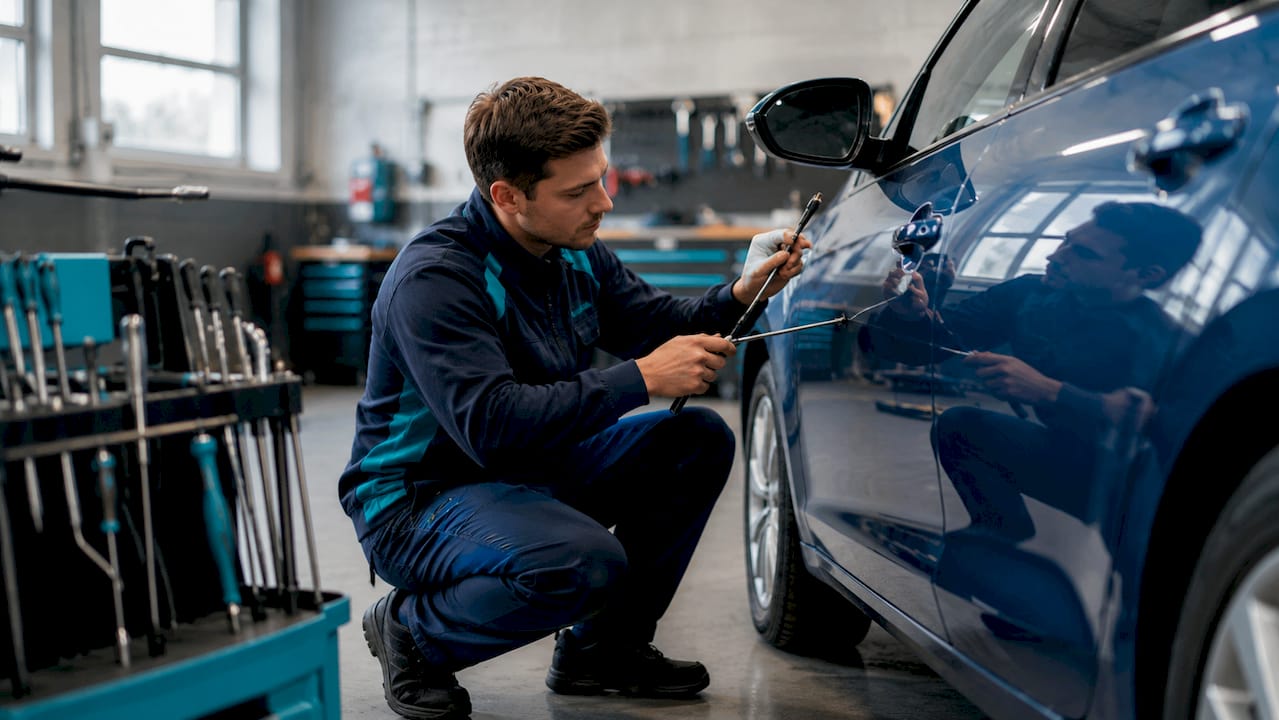
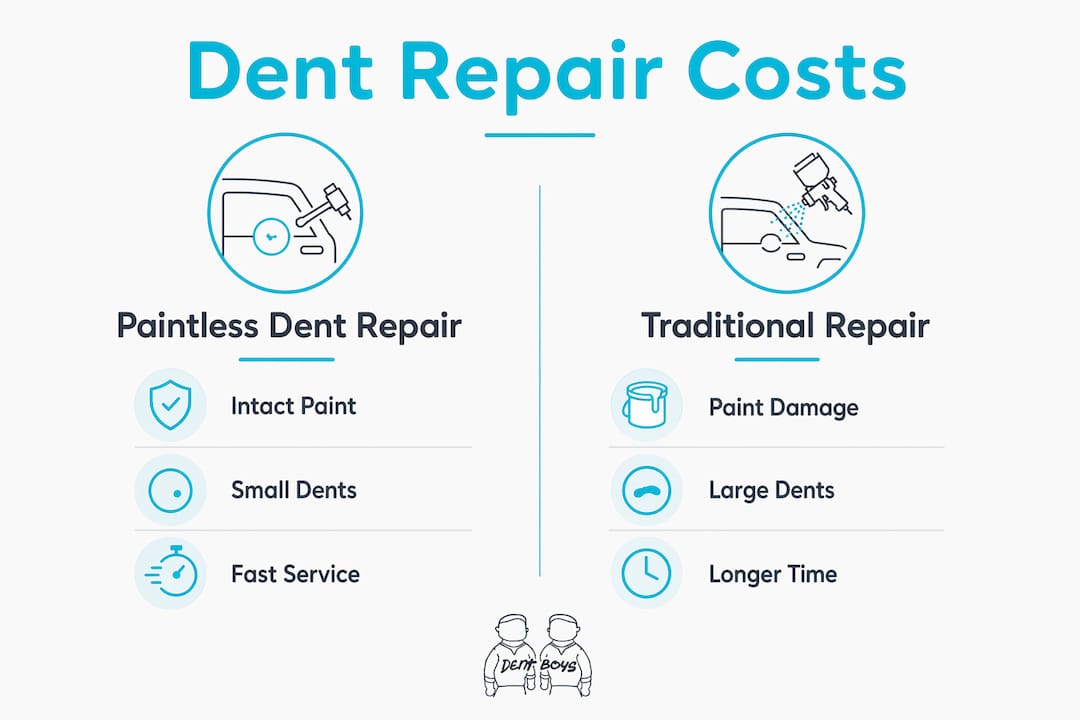
Paintless Dent Repair (PDR) works when the paint surface is fully intact. A technician uses specialized metal rods and body picks to push the dent back into shape from behind the panel. No filler, primer, or paint is needed. PDR costs range from $75–$150 for small dents, $150–$400 for medium dents, and $300–$800 or more for large dents. That price stays low because the labor time is short and no materials are consumed.
Traditional body shop repair becomes necessary when paint is cracked, chipped, or the metal is creased beyond what PDR can address. The shop must sand, apply body filler, prime, repaint, and apply clear coat. Traditional repair costs run $500–$1,000 for small dents with paint damage and $1,000–$2,500 for larger or creased dents. That is a significant jump for what might look like a similar dent from the outside.
Repair time: hours vs. days
Turnaround time is a real cost too, especially if you need a rental vehicle. PDR door ding repairs take 30–90 minutes. A full repaint job takes 3–7 days depending on complexity. That difference matters when you are deciding between methods and budgeting for transportation.
| Repair Method | Typical Cost Range | Turnaround Time | Paint Required? |
|---|---|---|---|
| PDR (small dent) | $75–$150 | 30–90 minutes | No |
| PDR (medium dent) | $150–$400 | 1–3 hours | No |
| PDR (large dent) | $300–$800+ | 3–6 hours | No |
| Traditional (small, paint damage) | $500–$1,000 | 3–5 days | Yes |
| Traditional (large/creased) | $1,000–$2,500 | 5–7 days | Yes |
Pro Tip: Ask the shop directly whether your dent qualifies for PDR before accepting any quote. If they say no, ask why. Paint condition and panel accessibility are the two most common disqualifiers.
PDR saves 40–70% compared to conventional bodywork when the paint is intact. That savings comes from eliminating materials and cutting labor time dramatically.
What factors drive the cost of dent repair?
Dent size is the most obvious cost driver, but paint condition is the factor that most people overlook. A small dent with cracked paint will cost more than a large dent with intact paint in many cases.
Dent size and location
Small dents under one inch in diameter are the cheapest to fix with PDR. Medium dents in the two to four inch range cost more because they require more working time and greater precision. Large dents or those covering multiple panel sections push into the upper range of PDR pricing or may require traditional repair entirely. Location also matters. Dents near panel edges, door handles, or body lines are harder to access and cost more to repair regardless of method.
Paint condition
Paint condition is the single biggest factor in determining which method applies and what you will pay. Intact paint means PDR is on the table. Cracked, chipped, or peeling paint means traditional repair is required. Cost comparisons are often misleading because paint damage changes the repair method and price significantly, even for visually similar dents. Two dents that look identical from ten feet away can require completely different repair approaches.
Panel material and complexity
Aluminum panels cost more to repair than steel panels. Aluminum requires specialized PDR tools and more skilled technicians, which raises labor rates. Creased dents, where the metal has folded rather than simply pushed inward, are harder to restore and often require traditional methods. Hail damage is a special category. Hail damage via PDR typically runs $1,200–$4,000 for a full vehicle. Traditional body shop repair for the same hail damage can reach $5,000–$12,000. That price difference makes PDR the clear choice for hail when paint is intact.
Pro Tip: If your car has multiple dents from a hail storm, ask for bulk pricing. Many PDR shops offer per-vehicle rates that are significantly lower than per-dent pricing.
How do you interpret and compare dent repair estimates?
A dent repair estimate is a written breakdown of the expected labor, materials, and procedures needed to restore your vehicle. Understanding what is inside an estimate prevents surprise charges and helps you compare quotes accurately.
What a proper estimate should include
A complete automotive repair estimate covers four areas: labor hours and rates, parts if any panels need replacement, paint and materials costs, and any shop fees or procedures like blending adjacent panels. When you get a quote from a PDR technician, the estimate is simpler. It should state the number of dents, the method, and the total price. When you get a quote from a body shop for traditional repair, the estimate should itemize paint, primer, filler, and labor separately.
Hidden damage discovered after disassembly can cause estimate revisions. A shop may open a door panel to access a dent and find rust, damaged clips, or structural issues that were not visible during the initial inspection. This is normal, but you should ask upfront how the shop handles supplementary charges and whether they will contact you before proceeding.
Comparing quotes the right way
Comparing quotes without understanding their assumptions leads to bad decisions. A quote assuming intact paint and using PDR cannot be validly compared to one that assumes paint damage requiring a full repaint. Before comparing numbers, confirm that each quote is based on the same repair method and the same damage assessment.
Here is a practical process for comparing estimates:
- Get at least three quotes, including one from a mobile PDR technician, one from an independent body shop, and one from a dealership.
- Confirm whether each quote is for PDR or traditional repair and why.
- Ask each shop whether they inspected the paint condition directly or estimated from photos.
- Check whether the quote includes blending adjacent panels, which adds cost but improves color match.
- Ask about the warranty on the repair. PDR done correctly should carry a lifetime warranty on that specific dent.
Online dent repair cost calculators are a useful starting point for budgeting but should not replace a physical inspection and written quote. Calculators cannot assess paint condition, panel accessibility, or hidden damage. Use them to set expectations, not to make final decisions.
Estimate transparency directly improves customer satisfaction and reduces surprise costs. Shops that provide itemized written estimates before starting work are easier to hold accountable if the final bill differs.
What are the best practices for choosing a dent repair option?
The best dent repair option balances your budget, your vehicle's value, and the specific characteristics of the damage. Choosing the cheapest quote without understanding the method is the most common mistake car owners make.
When PDR is the right call:
- Paint is fully intact with no cracking or chipping
- The dent is on a steel panel with accessible backside
- You need the car back quickly
- You want to preserve the original factory paint, which protects resale value
When traditional repair is necessary:
- Paint is cracked, chipped, or missing
- The dent has a sharp crease that PDR cannot fully correct
- The panel is aluminum and the damage is severe
- The dent is on a structural component
Dealer vs. independent shop vs. mobile technician
Dealerships charge the highest rates and are best reserved for warranty work or situations where you need OEM parts. Independent body shops offer competitive pricing and are often the best choice for traditional repair. Mobile PDR technicians offer the lowest rates for straightforward dents and can come to your home or office. Mobile PDR technicians offer fast, lower-cost repairs on-site but may have limitations for complex damage or aluminum panels requiring specialized tools.
Pro Tip: Before negotiating price, ask whether the shop is I-CAR certified or uses certified PDR technicians. Certification gives you a baseline for quality and gives you leverage when comparing quotes.
Key takeaways
PDR is the most cost-effective dent repair method when paint is intact, saving 40–70% over traditional bodywork and returning your car the same day.
| Point | Details |
|---|---|
| PDR vs. traditional cost gap | PDR runs $75–$800; traditional repair with paint damage costs $500–$2,500 or more. |
| Paint condition determines method | Intact paint qualifies for PDR; cracked or chipped paint requires traditional repair at higher cost. |
| Compare quotes on equal terms | Confirm each quote uses the same repair method and damage assessment before comparing prices. |
| Hail damage favors PDR | PDR for hail damage costs $1,200–$4,000 versus $5,000–$12,000 for traditional body shop repair. |
| Online calculators have limits | Use cost calculators to set a budget range, then get written quotes from physical inspections. |
What i've learned after years of watching customers compare estimates
The most common mistake I see is car owners comparing a PDR quote to a body shop quote without realizing the two shops assessed the damage differently. One shop looked at the paint under good lighting and confirmed it was intact. The other glanced at a photo and assumed paint damage. The quotes came back $400 apart, and the customer almost chose the cheaper one without asking why the prices differed. The cheaper quote was actually for traditional repair, which would have taken five days and involved repainting a panel that did not need it.
Paint condition is the fork in the road for every dent repair decision. I have seen customers spend $1,200 on traditional repair for a dent that a qualified PDR technician could have fixed in two hours for $250. The difference was a small chip in the paint that the body shop used to justify a full repaint. In some cases, that chip could have been touched up separately for $50, leaving the dent eligible for PDR.
My honest advice is to get your paint condition assessed in person before you accept any quote. Ask the technician to show you exactly where the paint is damaged and why that rules out PDR. If they cannot show you, get a second opinion. The best shops welcome that question because they know their assessment will hold up to scrutiny.
Resale value is the long-term argument for choosing PDR when it applies. Original factory paint is worth more than repainted panels on a used car. A CarFax report that shows body work can reduce a vehicle's perceived value even when the repair was done well. PDR leaves no trace and no record.
— Martin
Why Dent-boys makes the cost comparison easy

Dent-boys specializes in paintless dent repair and hail damage restoration, which means you get the most cost-effective method applied by certified technicians who do this work every day. The service includes free estimates, pick-up and delivery, a $0 deductible option, and a lifetime warranty on every repair. You do not have to spend days without your car or pay for paint work your vehicle does not need. Dent-boys handles the entire process, from the initial assessment to returning your car in like-new condition. If you want to skip the guesswork and get a clear, honest estimate from a team that knows PDR inside and out, get your free estimate from Dent-boys today.
FAQ
What is a dent repair estimate?
A dent repair estimate is a written breakdown of the expected labor, materials, and procedures needed to fix your vehicle's dent. It should specify whether the repair uses PDR or traditional methods and itemize all associated costs.
How do i get a dent repair estimate online?
Most PDR shops and body shops offer online estimate forms where you submit photos and dent details. Online calculators provide ballpark ranges, but a physical inspection is required for an accurate written quote.
What is the cheapest dent repair option?
PDR is the cheapest dent repair option when paint is intact, with costs starting at $75 for small dents. Traditional repair with repainting starts at $500 and can exceed $2,500 for larger damage.
How long does dent repair take?
PDR repairs typically take 30 minutes to a few hours. Traditional body shop repairs involving repainting take 3–7 days depending on the size and complexity of the damage.
Can i negotiate a dent repair price?
Yes. Getting multiple quotes gives you leverage to negotiate, especially with independent shops. Asking about bulk pricing for multiple dents or hail damage can also reduce the total cost significantly.