
Paintless dent repair (PDR) is the industry-standard method for removing dents without touching the original factory paint. Car owners dealing with door dings, hail damage, or minor collision dents can restore their vehicle's finish without sanding, fillers, or a trip to a body shop. PDR works by using specialized metal rods and glue-pull tools to massage the damaged panel back to its original shape from behind. The result is a repair that preserves the factory clear coat, keeps repair costs low, and takes hours rather than days. This is dent repair without painting explained in full, from how the process works to when it applies to your car.
How does paintless dent repair work?
PDR relies on a physical property of automotive steel called elastic memory. Metal that has been dented but not stretched or cracked will return to its original shape when gradual, controlled pressure is applied from the correct angle. PDR uses this elastic memory to restore the panel without any filler or paint.
The repair process follows a clear sequence:
- Access the dent from behind. The technician removes interior panels, trim pieces, or weather stripping to reach the back side of the damaged metal. On doors, this often means pulling the door card. On fenders, it may require removing a wheel liner.
- Select the right tool. Technicians use a set of metal rods, picks, and levers in various lengths and tip shapes. Each tool is designed for a specific panel curve or dent location.
- Apply gradual back-pressure. The technician places the rod tip behind the lowest point of the dent and applies slow, steady upward pressure. The goal is to move the metal in small increments, not one forceful push.
- Use glue pulling when rear access is impossible. On some panels, like the roof or certain pillars, a glue tab is bonded to the dent's surface. A slide hammer or pulling bridge then lifts the metal from the front.
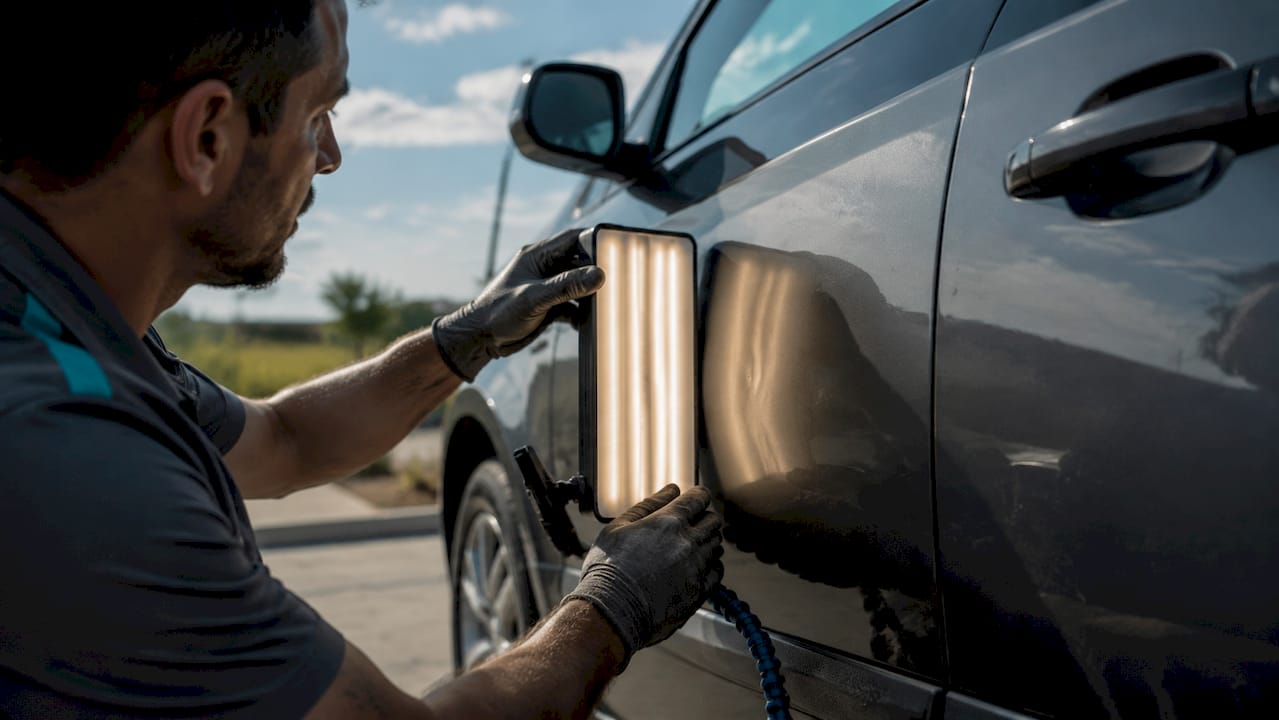
- Finish with light tapping. A small knockdown tool taps any high spots from the front while the technician monitors the surface under a specialized LED reflection board. This board shows distortions in the paint surface that the naked eye would miss.
No sanding, priming, or repainting happens at any point. The factory paint stays intact from start to finish.
Pro Tip: Ask your technician to use an LED reflection board during the repair. This tool reveals surface distortions invisible to the naked eye and is the clearest sign of a professional PDR setup.
What are the criteria for repairing dents without painting?
PDR is not a universal fix. Three conditions must be met for the process to work: intact paint, non-stretched metal, and physical access to the dent. If any one of these is missing, conventional body shop repair becomes necessary.
Here is what makes a dent a good candidate for PDR:
- Paint is fully intact. No cracking, chipping, flaking, or peeling. Even a hairline crack in the clear coat means the paint will not hold up through the repair process without further damage.
- Dent size is under approximately 4 inches across. Dents under 4 inches with a shallow depth-to-diameter ratio respond well to PDR. Larger dents spread stress across a wider area and are harder to restore evenly.
- No sharp creases. A smooth, rounded dent is ideal. A sharp crease means the metal has been forced past its elastic limit and will not spring back cleanly.
- Metal is not overstretched. When metal stretches, it thins and loses its ability to return to shape. Overstretched panels develop a wavy, oil-canning effect that PDR cannot correct.
- Panel access exists. The technician needs either rear access through a removed trim piece or a flat enough surface for glue pulling.
- Panel material is steel, not heavily damaged aluminum. Aluminum panels require specialized tools and more time. Aluminum panel repairs cost 30–50% more than equivalent steel repairs due to work-hardening properties that make the metal less forgiving.
When paint is cracked or the metal is creased, the honest answer is that PDR will not produce a clean result. A good technician tells you this upfront rather than attempting a repair that will look worse than the original dent.
What are the cost and time benefits of PDR vs. traditional repair?
The cost difference between PDR and conventional body shop work is significant. Conventional repair typically costs three times more than PDR because it adds fillers, primer, color-matched paint, and curing cycles to the bill. Each of those steps adds labor time and materials cost.
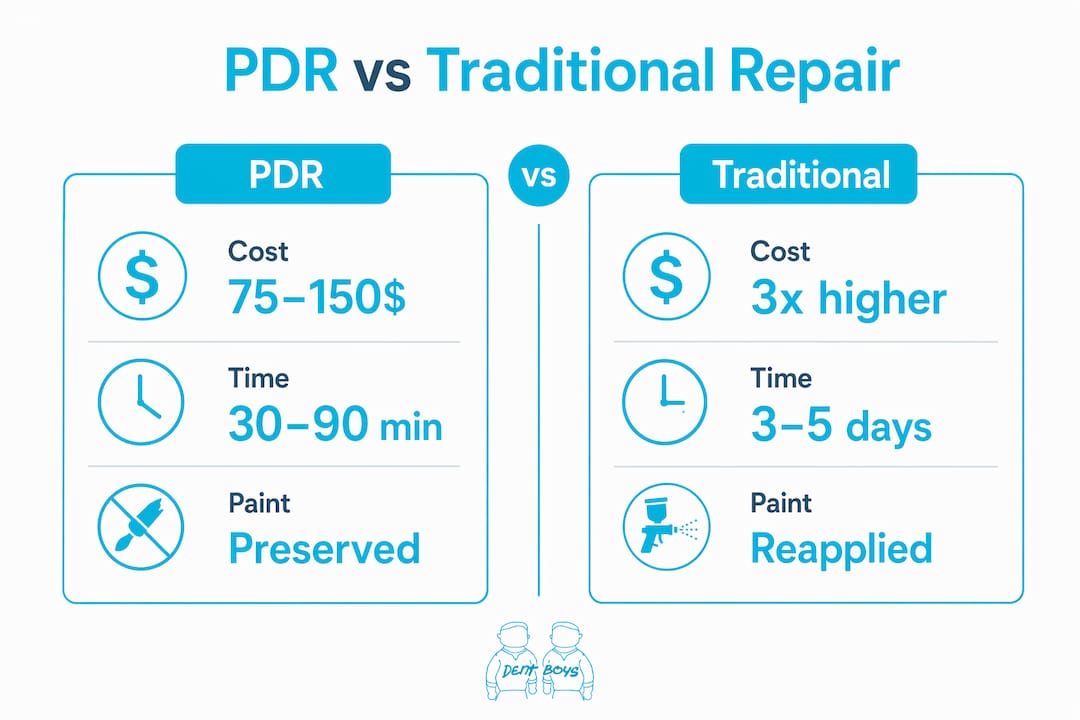
For a small door ding, PDR costs approximately $75 to $150 and completes in under 90 minutes. A body shop repair for the same dent can run $300 to $500 or more once painting and blending are factored in.
| Repair type | Typical cost | Typical time |
|---|---|---|
| PDR (small door ding) | $75–$150 | 30–90 minutes |
| PDR (medium dent, hail) | $150–$350 | 1–3 hours |
| Conventional body shop | $300–$900+ | 3–5 days |
PDR is significantly faster than body shop work, completing in 30 minutes to 3 hours versus 3 to 5 days for conventional repair. That time difference matters when you depend on your vehicle daily.
The quality benefit is equally important. PDR preserves the factory paint and clear coat, which body shop repainting cannot replicate. Factory paint is applied in a controlled environment with consistent thickness and bonding. Repainted panels, even when color-matched well, can show slight differences in texture or sheen over time. Keeping the original finish intact protects resale value in a way that repainted panels simply cannot match.
Conventional repair is still necessary when paint is cracked, metal is creased, or structural damage is involved. PDR is not a workaround for serious collision damage. It is the right tool for the specific job it was designed to do.
Are there practical tips for choosing a PDR service?
Choosing the right PDR technician matters as much as choosing the right repair method. A poorly executed PDR job can leave the panel with high spots, low spots, or a wavy surface that looks worse than the original dent.
Look for these qualities in a PDR service:
- Verifiable experience with your dent type. Hail damage repair and single door ding repair require different skill sets. Ask whether the technician specializes in the type of damage you have.
- LED reflection board use. Any professional setup includes this tool. It is the standard for quality control in PDR work.
- Written warranty on the repair. Reputable services back their work. Dent-boys, for example, offers a lifetime warranty on every repair, which is a strong signal of confidence in workmanship.
- Mobile service availability. Many PDR providers offer mobile dent repair that comes to your home or office. This eliminates the need to arrange a drop-off and pickup.
- Free estimate before commitment. A trustworthy technician assesses the dent in person before quoting a price. Avoid services that quote over the phone without seeing the damage.
Common mistakes car owners make include waiting too long after a dent occurs. Temperature cycling, car washes, and sun exposure can cause paint around a dent to stress and crack over time, which can turn a PDR-eligible dent into one that requires painting. Act within a reasonable timeframe.
Pro Tip: After a PDR repair, avoid automatic car washes with stiff brushes for at least two weeks. Hand washing or touchless washes protect the repaired area while the panel fully settles.
Post-repair maintenance is straightforward. Keep the repaired panel clean and waxed. Wax protects the clear coat and helps the surface shed water, which reduces the chance of paint stress around any remaining micro-imperfections.
Key Takeaways
PDR is the most cost-effective and time-efficient method for removing dents when paint is intact, metal is not creased, and panel access is available.
| Point | Details |
|---|---|
| PDR preserves factory paint | Original clear coat stays intact, protecting resale value better than any repaint. |
| Cost advantage is substantial | PDR costs roughly one-third of conventional body shop repair for the same dent. |
| Speed is a major benefit | Most PDR repairs finish in 30 minutes to 3 hours, versus 3–5 days at a body shop. |
| Suitability depends on three factors | Intact paint, non-stretched metal, and physical access all must be present for PDR to work. |
| Aluminum panels cost more | Aluminum dent repairs run 30–50% higher than steel due to specialized tools and work-hardening. |
Why PDR is worth understanding before you call a body shop
I have seen car owners spend $400 at a body shop for a repair that a PDR technician could have handled in an hour for $100. The gap is not about quality. It is about awareness. Most people default to the body shop because that is what they know, not because it is the right call for their situation.
The cases where PDR genuinely cannot help are real but narrower than most people assume. A sharp crease from a parking lot collision, a dent with cracked paint, or structural damage from a significant impact all require conventional repair. But a hail storm that leaves 30 shallow dings across a hood? That is exactly what PDR was built for, and a body shop would charge several times more for an inferior result.
The technology has also improved considerably. LED reflection boards, improved glue formulations, and better rod designs mean today's PDR technicians can work on dents that would have required painting a decade ago. The skill ceiling has risen, which means more dents qualify for the process than car owners typically expect.
My honest advice: get a PDR assessment before you book a body shop appointment. The assessment is usually free, and the worst outcome is learning that your dent genuinely needs paint work. The best outcome is saving hundreds of dollars and getting your car back the same day.
— Martin
Dent-boys: expert PDR without the body shop hassle
Car owners who want a fast, affordable repair without the body shop runaround have a direct option.

Dent-boys specializes in paintless dent repair for hail damage, door dings, and minor collision dents. Every repair comes with a lifetime warranty, a $0 deductible option, and free pick-up and delivery so you never have to rearrange your schedule. Mobile service means the technician comes to you. Free estimates mean you know the cost before any work begins. If your dent qualifies for PDR, get a free estimate from Dent-boys and skip the body shop entirely.
FAQ
What is paintless dent repair?
Paintless dent repair (PDR) is a method that removes dents by massaging the metal back into shape from behind the panel using specialized rods and tools, without sanding, filling, or repainting.
Can all dents be fixed without painting?
Not all dents qualify for PDR. Dents with cracked paint, sharp creases, overstretched metal, or no panel access require conventional body shop repair with paint work.
How much does paintless dent repair cost?
A small door ding typically costs $75 to $150 and completes in under 90 minutes. Larger or more complex dents cost more, but PDR consistently runs about one-third the price of conventional repair.
How long does a PDR repair take?
Most PDR repairs complete in 30 minutes to 3 hours, compared to 3 to 5 days for a conventional body shop repair that involves painting.
Does PDR affect a car's resale value?
PDR improves resale value compared to repainting because the factory paint and clear coat remain intact. Repainted panels can show texture or color differences that buyers and appraisers notice.