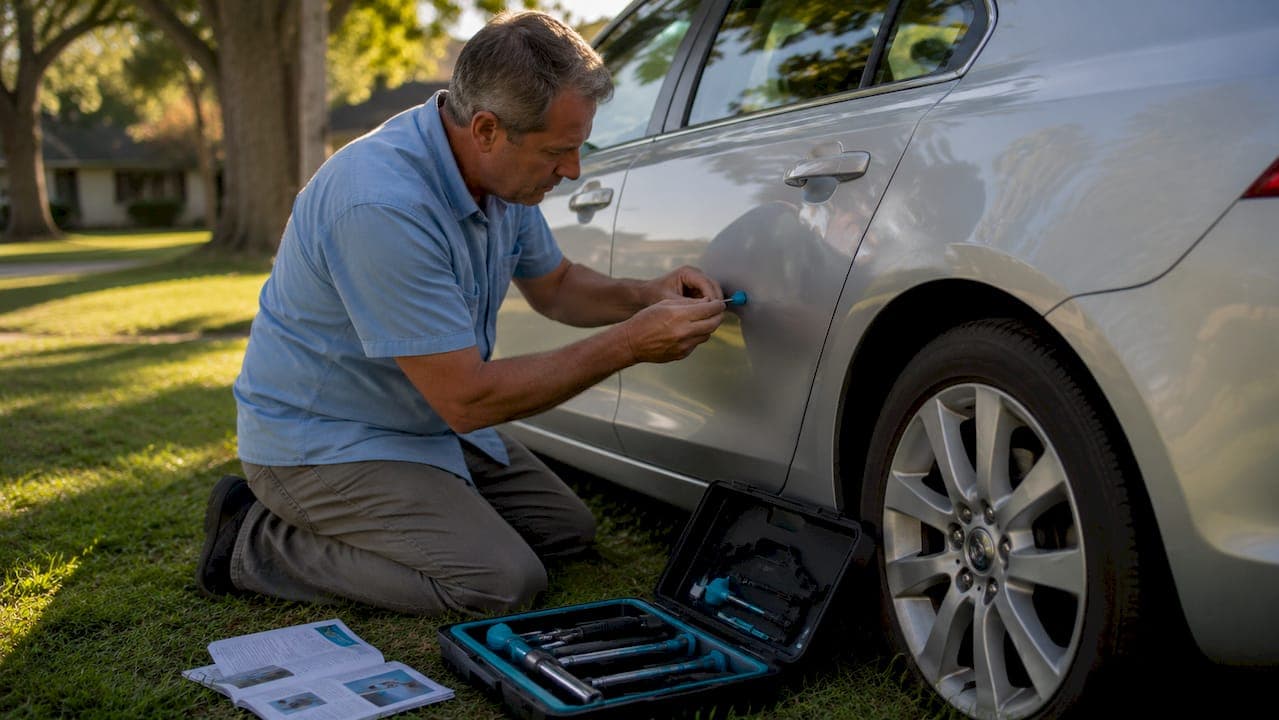
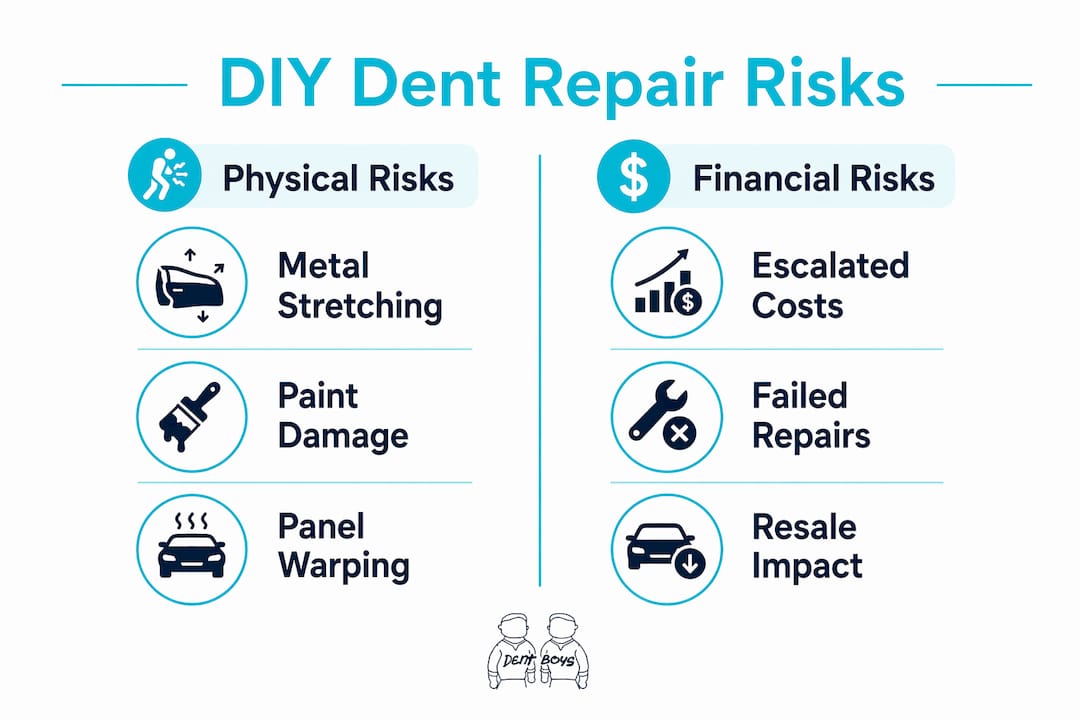
DIY dent repair risks are defined by three core dangers: metal stretching, paint damage, and repair costs that spiral when amateur attempts go wrong. Car owners reach for suction cups, glue pull tabs, and plungers hoping to save money, but the wrong technique on the wrong dent can turn a $150 paintless dent repair job into a $450 traditional body repair. Understanding these dangers before you touch your car is the difference between a clean fix and a permanent problem.
What are the most common risks of DIY dent repair?
The biggest risk in home dent repair is stretching the metal. When you apply uneven or excessive force, the panel deforms beyond its original shape. The result is a high spot, a raised area of metal that sits above the surrounding surface. High spots are harder to fix than the original dent and often require body filler or repainting.
Paint damage is the second major danger. Automotive paint is thin and brittle under stress. Pulling, prying, or applying heat can cause microfractures that are invisible at first but lead to peeling and rust within months. Glue pull tabs are a common culprit. If you remove the tab too fast or at the wrong angle, you can lift the clear coat right off the panel.
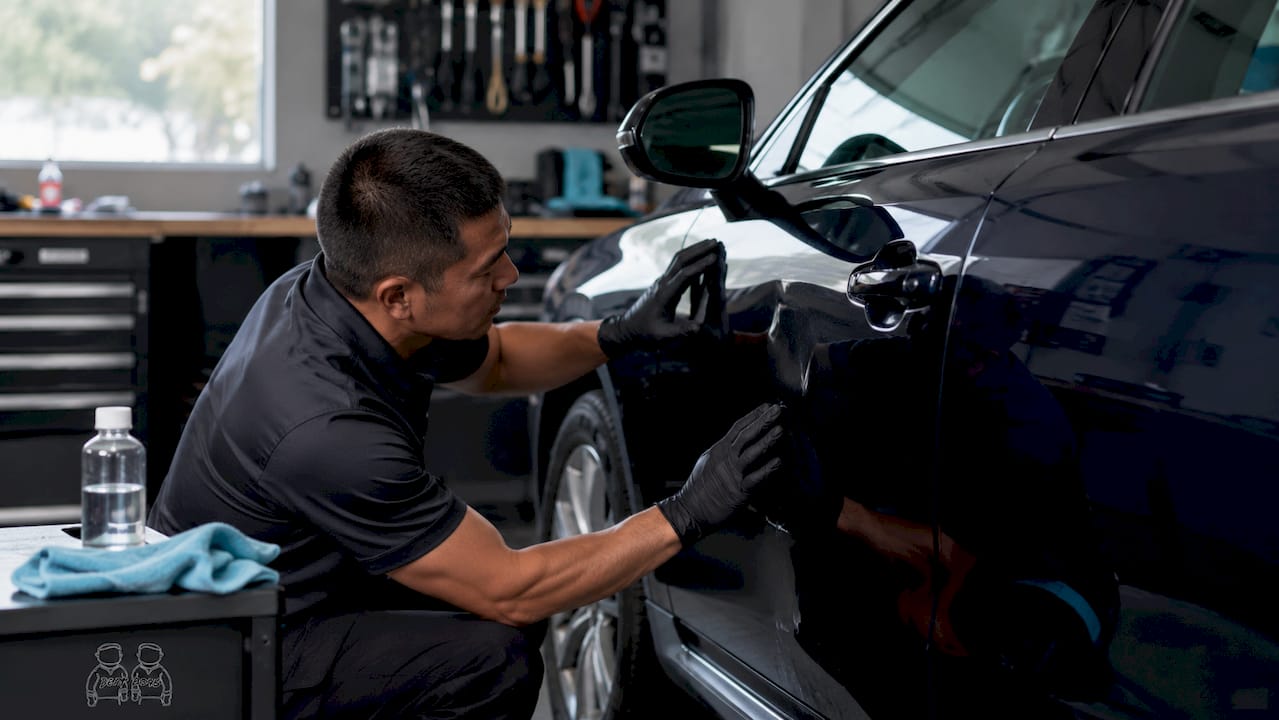
Rust is the long-term consequence nobody talks about. Once paint integrity is compromised, moisture reaches bare metal. A small dent with cracked paint becomes a rust spot within one to two seasons, especially in states that use road salt. What started as a cosmetic issue becomes structural damage.
The financial risk is real and specific. A bad DIY attempt can convert a $150 PDR job into a $450 traditional body repair due to metal stretching, paint damage, and high-spot creation. That math alone should give any car owner pause before picking up a kit.
- Metal stretching: Excess pulling force permanently distorts the panel, creating high spots that require grinding or filler.
- Paint cracking: Thermal stress and mechanical pulling cause microfractures in the clear coat and base coat.
- Glue residue damage: Removing glue tabs incorrectly strips clear coat, especially on dark or metallic finishes.
- Rust acceleration: Any break in the paint film exposes bare metal to moisture and oxidation.
- Repair escalation: A compromised panel may be rejected by PDR technicians, forcing more expensive traditional bodywork.
Pro Tip: Before attempting any repair, press gently around the dent with your fingertip. If the metal feels stiff and springy, it may pop back with minimal intervention. If it feels soft or creased, stop and call a professional.
How do dent type and location influence DIY repair risks?
Dent classification is the single most important factor in managing home dent repair risk. Not all dents behave the same way, and treating a crease like a round dent is one of the most common mistakes in DIY dent repair.
Round dents are the best candidates for DIY attempts. They result from direct, centered impact, like a hailstone or a shopping cart corner. The metal deforms evenly and retains its memory, meaning it wants to return to its original shape. Gentle suction or careful glue pulling can work on small, round dents with intact paint.
Crease dents are a different problem entirely. A crease concentrates force along a line, and sharp creases are prone to stretching and permanent distortion unlike round dents. The metal loses its memory along the crease line. Pulling a crease dent without professional tools and technique almost always makes it worse.
Location matters just as much as shape. Here is how dent location affects repair risk:
- Panel center: Lowest risk. Good access from behind, metal has room to flex, and PDR tools can reach most areas.
- Near a body line: High risk. Body lines concentrate stress. Pulling near a body line can flatten or distort the line itself, which is extremely difficult to restore.
- Near a brace or reinforcement: Dents near braces or panel edges present access challenges making both DIY and PDR more difficult and risky.
- Panel edge or wheel arch: Very high risk. Metal is thinner and more prone to tearing. Any DIY attempt here risks permanent deformation.
- Aluminum panels: Aluminum work-hardens faster than steel. It does not spring back the same way, and crease dents in aluminum are especially prone to permanent distortion. Many newer vehicles use aluminum hoods and doors.
The practical takeaway is straightforward. If your dent is round, smaller than a golf ball, located in the center of a steel panel, and the paint is intact, DIY carries manageable risk. Any other combination pushes you into professional territory.
What are the limitations of popular DIY dent repair methods?
Every popular DIY method has a specific failure mode. Knowing them helps you understand why home dent repair so often makes things worse.
Glue pull tabs are the most widely sold DIY solution, but glue pull success depends on strict process steps including cleaning with 99% isopropyl alcohol, correct temperature of both the tab and the panel, and proper cooling time before pulling. Most DIYers skip the cleaning step or pull before the glue has fully bonded. The result is either a failed pull or a tab that rips the clear coat off the panel. Glue pull success is more about process discipline than the glue itself.
Suction cups and plungers apply force across a wide area, which sounds safe but is not. DIY suction cups and plungers can cause uneven forces, stretching metal into oval shapes or creating pressure folds that increase finish defects. Professional suction tools apply directional, controlled force. A bathroom plunger applies random force in multiple directions at once.
Heat and cold treatments are the most unreliable methods. Boiling water poured over a dent or dry ice applied to the panel surface creates thermal shock. Heat or cold treatments do not reliably restore metal shape and risk paint cracking or damage. Automotive paint is not designed to handle rapid temperature swings, and the metal underneath rarely responds the way online videos suggest.
| Method | Common DIY outcome | Professional equivalent |
|---|---|---|
| Glue pull tabs | Paint lift, failed bond, high spots | Calibrated glue pulling with controlled release |
| Suction cup / plunger | Oval distortion, pressure folds | Directional suction with finish monitoring |
| Heat / cold treatment | Paint microfractures, no lasting shape change | Controlled heat with PDR tools for access |
| Tap-down tools | Overcorrection, new dents | Precision knock-down rods with light reflection |
Pro Tip: If you use a glue pull kit, wipe the dent area with 99% isopropyl alcohol, not household rubbing alcohol. Standard 70% isopropyl leaves residue that prevents proper bonding and causes tab failure.
How do professional PDR techniques differ and why are they safer?
Paintless dent repair, or PDR, is the industry standard for fixing dents without paint or filler. The core difference between PDR and DIY is tool access and finish control. Professional PDR technicians use a set of long, curved metal rods to push the dent from behind the panel. This approach applies force from the inside out, which is the direction the metal needs to move. DIY methods almost always pull from the outside, which is the wrong direction for most dents.
Finish control is where professional PDR truly separates itself. Professional PDR uses reflection lighting and micro-adjustments to control finish and avoid creating high spots or distortions. A technician uses a specialized light board or reflection bar to see the surface in real time. Every small push is checked against the reflection. DIY fixes miss this step entirely, which is why they so often leave the panel looking lumpy or uneven.
PDR also has honest limits. Crease dents, dents with broken paint, and dents on aluminum panels near body lines may require traditional bodywork even for professionals. A reputable PDR shop will tell you this upfront. Starting with a careful dent and paint condition assessment rather than a trial-and-error approach is the professional standard, and it protects the car owner from unnecessary costs.
The cost comparison is direct. A clean PDR repair on a simple round dent typically runs $150–$250. A poorly attempted crease dent repair can push costs to $500 or more because the technician must now correct both the original dent and the damage caused by the DIY attempt. The savings from skipping professional repair often disappear after one failed home attempt.
Key Takeaways
DIY dent repair carries real financial and cosmetic risks that most car owners underestimate until the damage is already done.
| Point | Details |
|---|---|
| Metal stretching is permanent | Excess pulling force creates high spots that require body filler or repainting to fix. |
| Dent type determines risk | Round dents in panel centers are lower risk; crease dents and aluminum panels are high risk for DIY. |
| Process discipline matters | Glue pull success requires 99% IPA cleaning, correct temperatures, and full cooling before pulling. |
| DIY failure multiplies costs | A failed home attempt can turn a $150 PDR job into a $450 or higher traditional body repair. |
| Professional PDR uses reflection lighting | Technicians check every adjustment against a light board, a step DIY methods cannot replicate. |
Why I always recommend getting a professional estimate first
Car owners often ask me whether DIY dent repair is worth it. My honest answer is: it depends on the dent, and most people cannot accurately assess that on their own.
I have seen cars come into shops where the owner spent $30 on a kit and created three new problems. The original dent was a clean round hail hit, fixable in 20 minutes by a PDR tech. After the DIY attempt, the panel had a high spot, a paint lift near the edge of the pull, and a stress crack in the clear coat. The repair bill tripled.
The cases where DIY makes sense are narrow. A small, round dent on a flat steel panel with fully intact paint and no crease is a reasonable candidate for a careful glue pull attempt, provided you follow the full process. Anything else, including any dent near a body line, any crease, any dent on a repainted panel, or any dent on an aluminum surface, belongs with a professional from the start.
The uncomfortable truth about home dent repair is that the people most likely to attempt it are also the least likely to recognize when a dent is too complex for DIY. A free estimate from a PDR shop costs nothing and gives you real information. That 10-minute phone call or visit is the best diy dent repair safety tip I can offer.
— Martin
Professional dent repair without the DIY risk
Car owners who want their vehicle restored without the risk of making things worse have a direct option.

Dent-boys specializes in paintless dent repair for hail damage, parking lot dents, and everything in between. Every repair comes with a lifetime warranty, $0 deductible, and free pick-up and delivery so you never have to rearrange your schedule. Dent-boys also provides a rental vehicle during the repair process. Free estimates are available, and the team assesses dent type and paint condition before any work begins, so you know exactly what to expect. For car owners who want a like-new result without the guesswork of home repair, Dent-boys is the call to make first.
FAQ
Can DIY dent repair damage my car's paint?
Yes. Pulling techniques, glue tabs, and thermal treatments can all cause paint microfractures, clear coat lifting, and peeling. Even a small paint break accelerates rust on bare metal.
What types of dents are too risky for DIY repair?
Crease dents, dents near body lines or panel edges, dents on aluminum panels, and any dent with existing paint damage are all too risky for DIY. These require professional PDR or traditional bodywork.
How much can a failed DIY attempt cost?
A failed home repair can escalate a $150 PDR job to $450 or more in traditional body repair costs. Metal stretching and paint damage from DIY attempts add complexity that professional technicians must then correct.
Is the glue pull tab method safe for home use?
It can be, but only when the full process is followed. The panel must be cleaned with 99% isopropyl alcohol, the glue and panel must be at the correct temperature, and the tab must cool fully before pulling. Skipping any step causes failure or paint damage.
What is the safest dent repair method for car owners?
The safest approach is a professional PDR assessment before attempting any repair. For small, round dents on flat steel panels with intact paint, a properly executed glue pull is the lowest-risk DIY option.