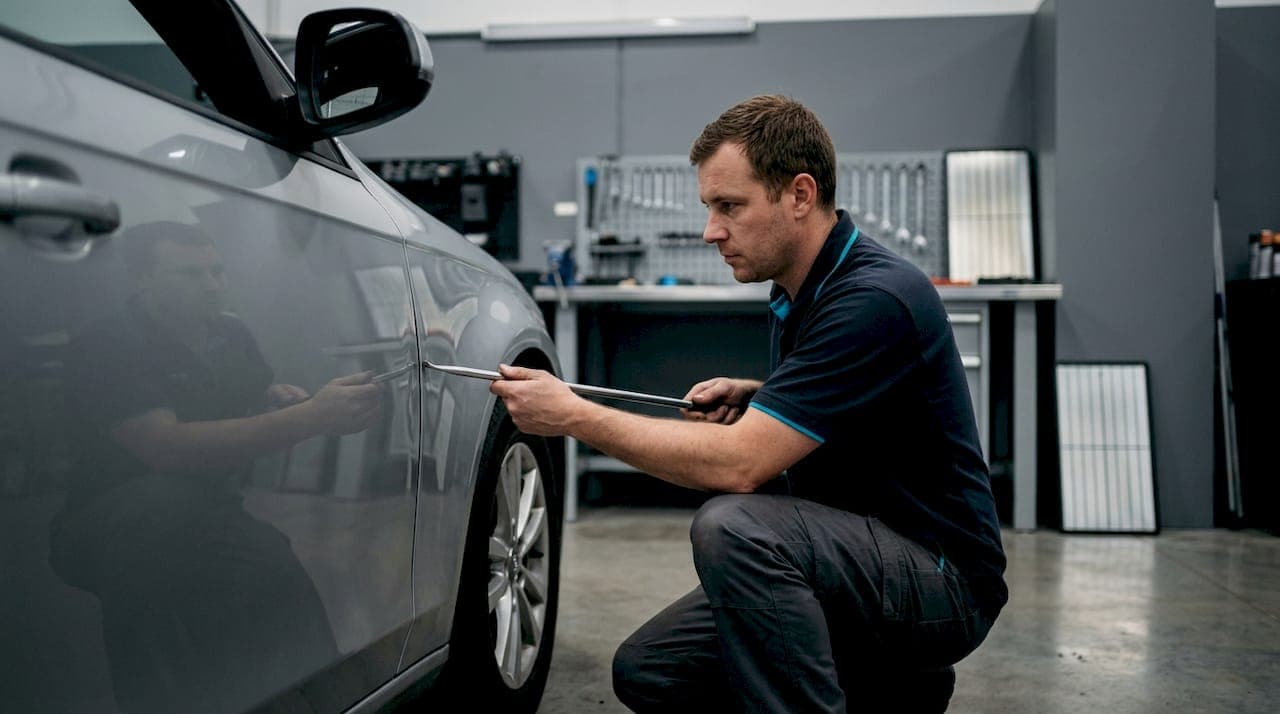
Body line dents are repaired primarily through Paintless Dent Repair (PDR), a technique that reshapes metal back to its original contour without touching the paint. Unlike a standard door ding, a body line dent sits on a raised ridge or sculpted crease that runs across your vehicle's panel. That position makes it one of the most technically demanding repairs in automotive bodywork. The good news: when a skilled technician handles it, PDR preserves your factory finish completely and costs a fraction of traditional body shop work.
How body line dents are repaired with PDR
Paintless Dent Repair is the industry standard for fixing body line dents when paint is intact. Technicians access behind the panel and apply micro-pressure adjustments, gradually restoring the line without creating high spots or waves. The process relies on specialized rods, glue tabs, and reflection lighting rather than filler or paint. PDR preserves your vehicle's original finish and resale value in a way that traditional body shop repairs simply cannot match.
Body line dents also affect structural integrity. A dent on a body line impacts metal tension and the visual contour that defines your car's shape. Restoring both requires more than pushing the metal back. It demands precise, controlled reshaping that accounts for how light reflects off the panel at every angle.
Why are body line dents harder to fix?
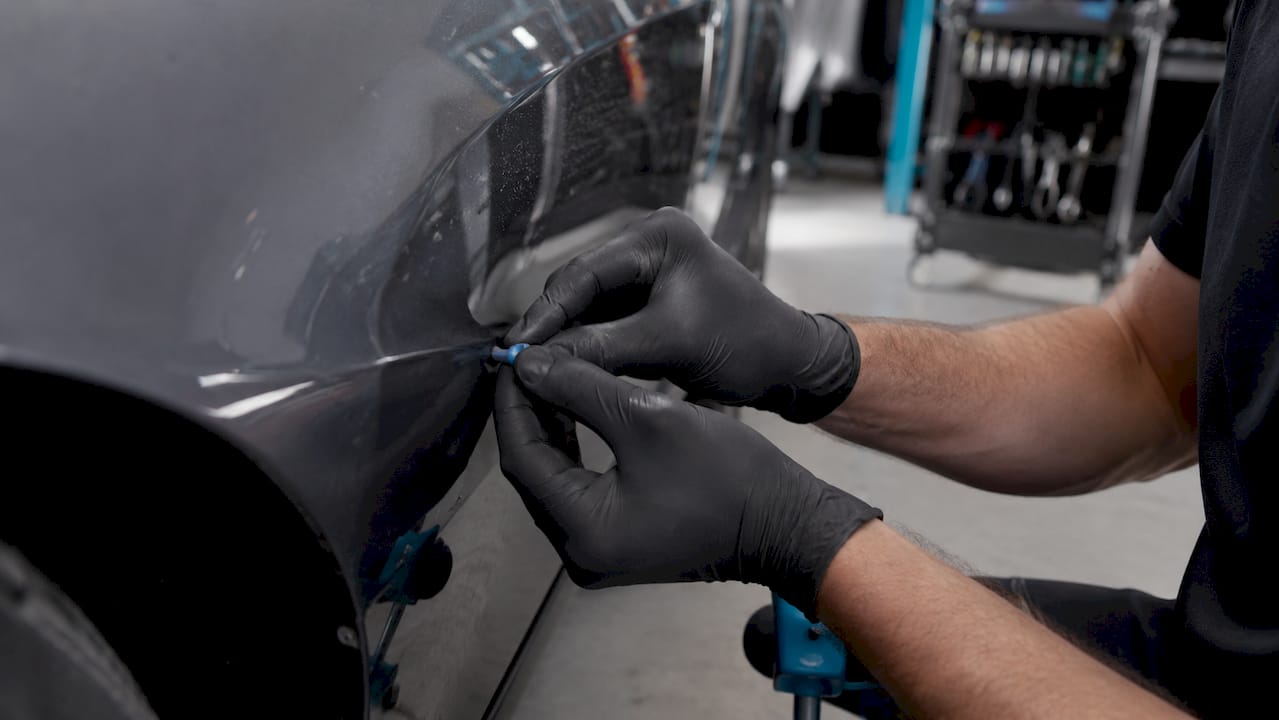
Body line dents are harder to repair than flat panel dents because the metal compresses and work-hardens directly on the crease. That work-hardening makes the metal stiffer and more resistant to reshaping. A technician cannot simply push from behind and call it done.
The role of metal tension and light reflection
When a dent forms on a body line, it distorts the ridge that runs along the panel. That distortion changes how light reflects off the surface, creating visible shadows and waves that reveal the damage even from a distance. Restoring the original contour means restoring those reflection lines, not just the physical shape.
Shallow dents with sharp creases are actually harder to fix than deeper, rounder dents. A sharp crease concentrates metal stress in a narrow zone, leaving less room for gradual correction. Push too hard in one spot and you create a high point that is just as visible as the original dent.
Aluminum panels require extra care
Aluminum body panels add another layer of difficulty. Aluminum risks cracking if heat is not applied correctly during repair. Proper heat application softens the work-hardened metal, allowing reshaping without fracturing the panel. This technique requires advanced skill and is not something a general mechanic can replicate.
Pro Tip: If your vehicle has aluminum body panels, always confirm your technician has specific experience with aluminum PDR before any work begins. The repair process differs significantly from steel panel work.
Common risks of improper body line dent repair include:
- High spots: Metal pushed too far past the original contour
- Rolled lines: The body line ridge shifts position slightly, creating a wavy appearance
- Paint stress: Aggressive pushing cracks or crazes the clear coat
- False lows: Areas that appear repaired under one light but show damage under another
Rod access vs. glue pulling: which method works best?
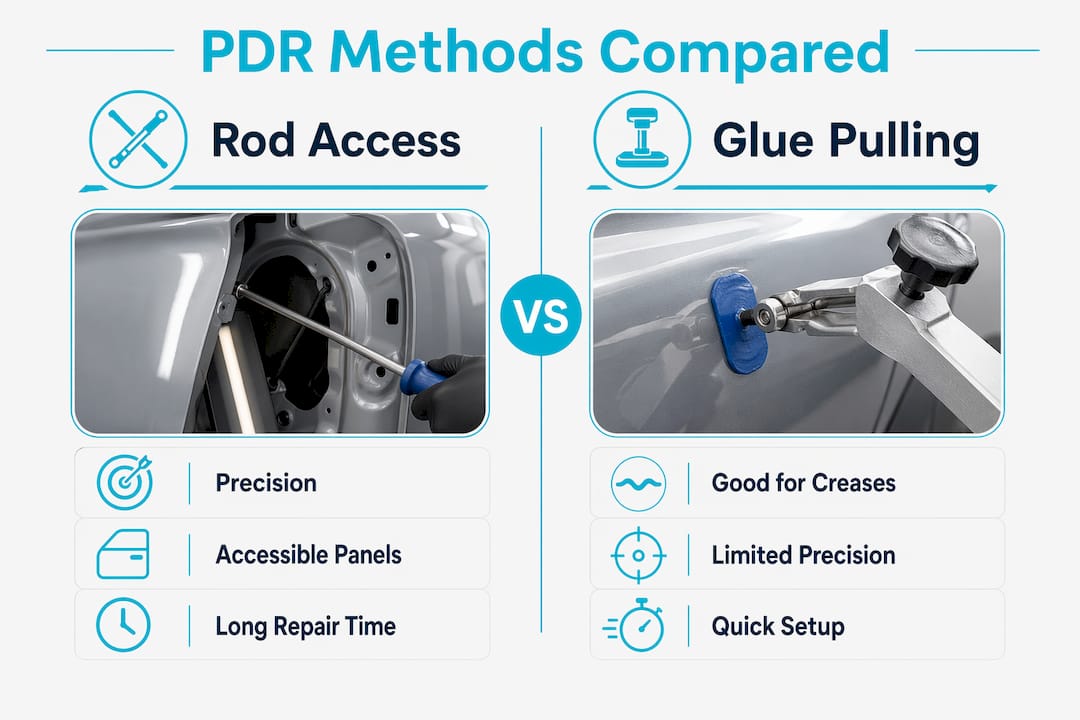
Two primary bodywork dent removal techniques apply to body line dents: rod access from behind the panel and glue pulling from the front. Each has specific strengths depending on the dent's location, depth, and the panel's accessibility.
Rod access method
Rod access involves inserting long, curved PDR rods through existing openings in the panel, such as door jambs or window frames. The technician positions the rod tip directly behind the dent and applies controlled upward pressure in small increments. This method delivers the most precise control for repairing body line dents because the technician can feel the metal's resistance and adjust pressure accordingly.
The main limitation is access. Some body line dents sit in areas where rods cannot reach without removing interior trim or panels. That adds time and cost to the repair.
Glue pulling method
Glue pulling uses cold glue tabs adhered externally to the dent area to gently pull the crease back when internal access is limited. Cold glue tabs bond firmly to the paint surface without damaging it. The technician attaches a slide hammer or pulling bridge to the tab and lifts the metal outward in controlled increments.
Glue pulling minimizes the risk of creating high spots and works well on sharper, harder-to-access body line dents. The tradeoff is slightly less precision compared to rod work on deep creases.
| Factor | Rod Access | Glue Pulling |
|---|---|---|
| Precision | Very high | High |
| Best for | Accessible panels, deeper dents | Limited access, sharp creases |
| High spot risk | Moderate if rushed | Lower |
| Panel removal needed | Sometimes | Rarely |
| Paint contact | None | Tab adhesion only |
Pro Tip: Many professional technicians combine both methods on a single repair. They use glue pulling to lift the bulk of the dent, then switch to rod access for final micro-adjustments along the body line.
Reflection boards and line boards are critical tools in both methods. These flat boards with printed parallel lines create a visual grid that the technician reads off the panel surface. Any deviation in the reflected lines reveals exactly where metal still needs correction.
When does PDR work, and when do you need a body shop?
PDR is only suitable under specific conditions. Paint must be intact, dent size must be moderate, no metal stretching can have occurred, and the dent must be free of sharp creases that have fractured the metal. When those conditions are met, PDR is faster and less expensive than traditional repair.
Signs that PDR is the right call:
- Paint shows no chips, cracks, or peeling around the dent
- The dent is visible but the body line ridge is still recognizable
- The metal springs back slightly when pressed gently
- The dent occurred from a low-speed impact like a parking lot collision
Signs you need a traditional body shop instead:
- Paint is chipped or cracked at the dent site
- The crease is sharp enough to feel like a fold in the metal
- The metal feels stretched or thin when pressed
- The body line ridge has shifted or disappeared entirely
| Repair Type | Average Cost | Turnaround Time | Paint Preserved |
|---|---|---|---|
| PDR (body line dent) | $150–$400 | 1–3 hours | Yes |
| Traditional body shop | $500–$1,500+ | 3–7 days | No |
Cost differences between PDR and traditional repair are significant. Traditional bodywork requires sanding, filler application, priming, painting, and clear coat matching. PDR skips all of that. For borderline cases where you are unsure which method applies, a professional inspection is the only reliable way to get an accurate answer. Attempting to guess based on photos or descriptions alone leads to incorrect repair choices.
DIY body line dent fixes: what actually works
Evaluating dent severity before attempting any DIY repair is the most important first step. A dent that looks minor from one angle may have a sharp crease that rules out home repair entirely.
Here is a practical approach for car owners considering DIY fixes:
- Inspect under direct sunlight or a work light. Move around the panel and look at the dent from multiple angles. If you see a sharp shadow line running through the dent, the crease is too defined for DIY methods.
- Try heat and cold therapy for very minor dents. A heat gun or hair dryer warms the metal, followed by a can of compressed air held upside down to rapidly cool it. Heat and cold therapy can reduce minor dents but is often insufficient for precise body line repair because it cannot address structural metal shifts on a crease.
- Use a basic glue pulling kit for small, accessible dents. Consumer-grade glue tab kits are available at auto parts stores. They work on the same principle as professional glue pulling but with less control. Apply the tab to the center of the dent, pull slowly and evenly, and release. Repeat in small increments rather than one aggressive pull.
- Stop immediately if you feel resistance or see the metal distort. Forcing a body line dent with DIY tools creates high spots that are more expensive to fix than the original damage.
- Call a professional for anything involving the actual body line ridge. The ridge itself requires the kind of micro-adjustment control that only professional PDR rods and reflection boards can deliver accurately.
Pro Tip: Never use a rubber mallet or suction cup on a body line dent. Both tools apply force over too wide an area and almost always distort the ridge further.
For a broader look at professional repair steps and the specialized tools involved, reviewing a detailed bodywork repair tutorial gives you a clearer picture of what professional technicians actually do versus what DIY kits can replicate.
How experts use lighting to read and verify repairs
Lighting is a measuring instrument in PDR, not just a convenience. Consistent lighting angles and contrast patterns provide the measurement tool technicians use to guide metal reshaping precisely. Without proper lighting, a technician is working blind.
Here is how the process works in practice:
- Reflection boards create parallel lines that project onto the panel surface. Any dent or high spot bends those lines, showing the technician exactly where the metal deviates from the correct contour.
- LED light bars provide consistent, high-contrast illumination that makes subtle surface variations visible. Fluorescent shop lighting is too diffuse for this level of detail.
- Viewing angle matters as much as the light itself. The technician must keep their eye position consistent relative to the light source throughout the repair. Shifting position even slightly changes what the reflection shows.
- Inconsistent lighting or eye angle can cause finishing errors, masking false highs or lows that only become visible in different lighting conditions after the repair is complete.
Small incremental pushes with continuous re-checking under reflection boards reduce the risk of repair imperfections. Professional PDR is not one continuous push. It is dozens of tiny adjustments, each verified under the reflection board before the next one begins. That discipline is what separates a flawless repair from one that looks acceptable in the shop but shows flaws in sunlight.
Professional body line dent repair also includes final texture matching to replicate the factory orange peel finish. Failure to match texture creates visible shiny spots that reveal the repaired area even when the shape is perfectly restored.
Key takeaways
Body line dent repair done right requires PDR techniques, proper lighting, and incremental metal reshaping to restore both contour and factory finish without repainting.
| Point | Details |
|---|---|
| PDR is the primary method | Micro-pressure adjustments from behind the panel restore contour without touching paint. |
| Lighting guides every repair | Reflection boards and LED light bars are measuring tools, not optional accessories. |
| Rod and glue pulling serve different needs | Use rods for accessible panels and glue tabs when internal access is limited. |
| PDR has clear limits | Chipped paint, sharp folds, or stretched metal require traditional body shop repair. |
| DIY works only on minor dents | Heat, cold, and basic glue kits cannot fix body line ridge damage accurately. |
Why body line dents deserve more respect than they get
Most car owners underestimate body line dents. They see a small dent and assume it is a quick fix. After years of watching repairs go wrong, I can tell you the opposite is true. A body line dent is one of the most unforgiving repairs in PDR because the ridge amplifies every mistake. A high spot on a flat panel is subtle. A high spot on a body line is visible from across a parking lot.
The biggest misconception I encounter is that speed equals skill. Rushing a body line repair to save time almost always creates a second problem that costs more to fix than the original dent. The technicians who do this work best are the ones who check their progress constantly, make tiny adjustments, and are willing to spend an extra hour getting the reflection lines perfect.
I also think car owners undervalue paint preservation. Once you repaint a panel, you have introduced a color match variable that never fully goes away. The factory finish is the best finish your car will ever have. PDR keeps it intact. That is worth paying for.
— Martin
Restore your body line with Dent-boys

Dent-boys specializes in advanced PDR for body line dents, using professional rod tools, reflection boards, and precise metal reshaping to restore your vehicle's original contour without repainting. Every repair comes with a lifetime warranty, $0 deductible, and free pick-up and delivery so the process fits around your schedule. Dent-boys also provides a rental vehicle during repair, meaning you are never without transportation. If you have a body line dent and want a professional assessment, get a free estimate from Dent-boys today and see exactly what PDR can do for your car.
FAQ
What is the best method for repairing body line dents?
Paintless Dent Repair using rod access or glue pulling is the best method when paint is intact. Technicians use reflection boards and micro-pressure adjustments to restore the original contour without filler or repainting.
How long does a body line dent repair take?
Most PDR repairs on body line dents take 1–3 hours depending on dent severity and panel accessibility. Traditional body shop repairs for the same damage take 3–7 days.
Can i fix a body line dent myself at home?
DIY methods like heat and cold therapy or basic glue tab kits work only on very minor dents with no crease on the actual body line ridge. Any dent affecting the ridge itself requires professional PDR tools and lighting to repair accurately.
When is PDR not suitable for a body line dent?
PDR is not suitable when paint is chipped or cracked, when the metal is overstretched, or when the crease is sharp enough to feel like a fold. Those conditions require traditional body shop repair with filler and repainting.
Does PDR preserve the original paint on body line dents?
Yes. PDR works entirely from behind the panel or with external glue tabs, so the paint surface is never sanded, primed, or repainted. The factory finish remains intact when the repair is completed correctly.