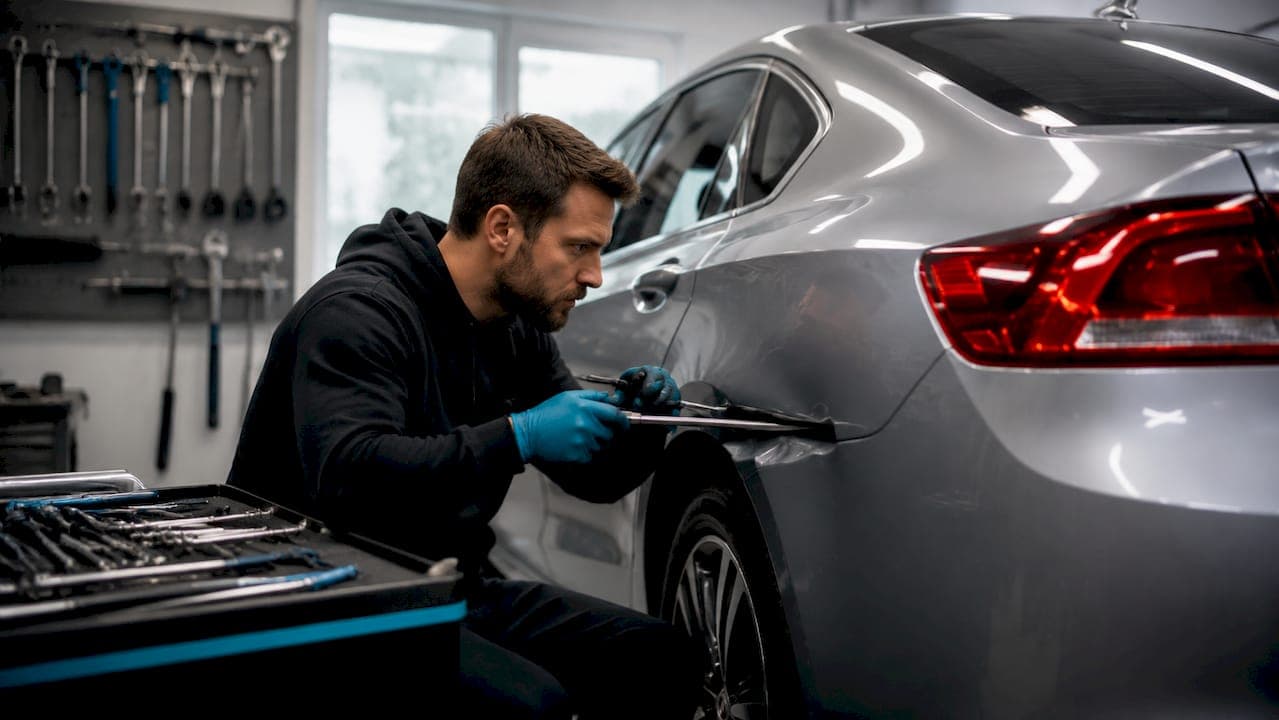
Paintless dent repair (PDR) is defined as a technique that removes vehicle dents by massaging the metal back into shape from behind the panel, leaving the factory paint completely untouched. No sanding, no body filler, no repainting. PDR works on small to medium dents where the paint surface is still intact, making it the go-to method for door dings, hail damage, and parking lot impacts. For car owners who want their vehicle looking like new without a body shop bill, understanding PDR is the first step toward making a smarter repair decision.
What is paintless dent repair and how does it work?
PDR is the industry standard term for a repair process where trained technicians use specialized metal rods and glue pulling tools to gently reshape dented metal from behind body panels. The paint never gets cut, sanded, or resprayed. The result is a repair that is virtually undetectable and preserves the original factory finish.
The process starts with a thorough inspection under specialized lighting. Technicians use bright LED light boards or reflective strips to see the exact contours of the dent. Without proper lighting, even a skilled technician cannot judge depth and shape accurately.
From there, the repair follows one of two main paths depending on dent location:
- Metal rod massage: The technician accesses the back of the panel through existing openings or by removing interior trim. A set of specialized rods, each shaped differently for different panel curves, is used to push the dent outward from behind. This is the most common PDR technique.
- Glue pulling: When the back of a panel is inaccessible, the technician attaches a plastic glue tab to the front of the dent and pulls it outward with a slide hammer or pulling bridge. This method is standard for pillars, roof panels, and areas blocked by structural supports.
- Tapping down: After the main dent is raised, technicians use small tapping tools to knock down any high spots and refine the surface to factory level.
Technician skill is the single biggest variable in PDR quality. A rushed or undertrained technician can over-push the metal, causing paint stress or a visible ripple. The best technicians work slowly, check their progress constantly under the light board, and stop before they overwork the metal.
Pro Tip: Ask your technician to show you the dent under a light board before and after the repair. A quality PDR job will show a perfectly smooth reflection with no waviness.
A single small dent can be fixed in as little as one hour. Extensive hail damage across an entire vehicle typically takes one to three days. Compare that to traditional body shop repairs, which can run one to three weeks due to drying times and paint curing.
Paintless vs traditional dent repair: which one should you choose?
PDR is the right choice when the paint is intact and the dent is shallow enough that the metal can spring back without cracking. Ideal candidates include dents ranging from the size of a quarter to a dinner plate, shallow dents without sharp creases, door dings, and hail damage across body panels.
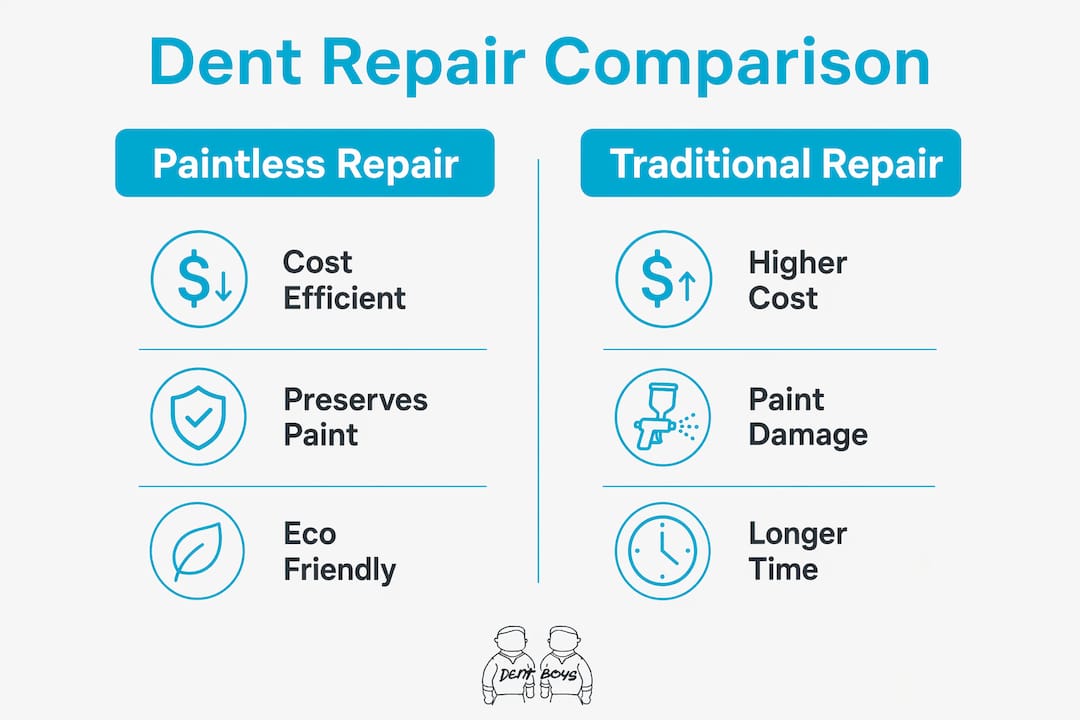
Traditional repair becomes necessary when the paint has cracked or chipped, when the dent has a sharp crease that has stretched the metal beyond its elastic limit, or when structural damage is involved. In those cases, body filler and repainting are unavoidable.
| Factor | Paintless dent repair | Traditional repair |
|---|---|---|
| Cost | $75–$500 per dent | Significantly higher, often $500+ |
| Repair time | Hours to 1–3 days | 1–3 weeks |
| Paint preservation | Factory paint fully intact | Paint cut, filled, and resprayed |
| Resale value impact | Neutral to positive | Can reduce value if repaint is detected |
| Insurance acceptance | Widely accepted for hail and minor dents | Standard for structural or paint damage |
| Best use case | Hail damage, door dings, minor dents | Deep creases, rust, structural damage |
Insurance companies widely accept PDR for hail damage claims. PDR is now the standard first-line repair for hail damage because of its speed and cost advantage over traditional methods. Many insurers prefer it precisely because it costs less and gets the car back on the road faster.
The situations where you should not choose PDR are clear:
- Paint is cracked, chipped, or peeling at the dent site
- The dent has a sharp, angular crease rather than a smooth curve
- The panel has been previously repaired with body filler
- Structural components like frame rails or crumple zones are involved
Why paintless repair saves money and protects your car's value
PDR costs 50% to 70% less than traditional body shop repairs. A small dent that runs $75 to $150 at a PDR specialist could cost $400 or more at a traditional shop once labor, filler, primer, paint, and clear coat are factored in. For hail damage across an entire vehicle, PDR typically runs $1,000 to $4,000, while traditional repair for the same damage would be substantially higher.
The financial benefit goes beyond the repair bill. Factory paint preservation directly protects resale value. When a buyer or dealership runs a paint thickness gauge over a vehicle, repainted panels show up immediately. A car with all original paint commands more buyer confidence and a better trade-in price than one with documented or detectable bodywork.
Original paint integrity also preserves the corrosion protection built into factory finishes. Factory paint systems include primers and sealers applied in controlled environments that aftermarket repaints cannot fully replicate. A PDR repair keeps that protection layer completely intact.
Luxury and collector car owners benefit most from this distinction. A Ferrari, Porsche, or classic muscle car with all original paint is worth meaningfully more than the same car with even one repainted panel. PDR is the only repair method that lets you fix a dent without touching that original finish.
Pro Tip: Before selling your car, get a PDR inspection. Small dents you have stopped noticing can reduce your trade-in offer significantly, and fixing them with PDR costs far less than the value they subtract.
PDR also cuts the hidden cost of downtime. Faster repairs mean fewer days in a rental car. A repair that takes one day instead of two weeks saves you rental fees and the inconvenience of being without your vehicle.
PDR skips fillers, paints, and associated chemicals entirely, making it a greener repair process compared to traditional body shop methods. That matters to car owners who want to reduce their environmental footprint alongside their repair bill.
What to expect at a PDR appointment
A professional PDR visit follows a predictable sequence. Knowing what happens at each step helps you ask the right questions and recognize quality work.
- Initial inspection. The technician examines every dent under a light board and assesses paint condition, dent depth, and panel accessibility. This step determines whether PDR is viable and sets the price.
- Access preparation. For rod-based repairs, the technician removes interior trim panels or accesses factory openings to reach the back of the dented panel. No drilling or cutting is involved.
- Dent massage. Using the appropriate rod or glue pull method, the technician works the dent from its outer edges toward the center, gradually raising the low point.
- Finishing and tap-down. High spots are tapped down with precision tools. The technician checks progress repeatedly under the light board.
- Final inspection. The repaired panel is examined under multiple light angles. A quality repair shows no visible trace of the original dent.
Ask these questions before you commit to a shop:
- How many years of PDR experience does the technician have?
- What tools do you use for glue pulling versus rod work?
- Can you show me the repair under a light board when it is done?
- What happens if the paint shows stress during the repair?
Dent accessibility is the most common limitation to discuss upfront. Some panels, particularly on modern vehicles with thick structural reinforcements, limit rod access significantly. A good technician will tell you this before starting, not after.
Post-repair, no special maintenance is required. The factory paint is unchanged, so your normal wash and wax routine is all you need.
Key takeaways
Paintless dent repair is the most cost-effective method for restoring dented vehicles while keeping factory paint and resale value fully intact.
| Point | Details |
|---|---|
| PDR preserves factory paint | No sanding, filler, or repainting means original corrosion protection stays intact. |
| Cost savings are significant | PDR costs 50% to 70% less than traditional body shop repairs for the same dent. |
| Repair time is far shorter | Most PDR jobs finish in hours; even major hail damage takes one to three days. |
| Not every dent qualifies | Cracked paint, sharp creases, or prior filler work rules out PDR as an option. |
| Resale value is protected | Original paint signals a well-maintained vehicle and commands better trade-in offers. |
Why I think most car owners underestimate PDR
Most car owners I talk to assume a dent means a trip to the body shop, a week without their car, and a bill that stings. That assumption costs them real money every year. PDR has been the professional standard for hail damage and minor dents for decades, yet it still surprises people when they hear the price and the turnaround time.
The biggest misconception I encounter is that PDR is a temporary fix. It is not. A properly executed PDR repair is permanent. The metal is back in its original position, the factory paint is intact, and there is nothing to crack, peel, or fail over time. A body filler repair, by contrast, can shrink and crack as temperatures change.
My honest advice: if your car has a dent with no paint damage, get a PDR estimate before you do anything else. The difference between a $100 PDR repair and a $500 traditional repair for the same dent is not quality. It is method. Vehicle resale value is also directly tied to paint condition, and every repainted panel you add to a car's history works against you at trade-in time.
Collector car owners should treat PDR as non-negotiable. A single repainted panel on a classic vehicle can drop its value by thousands. PDR is the only way to fix a dent on a collector car without touching the original finish.
The repair industry has moved toward PDR as the default for good reason. It is faster, cheaper, cleaner, and better for the car. The only time traditional repair makes sense is when PDR genuinely cannot do the job.
— Martin
Get your dents fixed right with Dent-boys
Dent-boys specializes in professional paintless dent repair for car owners who want fast, affordable results without sacrificing their vehicle's finish or value.

Dent-boys handles everything from single door dings to full hail damage repair, with free estimates, pick-up and delivery, and a lifetime warranty on every repair. Their $0 deductible program means no out-of-pocket surprise when you go through insurance. If you have a dent that qualifies for PDR, Dent-boys will restore your car to like-new condition, often within the same day. Request your free estimate at dent-boys.com and see why customers consistently praise the speed and quality of the results.
FAQ
What is paintless dent repair used for?
Paintless dent repair is used to fix small to medium dents, including door dings and hail damage, where the paint surface is still intact. It works by massaging the dented metal back into shape from behind the panel without any sanding or repainting.
How much does paintless dent repair cost?
A single small dent typically costs between $75 and $150, while larger or more complex repairs can run up to $500 per dent. Hail damage across a full vehicle ranges from $1,000 to $4,000 depending on the number and severity of dents.
Does paintless dent repair last?
PDR repairs are permanent. The metal is restored to its original position and the factory paint remains unaltered, so there is nothing to crack or fail over time the way body filler can.
Will insurance cover paintless dent repair?
Most insurance companies accept and often prefer PDR for hail damage and minor dents because it costs less and takes less time than traditional repair. Check with your insurer to confirm coverage before scheduling.
Does PDR work on luxury or collector cars?
PDR is the preferred method for luxury and collector vehicles because it keeps the original factory paint completely intact. Repainting even one panel on a high-value car can reduce its worth, making PDR the only repair option that protects both appearance and investment.