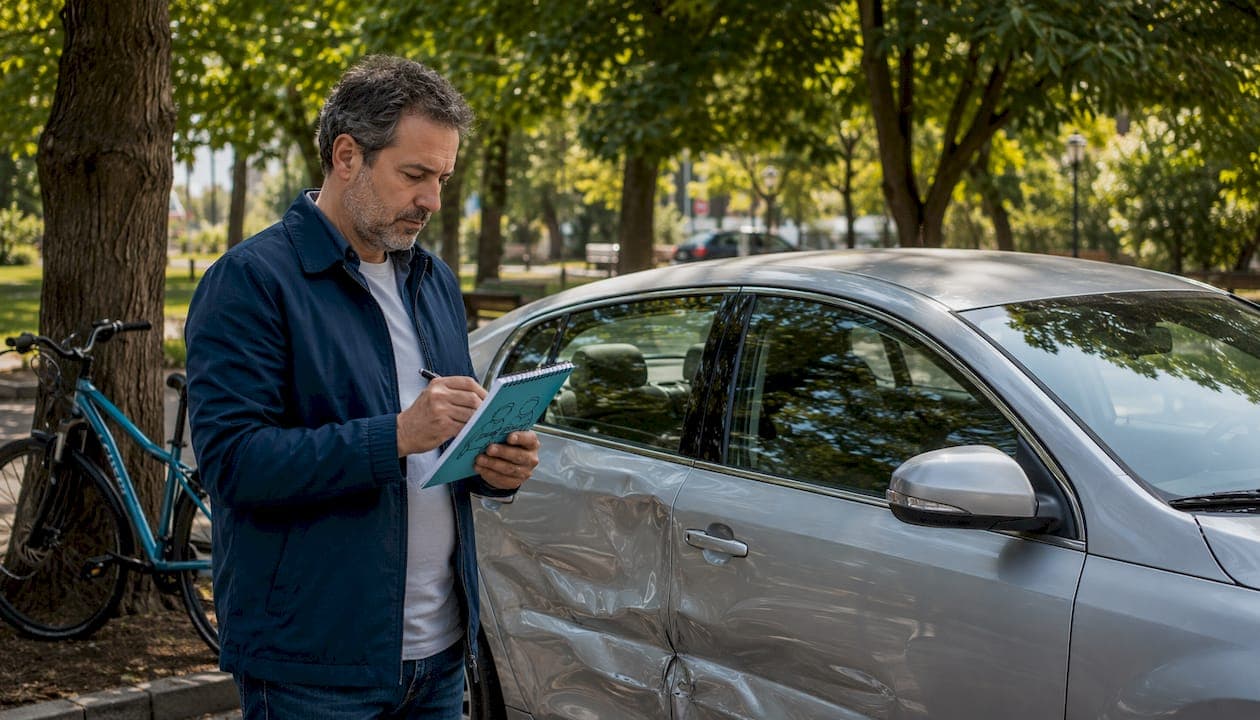
Real dent repair savings examples and what they actually cost
Paintless dent repair (PDR) generally costs significantly less than traditional bodywork for dents with intact paint. A coin-size door ding typically costs much less with PDR and can be completed quickly, while traditional body shop repairs are more expensive and take several days.
Here is what that looks like across common dent scenarios:
- Small door ding (paint intact): PDR $75–$150 vs. body shop $500–$1,000
- Palm-size dent (paint intact): PDR $150–$350 vs. body shop $500–$1,000
- Large or creased dent (paint damaged): Body shop only, $1,000–$2,500
- Multi-panel hail damage: PDR $1,200–$4,000 vs. body shop repaint $5,000–$12,000
- Plastic bumper dent: Heat reshape plus repaint, $300–$1,000 (PDR does not apply)
The resale math is just as compelling: Repairing 3–5 minor dents via PDR for $300–$500 can increase a vehicle's trade-in offer by $500–$800, putting $200–$300 back in your pocket while also making the car sell faster. On a high-value luxury vehicle, PDR repairs may help prevent significant reductions in resale value.
Pro Tip: A mobile PDR technician can often complete repairs on site within a short timeframe, avoiding rental car costs and minimizing disruption compared to multi-day body shop visits.
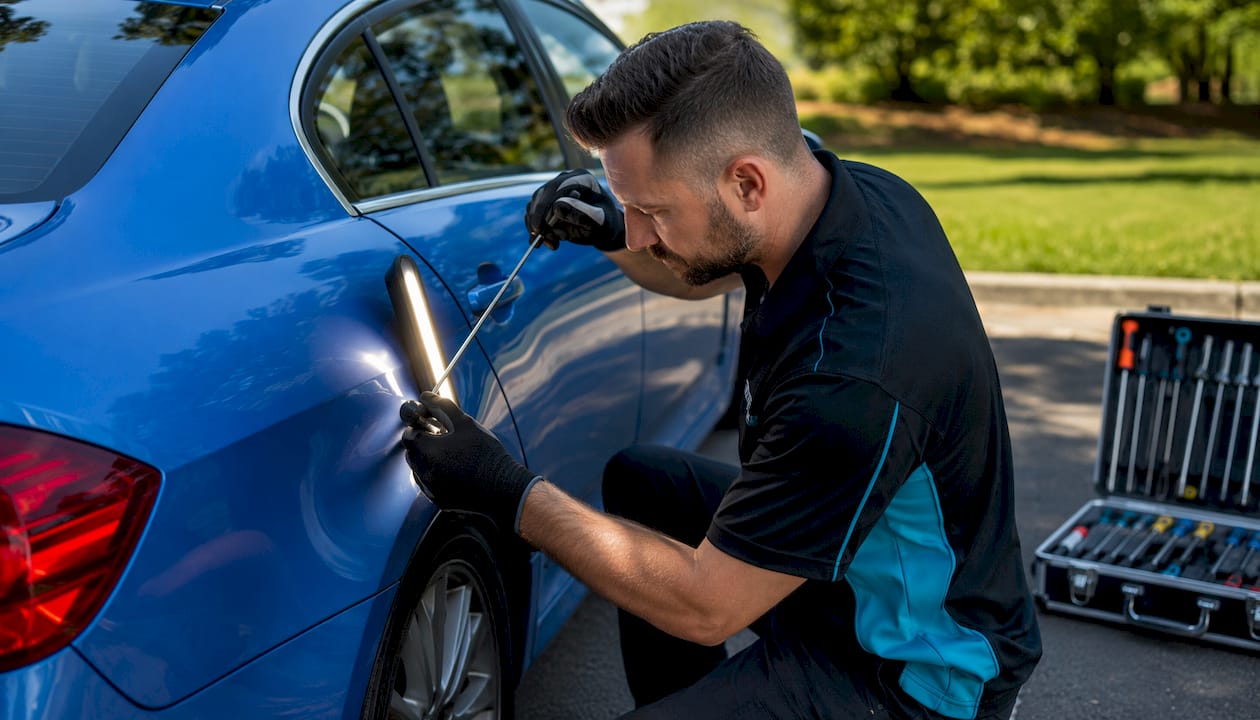
Paint condition is the key factor determining if PDR is suitable; intact paint allows for less expensive PDR repairs, while damaged paint requires costlier bodywork.
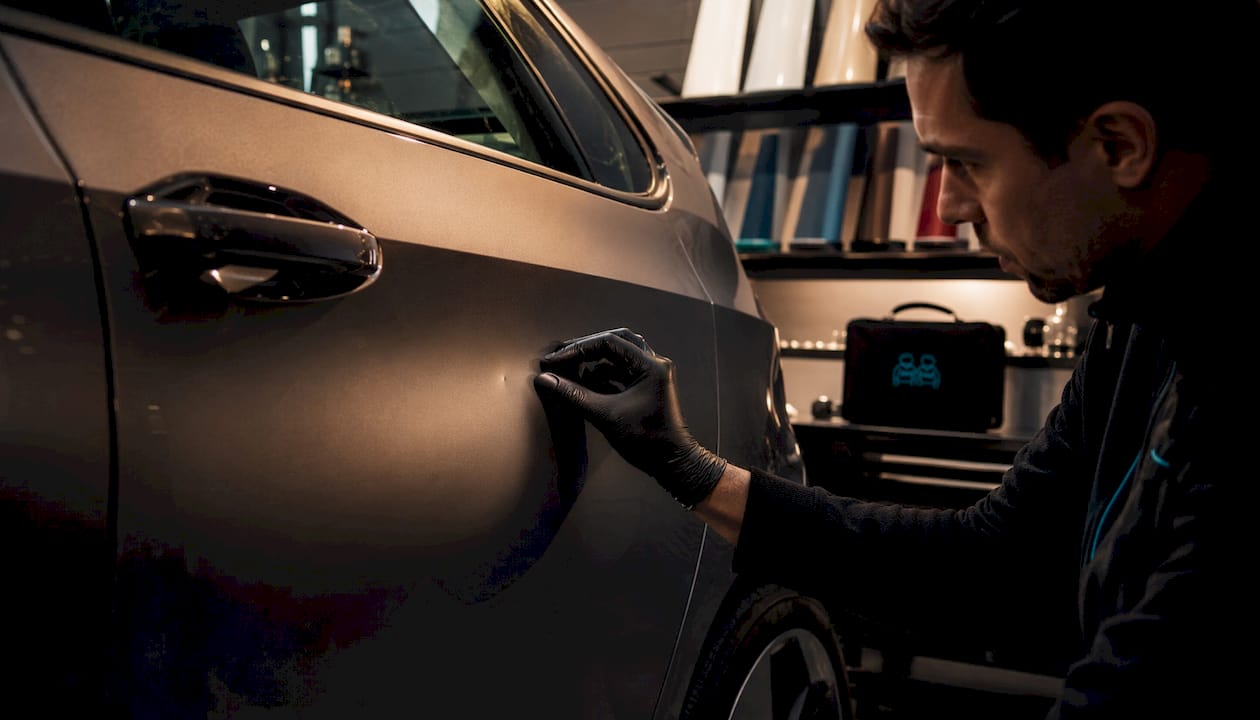
What actually drives dent repair pricing
Paint condition is the biggest cost driver in dent repair, and it is not close. When paint breaks, the repair requires filler, sanding, primer, color match, and clear coat, which can triple the bill compared to PDR on the same dent. Every other variable matters, but none of them swing the price as dramatically.
Dent size and depth come second. A shallow dime-size ding on a flat door panel is the easiest, cheapest repair a technician handles. A dent with a sharp crease or stretched metal is a different job entirely, sometimes requiring panel replacement rather than reshaping. Location adds another layer: dents near body lines, edges, or in tight spots like quarter panels take longer to access and cost more as a result.
Panel material is a cost factor many vehicle owners overlook. Aluminum panels add 30–50% to repair costs because aluminum work-hardens during impact and requires specialized tools. Ford, BMW, Tesla, and most modern luxury brands use aluminum extensively, so if you drive one of those vehicles, build that premium into your estimate.
Regional labor rates create some of the widest price swings. A medium PDR dent in Wichita quotes at $125–$200, while the identical job in Los Angeles quotes at $250–$425. Labor rates range from $60 per hour in rural markets to $180 per hour in major metros, a spread that can double an otherwise identical repair bill.
Here is a quick summary of each cost factor and its typical price impact:
- Paint condition: Intact paint keeps costs at $75–$350 (PDR); broken paint pushes costs to $500–$2,500 (body shop)
- Dent size: Small dings $75–$150; palm-size $150–$350; large or creased $300–$800 via PDR where eligible
- Panel material: Aluminum adds roughly 30–50% over standard steel pricing
- Location on vehicle: Edge-of-panel or body-line dents cost more due to limited tool access
- Labor market: Rural shops run $60–$80/hour; high-cost metros run $130–$180/hour
- Multi-panel damage: Expect costs to climb past $3,000 once three or more panels are involved
Pro Tip: Before you call a shop, run your fingernail across the dent. If it does not catch on broken paint, you are likely a PDR candidate. If it catches, budget for body shop repair costs instead.
PDR vs. traditional repair: which one actually saves you money?
The cost gap between PDR and traditional bodywork is not subtle. PDR runs 50–70% cheaper than conventional body shop repair with paint, and the savings compound when you factor in rental cars, resale value, and repair history.
| Category | Paintless dent repair (PDR) | Traditional body shop repair |
|---|---|---|
| Cost range | $75–$350 per dent | $500–$2,500 per panel |
| Damage suitability | Paint-intact dents under 4 inches | Cracked paint, creases, large dents |
| Repair process | Metal massage from behind, no materials | Filler, sand, prime, color match, clear coat |
| Turnaround time | 30 minutes to 3 hours | 3–5 days |
| Long-term vehicle value | Preserves factory paint, no history flag | Repaint reduces resale value, shows on history reports |
The long-term value difference is where PDR pulls further ahead. Traditional body shop repairs require repainting and can reduce resale value by hundreds to thousands of dollars because buyers and dealers treat repainted panels as a red flag. PDR preserves the original factory finish, so there is no "bodywork history" on the vehicle. That matters most on vehicles worth $15,000 or more, where a repainted panel can knock $1,000–$3,000 off the sale price.
Traditional repair is the right call when paint is already cracked, the metal is creased or stretched, or the dent exceeds four inches. In those cases, PDR is not an option and body shop pricing is simply the cost of the job. The mistake is routing a PDR-eligible dent through a body shop out of habit or because the dealer recommended it.
Key factors that determine which method fits your situation:
- PDR is the right choice when: Paint is intact, dent is under 4 inches, panel is accessible, and metal is not creased
- Body shop is necessary when: Paint is chipped or cracked, metal is stretched, dent has a sharp crease, or the panel needs blending with adjacent sections
- Hail damage: Almost always PDR-eligible since hail lands flat and typically leaves the clear coat intact, keeping per-dent costs low
How to choose the right repair method and keep costs down
Start with a paint check before you call anyone. Run your fingernail across the dent. No catch means intact paint and a strong chance PDR applies. A catch means broken paint and body shop territory. That one test narrows your options immediately and prevents you from getting quoted for the wrong method.
Get at least three estimates for any job over $500. A spread of $200–$600 on a single panel is completely normal and reflects differences in labor rates, tool investment, and how busy a shop is that week. Always confirm whether the quote includes blending into adjacent panels for color match, and ask for a lifetime warranty in writing before you commit.
On insurance, the math usually favors paying out of pocket for minor dents. Small claims can increase premiums, and if the repair costs less than your deductible, filing accomplishes nothing. For extensive hail damage where repairs run $1,000–$5,000, comprehensive coverage makes sense since those claims rarely impact rates significantly. The break-even point is roughly when repair costs exceed your deductible by a comfortable margin.
Timing repairs early is one of the most overlooked ways to cut costs. A fresh dent with intact paint stays in the $75–$350 PDR range. Leave it until the paint chips or rust starts forming on a steel panel, and the same dent becomes a $500–$1,000 body shop job. Understanding why prompt dent repair matters for your car's value can save you from that exact scenario.
Practical steps to maximize your savings:
- Check paint integrity before requesting any quote
- Ask specifically for PDR pricing if paint is intact
- Get three bids on jobs over $500 and compare scope, not just price
- Consider suburban shops for non-urgent repairs, where regional pricing can run 25–40% lower than metro rates
- For lease returns, PDR before turn-in prevents excess wear charges that often exceed the repair cost itself
- DIY pull kits are inexpensive and suitable only for minor cosmetic dents but risk causing further damage on more serious dents.
Pro Tip: If you are planning to sell your vehicle within the next year, treat PDR as an investment with a calculable return. Repairing visible dents before listing can increase your sale price by more than the repair cost, especially on vehicles valued above $15,000.
Why professional PDR delivers value that goes beyond the repair bill
The financial case for professional PDR is straightforward. Fixing 3–5 minor dents for $300–$500 can increase a vehicle's resale value by $500–$800, which means the repair pays for itself and then some. Dealers are particularly aggressive about dent damage during trade-in valuations, so a $400 PDR investment can translate to a $600–$1,000 higher offer at the dealership.
Beyond the numbers, professional PDR preserves something that body shop work cannot restore: the original factory finish. Once a panel gets repainted, that history follows the vehicle. Buyers searching for "all original" condition will discount or walk away entirely. PDR keeps the car's record clean.
Dent-boys brings additional value that reduces the total cost of ownership even further. Free estimates, pick-up and delivery, a rental vehicle during repair, a $0 deductible option, and a lifetime warranty on every repair mean you are not absorbing hidden costs on top of the repair bill. That combination is what separates a professional PDR provider from a quick-fix operation.
Key financial benefits of choosing professional PDR:
- Repair costs for PDR are generally less than half those for comparable body shop work involving repainting.
- Factory paint is preserved, avoiding the resale penalty that comes with repainted panels
- Turnaround in hours rather than days eliminates or minimizes rental car expenses
- A lifetime warranty protects the repair investment for as long as you own the vehicle
- No paint, filler, or primer means no toxic materials and no color-match risk
Dent-boys specializes in paintless dent repair with a process built around your convenience: free estimates, vehicle pick-up and delivery, a rental car while your vehicle is being repaired, and a lifetime warranty on every job. No deductible, no surprises, no repainting. Get your free estimate today and see exactly how much you can save.
Key Takeaways
PDR costs 40–70% less than traditional bodywork on paint-intact dents, and repairing 3–5 dents for $300–$500 can increase resale value by $500–$800.
| Point | Details |
|---|---|
| PDR saves 40–70% per dent | A door ding costs $75–$150 with PDR versus $500–$1,000 at a body shop. |
| Paint condition is the deciding factor | Intact paint unlocks PDR; broken paint means body shop costs of $500–$2,500. |
| Aluminum panels cost more | Aluminum body panels add 30–50% to repair costs due to specialized tooling. |
| Regional pricing varies widely | The same dent costs $125–$200 in Wichita and $250–$425 in Los Angeles. |
| Early repair protects resale value | Fixing dents before paint chips keeps costs low and preserves factory finish for trade-in. |