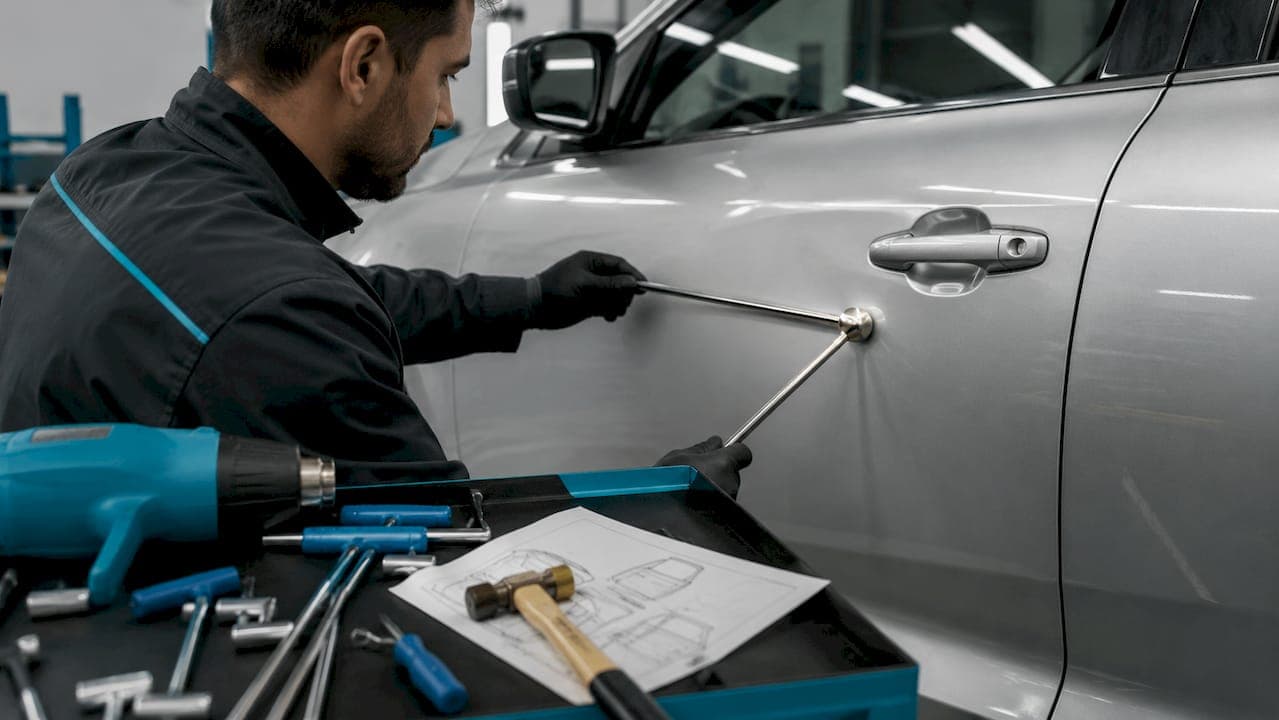
Paintless dent repair (PDR) tools are specialized instruments designed to restore vehicle body panels without damaging the paint, maximizing repair quality and efficiency. The dent repair tools professionals use fall into four core categories: PDR rods, glue pull systems, knockdown and finishing tools, and lighting equipment. Mastering each category separates a clean, invisible repair from one that leaves the panel worse than before. Whether you work in a professional shop or tackle repairs at home, understanding these tools gives you a real advantage in vehicle restoration.
1. What dent repair tools professionals use most: PDR rods
PDR rods are the backbone of paintless dent repair. Professionals insert them through door jambs, window openings, and body panel gaps to push dents outward from behind the metal. The goal is gradual, controlled pressure applied in small increments until the panel returns to its factory shape.
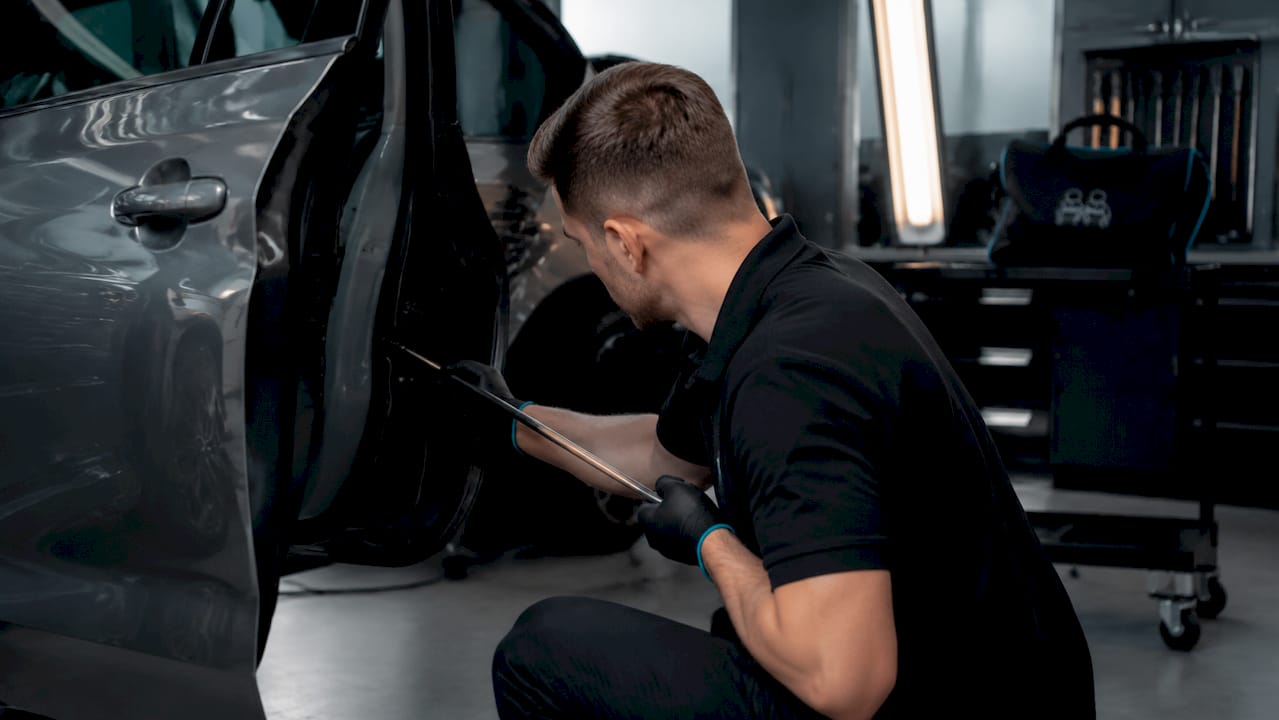
Professional PDR rods like whale tails and adjustable tip rods are made from stainless steel or manganese steel for durability and precise dent manipulation. Manganese steel resists bending under repeated stress, which matters when you are working a stubborn crease over multiple sessions. Whale tail rods have a flattened, curved tip that spreads pressure across a wider area, reducing the risk of creating a new high spot.
Changeable tip rods and indexable handles give technicians the ability to swap tips without pulling the rod out of the panel. This saves time on complex repairs and lets you match the tip profile to the exact dent shape. A rod with the wrong tip radius will push unevenly and create ripples.
- Whale tail rods: Best for large, shallow dents on door panels and hoods
- Changeable tip rods: Ideal for tight access points and varied dent shapes
- Indexable handles: Allow tip rotation without removing the rod from the panel
- Short body rods: Designed for pillars, quarter panels, and areas with limited reach
Pro Tip: Start with the lightest possible pressure at the dent's outer edge and work inward in a spiral pattern. Aggressive center pushes almost always create a high spot that takes twice as long to correct.
2. Glue pull repair tools: the modern standard
Glue Pull Repair (GPR) has moved from a last resort to a precision repair system now adopted by OEMs and leading collision centers worldwide. The shift happened because GPR works on panels where backside access is physically impossible, including roof skins, pillars, and outer door skins with internal reinforcements.
"GPR is no longer a workaround. It is a first-class repair method with its own engineering, its own tools, and its own standards. Shops that treat it as a backup are leaving quality and efficiency on the table." — Kye Yeung, industry leader in PDR and GPR development
A complete GPR system includes glue tabs in multiple sizes and profiles, a temperature-controlled glue gun, and at least one pulling device. Pulling devices come in three main types:
- Slide hammers: Deliver sharp, controlled pulls for deeper dents with sharp edges
- Bridge pullers: Distribute pull force evenly across multiple tabs for large dent areas
- Mini lifters: Apply slow, steady upward pressure for shallow dents and final leveling
Glue formulation matters as much as the tab shape. High-temperature glues bond more aggressively and suit cold weather or stubborn dents. Low-temperature glues release cleanly without leaving residue on the paint, which is critical for dark or single-stage finishes.
The GPR process follows a clear sequence: clean the panel with isopropyl alcohol, heat the tab and apply glue, press the tab firmly onto the dent center, allow the glue to set, pull steadily, then use a knockdown tool to tap down any resulting high spots. Slow, controlled pulls consistently outperform single aggressive yanks for cleaner results.
Pro Tip: Warm the panel surface slightly with a heat gun before applying glue tabs in temperatures below 60°F. Cold metal reduces glue adhesion and causes tabs to pop off mid-pull.
3. Knockdown tools, hammers, and finishing equipment
Pulling a dent out rarely leaves a perfectly flat panel. Knockdown tools and small hammers are the finishing instruments professionals use to tap down high spots and blend the panel back to its original contour. Skipping this step is the most common reason a repair looks good from one angle and terrible from another.
Knockdown tools come in several tip profiles: flat, rounded, and tapered. Flat tips work on broad high spots across door panels. Rounded tips target small, localized peaks without affecting the surrounding metal. Tapered tips reach into tight creases where a flat tip would contact too much surface area at once.
The technique matters as much as the tool. Proper use of knockdown tools requires light taps with a small body hammer, not full swings. Each tap moves the metal a fraction of a millimeter. Professionals check their work with a reflection board after every three to five taps to catch overcorrection before it becomes a new problem.
- Flat knockdown tips: For wide, shallow high spots on large panels
- Rounded knockdown tips: For small peaks and post-pull correction
- Tapered tips: For crease lines and tight panel geometry
- Body hammers (small face): Deliver controlled force without transmitting vibration to surrounding metal
4. Lighting and visual aids critical for precise dent detection
Lighting is not optional in professional dent repair. Reflection boards and LED line lights dramatically improve dent visualization, enabling precise repair work and results that hold up under direct sunlight. Technicians call good lighting "your eyes" because the human hand cannot feel a 0.5mm high spot that a reflection board reveals instantly.
| Lighting type | Best use | Key advantage |
|---|---|---|
| LED line lights | Crease and edge detection | High contrast reveals sharp dents clearly |
| Fluorescent reflection boards | Large panel assessment | Wide coverage shows gradual contours |
| Portable LED panels | Mobile and field repairs | Adjustable angle for any lighting condition |
| Natural daylight (indirect) | Final quality check | Reveals color and gloss inconsistencies |
LED line lights project a straight line across the panel. Any deviation in that line shows exactly where a low or high spot sits. Fluorescent boards work differently: they reflect a broad pattern that makes gradual panel waves visible across a full door or hood. Professionals use both in sequence, starting with the LED for initial dent mapping and finishing with the fluorescent board for final quality confirmation.
Tactile feedback and lighting work together. After pushing or pulling a section, a technician runs a fingertip across the repair while watching the reflection. The combination of touch and visual data catches errors that either method alone would miss.
5. Choosing the right tools for your skill level and dent type
Matching tools to the repair is the decision that separates clean work from costly mistakes. Entry-level car dent repair kits costing $30–$80 work well for shallow, round dents on flat panels with intact paint. They are not designed for sharp creases, dents near panel edges, or damage on high-strength steel.
Matching tools to dent characteristics:
- Shallow, round dents on flat panels: Entry-level glue pull kits with basic tabs
- Medium dents with backside access: Mid-range PDR rod sets with two to three tip profiles
- Deep creases or sharp impact dents: Professional GPR systems with slide hammers and multiple tab sizes
- Dents near panel edges or body lines: Professional rods with short reach and precision tips
- Roof and pillar dents (no backside access): Bridge pullers and GPR systems only
Professional kits include LED lights, reflective boards, glue tabs in multiple profiles, pulling devices, and rod sets for versatility across dent types. That breadth of equipment is what allows a technician to handle any repair without switching to a different kit.
Incorrect tool use carries real consequences. Applied heat and cold methods help on plastic bumpers but have limited and risky application on metal panels. Forcing a glue tab on a crease dent without the right profile tears the paint. Using a rod with too much pressure on a thin aluminum panel creates a stretched spot that cannot be corrected without filler.
When the dent involves sharp creases, structural panels, or paint that has already cracked, professional service is the right call. Dent-boys specializes in PDR without painting or fillers, which preserves the factory finish and the vehicle's resale value.
Key takeaways
Professional dent repair requires matching the right rod, glue pull system, knockdown tool, and lighting to the specific dent type, panel location, and skill level of the technician.
| Point | Details |
|---|---|
| PDR rods are the primary tool | Stainless or manganese steel rods push dents from behind without touching the paint surface. |
| GPR is now a first-class method | OEMs and collision centers use glue pull systems as a primary repair method, not a backup. |
| Knockdown tools finish the repair | Tapping down high spots after pulling is required for a smooth, invisible result. |
| Lighting reveals what hands cannot | LED line lights and reflection boards expose high and low spots invisible to touch alone. |
| Match tools to dent type | Entry-level kits suit shallow round dents; professional systems handle creases and inaccessible panels. |
What I have learned after years of watching repairs go right and wrong
The biggest mistake I see is technicians who invest in rods and glue tabs but skip the lighting. A $20 reflection board will improve your results more than doubling your rod collection. The repair lives or dies in the visual feedback loop, and you cannot fix what you cannot see clearly.
GPR adoption is the most significant shift in auto body repair I have watched over the past decade. Shops that resisted it because it "looked like a shortcut" are now the ones playing catch-up. The engineering behind modern tab profiles and glue formulations is genuinely sophisticated. Treating GPR as a secondary skill is like treating a torque wrench as optional.
For DIY enthusiasts, my honest advice is this: buy a quality entry-level kit, practice on scrap panels before touching your car, and accept that some dents require professional equipment and trained hands. Knowing when to stop is a skill too. A repair that goes wrong costs far more than a professional service would have.
The trend toward classic car restoration using PDR is also worth watching. Older vehicles with softer steel actually respond well to rod work, but the panel geometry on vintage cars requires specialized short-reach rods that most general kits do not include.
Patience is the one tool that no kit sells. Every professional I respect works slowly, checks constantly, and stops before overcorrecting. That discipline is what separates a repair that holds up for years from one that looks fine until the next sunny day.
— Martin
Dent-boys and professional-grade dent repair
Dent-boys brings professional PDR tools and trained technicians to every repair, with no painting, no fillers, and no guesswork about outcomes.
Every repair at Dent-boys comes with a lifetime warranty, a $0 deductible option, and free pick-up and delivery. The team uses the same professional rod sets, GPR systems, and LED lighting rigs described throughout this article. Free estimates are available, and the process is designed to get your vehicle back to factory condition with minimal time off the road. If your dent is beyond what a DIY kit can handle, Dent-boys is the direct next step.
FAQ
What are the best dent repair tools for professionals?
Professional technicians rely on PDR rod sets in stainless or manganese steel, glue pull systems with multiple tab profiles, knockdown tools, and LED reflection boards. Complete professional kits combine all four categories for versatility across dent types and panel locations.
Can DIY enthusiasts use the same tools professionals use?
Entry-level glue pull kits work well for shallow, round dents on flat panels with intact paint. Full professional PDR rod sets and GPR systems require practice and technique knowledge that most DIY enthusiasts build over time, not immediately.
What is glue pull repair and why do professionals prefer it?
Glue Pull Repair (GPR) uses adhesive tabs and pulling devices to remove dents from the front of the panel when backside access is not possible. It is now a precision repair method used by OEMs and collision centers, not a last resort.
Why is lighting so important in dent repair?
Reflection boards and LED line lights reveal high and low spots that hands alone cannot detect. Technicians use lighting throughout the repair process to guide each push or pull and confirm the final result before releasing the vehicle.
When should you call a professional instead of using a DIY kit?
Call a professional when the dent involves a sharp crease, a panel edge, structural metal, or paint that has already cracked. Incorrect tool use on these dents risks paint damage and repairs that cost significantly more than professional service would have.