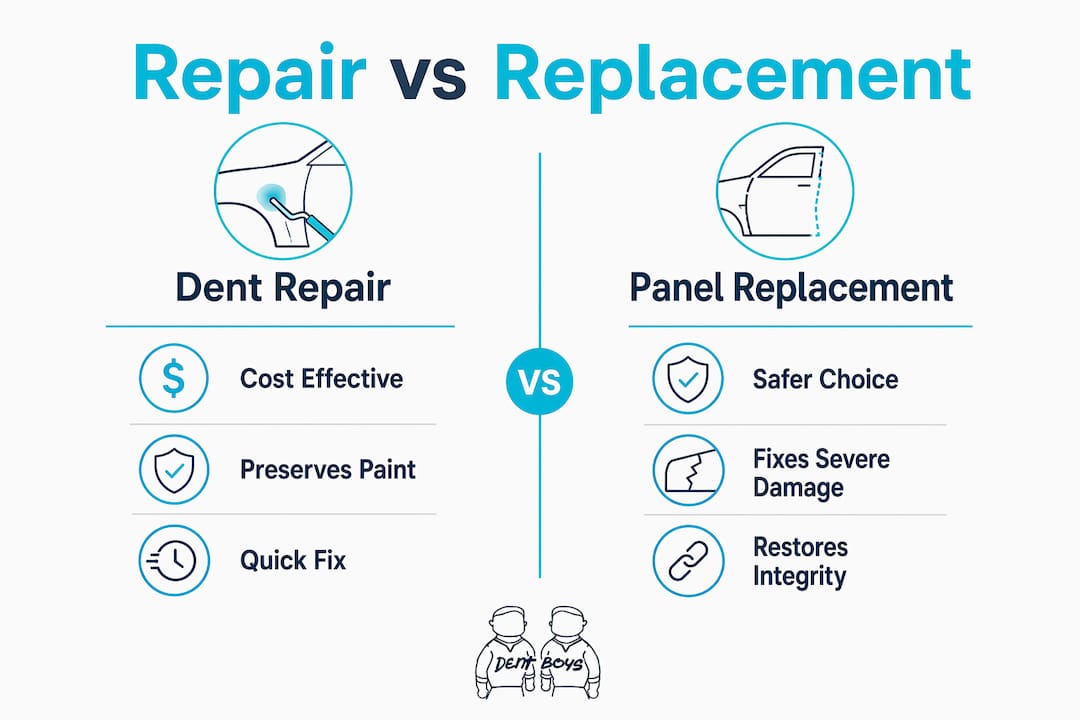
For most minor dents with intact paint and metal that hasn't stretched, repair is the right call. Panel replacement becomes necessary when structural components, crumple zones, ADAS sensors, or airbags are involved, or when the metal has creased beyond its elastic limit. Here's how to know which situation you're actually in.
Choose dent repair when:
- The paint surface is unbroken and the dent is shallow
- The metal hasn't stretched or folded sharply
- The damage sits away from mounting edges, seams, or structural reinforcements
- No safety sensors or airbag components are behind the panel
Choose panel replacement when:
- The panel has deep creases, tears, or metal that can't return to shape
- Structural integrity, crumple zones, or safety sensor mounts are compromised
- Prior thick bodywork or corrosion makes another repair unreliable
- ADAS cameras, radar units, or parking sensors need recalibration after impact
How paintless dent repair works, and when it's the right fit
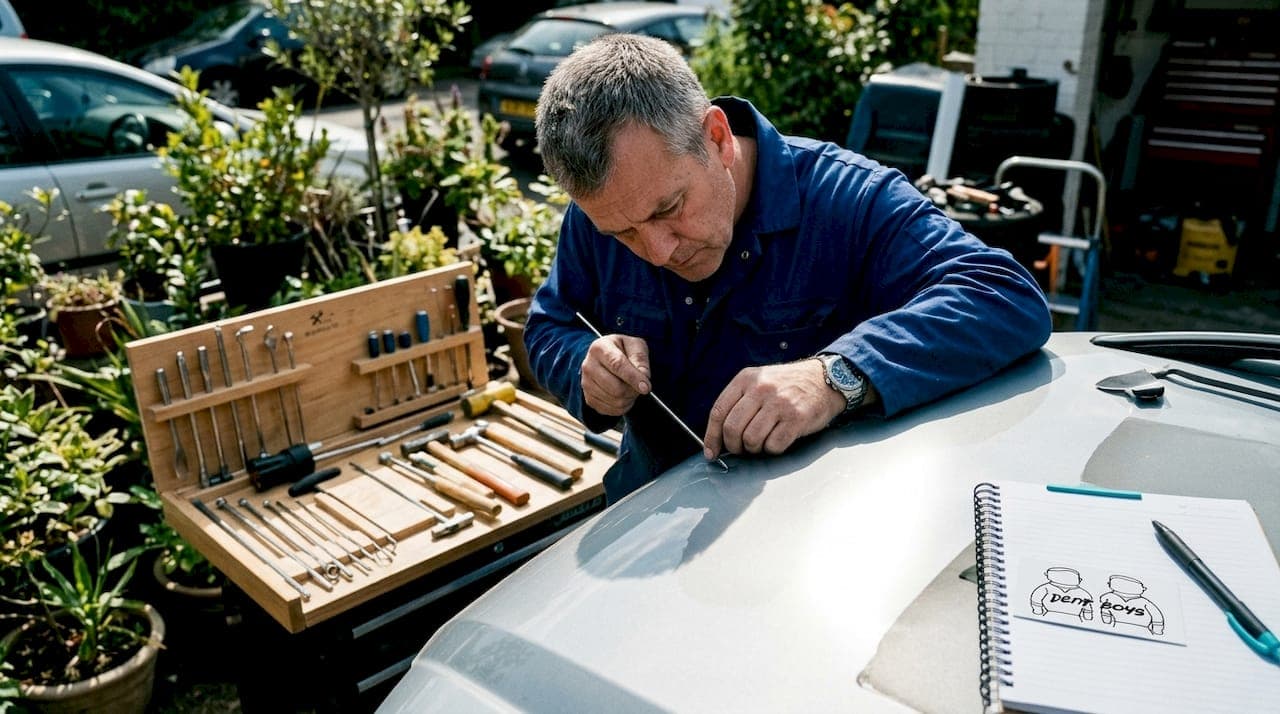
Paintless dent repair (PDR) is the industry standard technique for removing minor dents without touching the paint. Technicians use metal rods and body picks to push dents out from behind the panel, or use glue tabs to pull them from the outside. No filler, no primer, no color matching. The factory finish stays intact, which matters more than most drivers realize because body shops cannot replicate the exact spray conditions of the original factory paint.
PDR works best on:
- Hail damage across hoods, roofs, and trunk lids
- Parking lot door dings and minor collision dents
- Shallow dents on flat or gently curved panel sections
- Damage where the paint is fully intact and the metal hasn't stretched
The cost advantage is real. PDR runs $75–$400 per dent, while a conventional body shop repair on the same panel ranges from $300 to $1,500 for a typical repair. PDR also finishes in 1–3 hours versus 3–5 days for traditional bodywork, so you're not hunting for a rental car.
PDR can also serve as a prep technique. The "push to paint" or "push to prep" method uses PDR to minimize filler volume before repainting, preserving panel rigidity and reducing the risk of cracking over time. Paint damage alone doesn't automatically rule out a PDR-based approach.
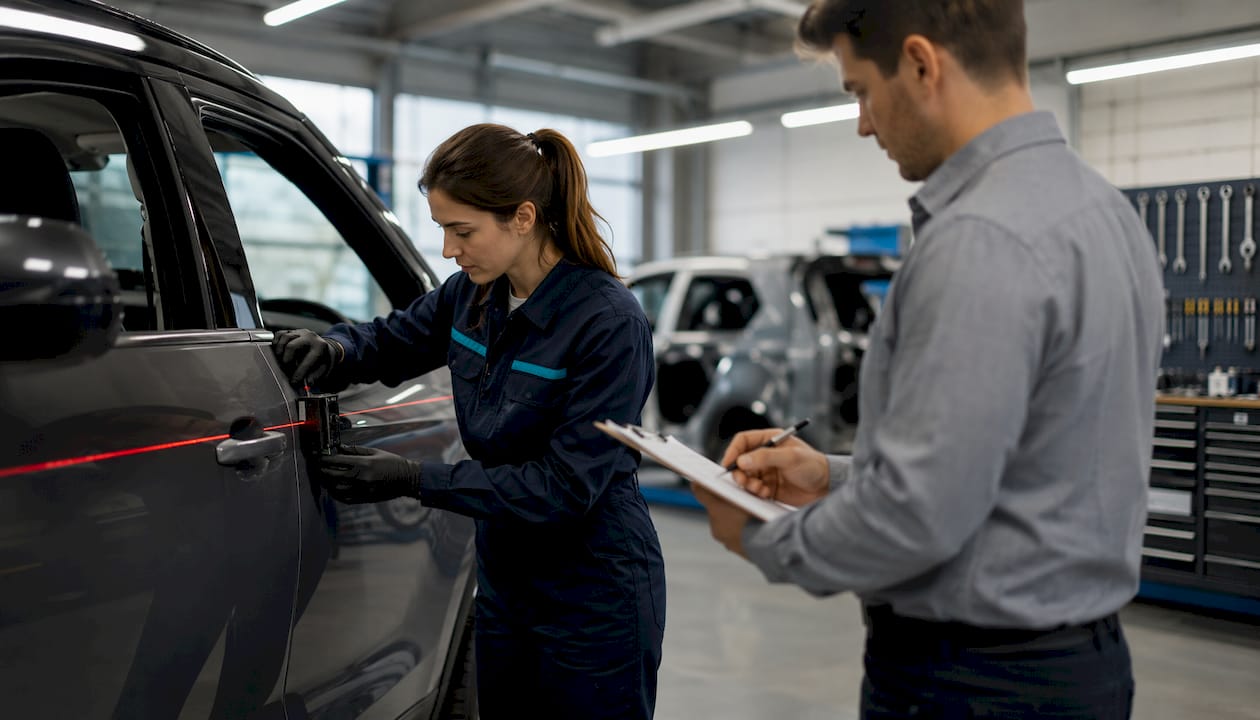
Pro Tip: Run your fingernail across the dent. If it doesn't catch on broken paint, PDR is likely an option. If it catches, you're looking at conventional bodywork regardless of dent size.
When panel replacement is the safer and smarter choice
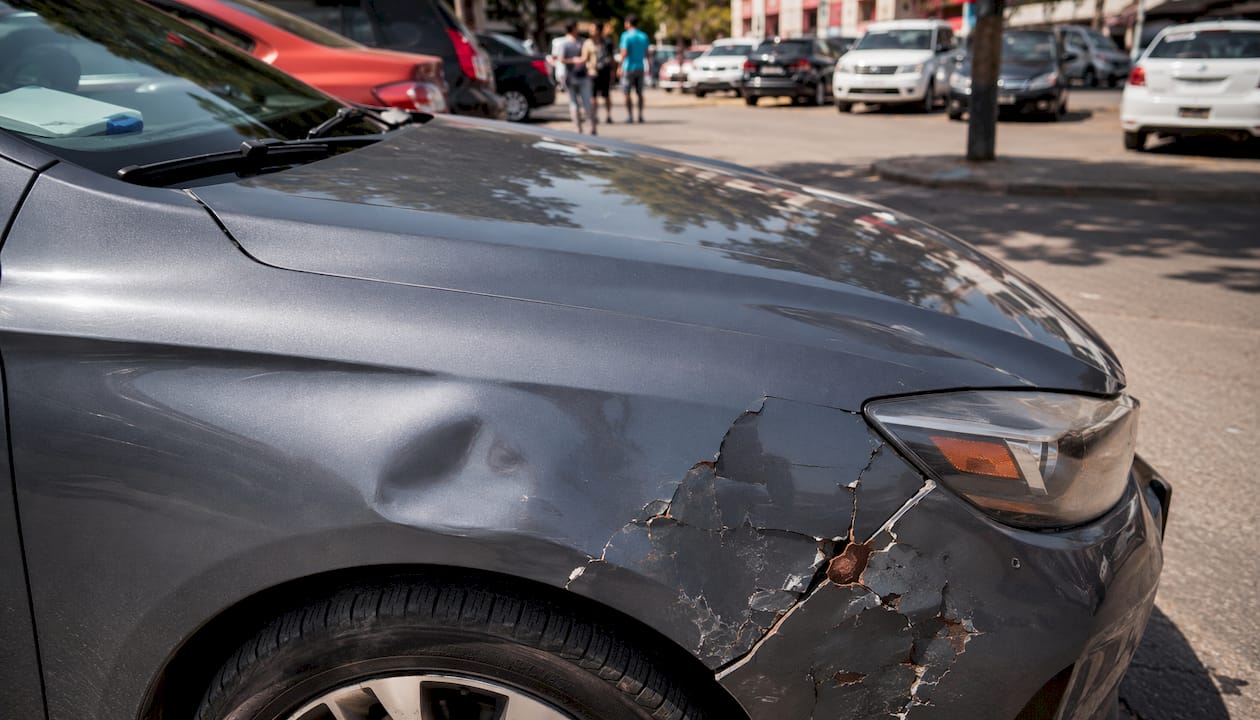
Some damage looks minor from the outside but rules out repair entirely. Technician decisions depend on dent size, depth, creasing, paint condition, panel material, and proximity to structural or sensor areas, and several of those factors point directly to replacement.
Replacement is the right call when:
- Deep creases or metal tearing are present. Metal pushed past its elastic limit can't return to its original shape cleanly. Forcing it back creates micro-cracks that fail later under heat and vibration.
- Structural components are involved. Damage reaching chassis rails, sub-frame mounts, or inner reinforcements means the outer panel often has to come off anyway. A new panel goes back on cleaner.
- Crumple zones have absorbed an impact. These panels are engineered to fail in a specific way during a crash. A repaired crumple zone doesn't behave the same way in the next impact.
- ADAS sensors or airbag components are behind the panel. Cameras, radar units, and parking sensors are calibrated to fractions of a degree. Replacement plus recalibration is often the only way to restore factory tolerance.
- Prior bodywork is already thick or cracking. Panels with prior thick body filler risk cracking if repaired again; replacement gives a clean foundation.
- Corrosion is present under the paint. Rust spreads under repair materials. Replacing the panel stops the problem rather than covering it.
Dent repair vs panel replacement: side-by-side comparison
| Criteria | Dent repair (PDR / traditional) | Panel replacement |
|---|---|---|
| Best damage type | Shallow dents, minor dings, intact paint | Deep creases, tears, structural or sensor damage |
| Panel material | Steel panels ideal; aluminum adds 25–60% to repair cost | Aluminum and composites often require replacement by default |
| Typical cost | $75–$400 depending on size and method | — |
| Repair time | 1–3 hours (PDR); 3–5 days (conventional) | 3–5 days, longer if sensor recalibration is needed |
| Effect on vehicle value | Preserving factory paint often yields better resale outcomes | New panel may not match factory finish exactly |
| Safety considerations | Suitable only when structure and sensors are unaffected | Restores crash standards; required for sensor recalibration |
| Environmental impact | Less material waste; no new panel manufacturing | New panel production adds material and energy cost |
| Warranty | Varies by shop; Dent-boys offers a lifetime warranty on PDR | Typically manufacturer-backed panel warranty |
One number worth keeping in mind: aluminum panel repairs run 25–60% more than equivalent steel work because aluminum work-hardens differently and requires specialized heat induction tools. Many smaller shops won't touch it and refer those jobs to specialists.
How to decide: a practical framework for vehicle owners
The decision isn't made from the driveway. It requires a close look at several specific factors, and getting one wrong can mean paying for a repair that fails in 18 months.
- Assess dent size and depth first. Shallow dents under roughly 4 inches across with no sharp crease are PDR candidates. Larger dents, or any dent with a fold along a body line, move toward conventional repair or replacement.
- Check paint condition carefully. Intact paint unlocks PDR, which runs 40–70% cheaper than conventional bodywork. Chipped, cracked, or bare metal means you're in body shop territory regardless of dent size.
- Map the dent's location relative to structure. A bolt-on fender is a different conversation than a welded quarter panel. Panel damage assessment includes type of panel, access for repair, structural impact, corrosion, prior repairs, and hidden damage affecting fit and safety.
- Identify the panel material. Steel panels offer more repair flexibility. Aluminum panels, common on Ford F-150s, most BMWs, and many modern hoods, have a lower repair threshold because aluminum can't be shrunk back once stretched.
- Consider what's mounted behind the panel. Any panel with ADAS cameras, radar, or parking sensors requires extra scrutiny. If the sensor mount has shifted, replacement and recalibration is the only path back to factory tolerance.
- Factor in repair history and corrosion. A panel that's been straightened before has work-hardened. Pushing it back again creates invisible micro-cracks. Corrosion under the paint keeps spreading under repair materials.
- Weigh cost against the full finished job, not just the labor line. A repair that needs a full panel respray for color match can end up costing as much as a clean replacement with new paint. Get both numbers before deciding.
- Let insurance inform but not dictate the choice. Most insurers cover whichever option restores the car to pre-loss condition. If structure or technology is involved, insurers may require replacement. Small dents usually aren't worth claiming since premium increases can outrun the savings within two years.
Pro Tip: Before committing to either option, have a qualified technician inspect for hidden damage behind the panel. A small-looking crease in the wrong spot can be harder to fix than a larger dent in a flat area, and the difference only shows up once the panel is off.
What experienced technicians and industry standards say
The best technicians don't default to the fastest option. They default to the option that holds up. A quality repair preserving factory paint can better maintain vehicle value than a replaced panel, but only when the repair is done right and the damage genuinely qualifies.
A few principles that guide professional decisions:
- Minimize filler, always. Proper repair keeps filler use as low as possible to maintain panel strength. Excessive filler leads to cracking, especially on panels that flex regularly or have been repaired before.
- Access determines feasibility. Sometimes the panel itself is repairable, but access is the problem. If reaching the back of a dent requires cutting, drilling, or major disassembly, replacement on a bolt-on panel can be the more practical and cost-effective path.
- Aluminum demands specialist tools. Modern vehicle panels incorporate aluminum and reinforced steel, and aluminum requires heat induction and specialized tools to prevent work hardening. A shop without that equipment shouldn't be repairing aluminum panels.
- OEM repair guidelines exist for a reason. Manufacturer standards specify which panels can be repaired and which must be replaced, particularly around crumple zones and sensor mounts. Following those guidelines protects both safety and warranty coverage.
- Damage near critical structural and sensor areas demands replacement. Non-structural cosmetic damage is best matched with repair using PDR or traditional refinishing.
"The goal is not to choose the fastest option but to choose the option that restores the vehicle properly and holds up over time. The decision usually comes down to what the metal or material has been through and what it will take to bring it back." — F&M Automotive Body & Repair
If your car's value matters to you, or if you're driving a vehicle with active safety systems, the technician's answer to "why repair versus replace?" should reference specific damage features: the crease shape, whether the metal stretched, what's behind the panel. A shop that can't answer with that level of detail is worth leaving.
Dent-boys can handle this decision for you
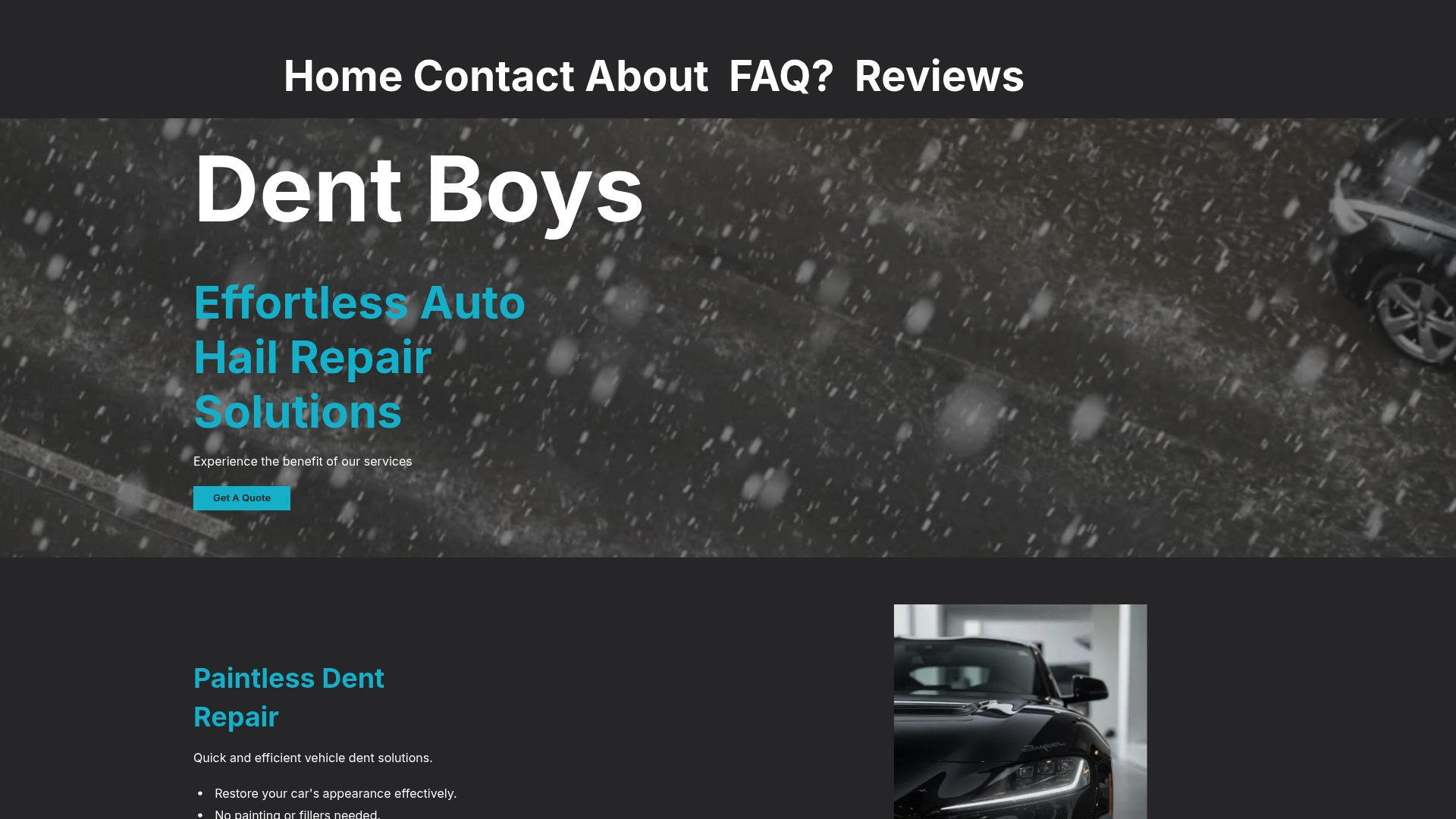
Dent-boys specializes in paintless dent repair with a $0 deductible, a lifetime warranty on every repair, and free pick-up and delivery so you're not rearranging your week around a shop visit. Free estimates mean you get a clear answer on whether PDR is the right fit before any money changes hands.
If your vehicle has hail damage, parking lot dings, or minor collision dents with intact paint, Dent-boys is built exactly for that scenario. And if the damage turns out to need something beyond PDR, you'll know that upfront too. Visit dent-boys.com to schedule your free inspection.
Key Takeaways
Dent repair preserves factory paint and costs far less than replacement, but only when the metal is undamaged, the paint is intact, and no structural or sensor components are involved.
| Point | Details |
|---|---|
| Paint condition is the deciding factor | Intact paint unlocks PDR at $75–$400; broken paint means conventional bodywork at $300 to $1,500 for most repairs. |
| Structural damage requires replacement | Crumple zones, sensor mounts, and deep creases beyond the metal's elastic limit cannot be safely repaired. |
| Aluminum raises the cost and lowers the repair threshold | Aluminum panel repairs run 25–60% more than steel, and stretched aluminum cannot be shrunk back reliably. |
| Factory finish preservation protects resale value | A clean repair preserving OEM paint often yields better resale outcomes than a replaced panel. |
| Get the full finished cost, not just the labor line | A repair requiring a full panel respray can match or exceed the cost of a clean replacement with new paint. |