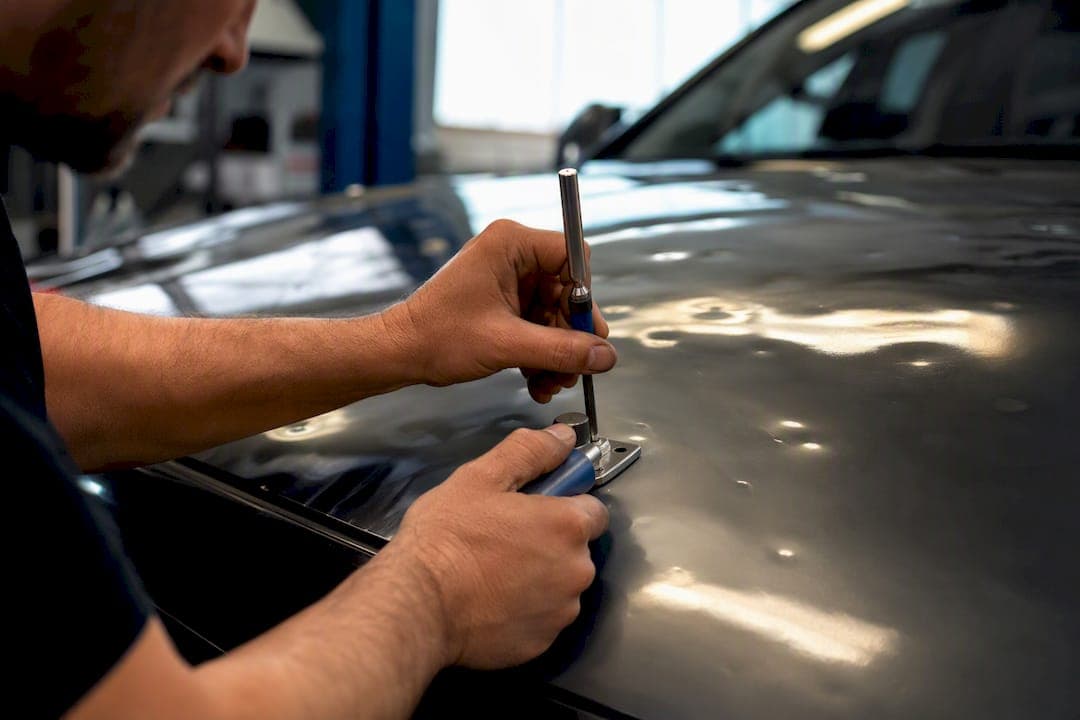
Most car hail claims wrap up in days to a few weeks. Most home roof claims take longer: expect a few weeks to your first check and several weeks total if nothing goes wrong, based on median stage timing from HailMate's claims data. Catastrophe-level storms or disputed scopes push both timelines out considerably.
The single best move after any hailstorm is the same whether you're looking at a dented hood or a pockmarked roof: document everything now, report the loss fast, and get a professional look at the damage before you decide anything else.
Do these three things in the first 72 hours:
- Document it. Time-stamped photos and video of every damaged panel, shingle, or gutter, shot in daylight from multiple angles.
- Report it. Call your agent or use your insurer's app to open a claim, even if you haven't decided whether to pursue it fully.
- Get eyes on it. If the damage looks minor or you're unsure, a professional inspection (a body shop for vehicles, a licensed contractor for roofs) tells you whether it's worth filing at all.
For vehicles, comprehensive coverage typically pays out based on actual cash value (ACV) minus your deductible. For roofs, most policies split payment into an ACV check up front and a second, recoverable depreciation check once repairs are complete. A shop offering paintless dent repair, like Dent-boys, can often turn a hail-damaged vehicle around faster than a traditional body shop precisely because there's no paint to cure or panels to replace.
Key Takeaways
Hail damage claim timelines depend heavily on documentation quality, claim complexity, and repair method, with vehicle claims resolving in days to weeks and roof claims typically taking five to eleven weeks.
| Point | Details |
|---|---|
| Vehicle claims move fast | Comprehensive auto claims often resolve in days to a few weeks with clear documentation. |
| Roof claims run longer | Clean property claims average about 38 days to the first check and 74 days to final payment. |
| Deadlines start at the storm | Policy filing windows (30 days to 1 year typically) begin on the date of loss, not discovery. |
| Supplements cause the longest delays | Incomplete initial scopes that require reopening can add multiple weeks to a roof claim. |
| PDR shortens vehicle repair time | Dent-boys' paintless dent repair skips paint and cure time, often finishing in hours to a couple of days with free estimates, pickup and delivery, $0 deductible support, and a rental vehicle included. |
Table of Contents
- Understanding Hail Damage Insurance Coverage
- How Long Does Each Stage Of A Hail Claim Take?
- What Speeds Up Or Slows Down Your Claim?
- What Documentation Do You Need To File A Hail Claim?
- What Happens During The Adjuster Inspection?
- PDR Vs. Traditional Repair: Which Is Faster?
- What If Your Hail Claim Gets Delayed Or Denied?
- Does Filing A Hail Claim Raise Your Premium?
- What A Repair Provider Sees After Every Hailstorm
- Get Your Car Fixed Faster After A Hailstorm
- Frequently Asked Questions
- Sources
Understanding Hail Damage Insurance Coverage
Auto hail damage falls under the comprehensive portion of your policy, not liability or collision. If you carry comprehensive coverage, hail is one of the more straightforward claims to process because the cause of loss is rarely disputed. Insurers pay out the cost of repair minus your deductible, and for major regional storms, some carriers deploy mobile hail estimation units to speed up assessments across hundreds of vehicles at once.
Homeowners insurance handles hail differently. Most standard policies cover roof, siding, gutter, and exterior damage from hail as a named peril, and many also cover damaged personal property inside the home if the storm breached the structure. The catch is how payment gets structured.
Roof claims typically pay in two installments. The first check reflects ACV, the depreciated value of your roof at the time of loss. The second check, called recoverable depreciation, only gets released after you complete repairs and submit proof, such as a contractor invoice. Skip the repair or delay it indefinitely, and you may never see that second check.
A quick coverage example: Say a hailstorm dents your car's hood and both doors. Your comprehensive deductible is $500, and the repair estimate comes in at $1,800. Your insurer pays $1,300 after the deductible. On the home side, if your roof's ACV is assessed at $9,000 with $2,000 in depreciation, you'd get $7,000 upfront (minus your deductible) and the remaining $2,000 once the roof is actually replaced.
Filing deadlines vary by insurer and by state, and they almost always run from the date of loss, the night of the storm, not the day you spot the dent. Common windows include:
- A typical range for most policies is from several weeks up to around a year, according to LegalClarity's review of hail claim deadlines.
- Some states and carriers allow extended filing windows of multiple years, particularly for roof claims where damage isn't immediately visible.
- "Notice" of loss and formal "proof of loss" are often treated as separate steps with separate clocks, so don't assume calling your agent once satisfies every deadline.
Check your policy declarations page and your state Department of Insurance website before you assume you have plenty of time. Some homeowners lose the right to file simply because they waited to see if the roof would "hold up."
How Long Does Each Stage Of A Hail Claim Take?
The full hail damage claim timeline runs through a predictable sequence of stages, and the pace differs sharply between a car and a house.
Vehicle claims move fast. Once you report the loss, most insurers assign an adjuster or estimating service within a day or two. For a routine claim with clear photos and a cooperative shop, you can go from filing to a completed estimate inside a week, and receive payment shortly after you accept it. Large hailstorms complicate this: when a single storm cell damages thousands of cars in one metro area, insurers often set up mobile estimating units at a central lot to keep pace, which Nationwide describes as standard practice for catastrophe response.
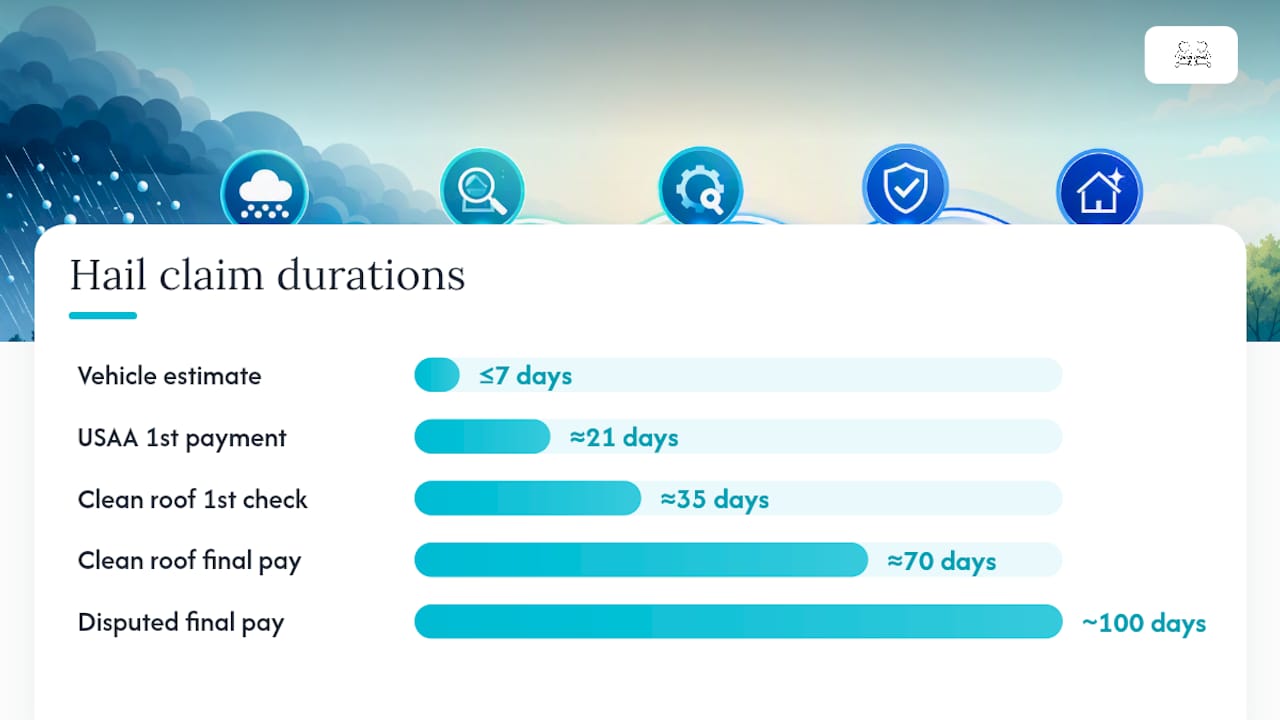
Add those stages together and a clean, undisputed roof claim runs about a bit over a month to the first check and around two to three months to final payment, per HailMate's analysis of claims-tracking data. USAA's own guidance lands in a similar range, estimating about three weeks to the first payment under typical conditions, with inspections and estimate reports taking up to ten business days to finish.
Here's what that looks like in practice, using two realistic scenarios.
- The clean claim. A homeowner in a mid-size Texas suburb reports golf-ball-sized hail damage the morning after a storm. She photographs the roof from a ladder, submits her claim online, and an adjuster is assigned three days later. Inspection happens the following week, the estimate arrives six days after that, and her ACV check lands about five weeks after filing. She hires a roofer within two weeks, submits the completion invoice, and gets her depreciation check about 70 days after her original filing date.
- The disputed claim. A neighbor two streets over files the same week, but her adjuster's initial estimate misses hidden damage to the roof decking. Her contractor flags the gap, she requests a re-inspection, and the file gets reopened for a supplement. That single supplement adds several weeks to the process, and her final payment doesn't arrive until closer to the 100-day mark, well past the clean-claim median.
The gap between those two homeowners isn't luck. It's documentation, scope completeness, and how quickly disputes get flagged and resolved.
What Speeds Up Or Slows Down Your Claim?
Some delays are entirely outside your control. Others are avoidable with a little prep work before the adjuster ever shows up.
What slows a claim down:
- Catastrophe backlog. After a widespread hailstorm, adjusters may be juggling hundreds of files, pushing inspection scheduling out by weeks.
- Missing or incomplete documentation. Vague photos or no record of the storm date invite delays and follow-up requests.
- Supplements. A missed scope item found after the first inspection reopens the file and restarts parts of the clock, often adding multiple weeks according to HailMate's claims data.
- Slow carrier tiers. Some insurers simply process claims faster than others, particularly regional carriers versus large nationals during peak storm season.
- Mortgage endorsements. If your lender is on the policy, checks may need to be co-endorsed, adding a mailing and processing step.
- Homeowner scheduling delays. Waiting months to hire a contractor stalls the depreciation release even after the first check clears.
What speeds it up:
- File within days of the storm, not weeks.
- Be present, or have your contractor present, during the adjuster's inspection.
- Hand over full documentation up front: photos, video, and a contractor estimate if you already have one.
- Ask if the insurer offers mobile estimating units for large-scale events, which can cut inspection wait times significantly.
Pro Tip: Before your adjuster inspection, walk the property yourself with your contractor and build a complete list of every damaged component, gutters, vents, flashing, AC units, fencing. Claims that get scoped fully on the first pass rarely need supplements, and supplements are the single biggest cause of claims stretching past 100 days.
What Documentation Do You Need To File A Hail Claim?
The strength of your claim file determines how fast it moves and how few questions you get asked later. Build it methodically, not after the fact.
Photo and video checklist:
- Wide shots of the entire roof, vehicle, or property from multiple angles, taken in daylight.
- Close-up shots of individual dents, bruised shingles, or cracked vents, with something for scale (a coin, a tape measure).
- Video walkthroughs of the property or vehicle exterior, narrated with the date if possible.
- Roof-specific detail: gutters, downspouts, AC condenser fins, and any soft-metal flashing, which show hail impact clearly even when shingles look intact.
Claim information to record:
- The exact date and approximate time of the storm.
- Your claim number as soon as it's issued.
- Your adjuster's name and direct contact information.
- Any contractor or repair shop estimates, plus receipts for temporary repairs like tarping.
Keep every email, text, and call log tied to the claim in one folder. And be wary of storm-chasing contractors who show up unannounced and pressure you to sign a repair contract on the spot; a legitimate contractor will give you time to compare estimates and confirm coverage first.
What Happens During The Adjuster Inspection?
Once your claim is assigned, expect the insurer to make contact within a few days to schedule an inspection. The adjuster will walk the property or examine the vehicle, document the damage against your policy's covered perils, and issue a written estimate that becomes the basis for your ACV payment.
Come prepared with questions. Ask the adjuster:
- What date of loss are they using, and does it match the storm date you documented?
- What specific items are included in the estimate, and what got left out?
- Who's responsible for supplements if hidden damage turns up during repair?
- What's the expected timeline from this inspection to your first check?
Homeowners and vehicle owners have more leverage in this process than most realize. You can request a re-inspection if the estimate misses damage, hire an independent appraiser at your own expense to challenge a lowball number, and file a complaint with your state Department of Insurance if the insurer is unresponsive or acting in bad faith.
Insurers generally aim for contact within a few business days of filing, per Nationwide's own claims guidance, but hard-hit disaster areas routinely see that window stretch to weeks. Don't assume silence means your claim was denied. It often just means you're in a queue.
PDR Vs. Traditional Repair: Which Is Faster?
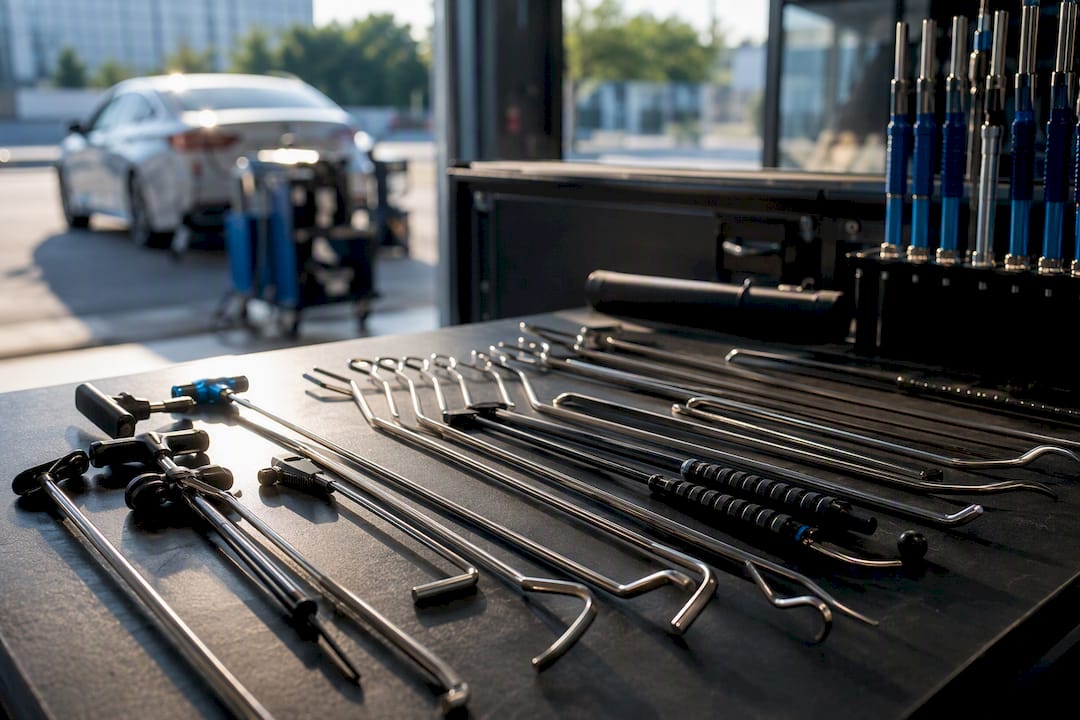
Vehicle hail damage almost always presents as a cluster of shallow dents across the hood, roof, and trunk, without cracked paint. That's exactly the kind of damage paintless dent repair (PDR) was built for, and it's a major reason PDR shops finish jobs faster than traditional body shops.
| Factor | Paintless Dent Repair | Traditional Body Shop Repair |
|---|---|---|
| Typical repair time | Hours to 1-2 days | Several days to over a week |
| Paint or filler needed | No | Often yes |
| Cure/dry time | None | Required, adds days |
| Effect on final payment timing | Faster, since no second-stage repair verification needed | Slower if depreciation or supplement checks depend on completion proof |
| Rental car duration | Shorter, tied to hours-not-days repair windows | Longer, tied to parts ordering and paint scheduling |
Because PDR skips painting and panel replacement entirely, there's no cure time and usually no waiting on parts. That shrinks the gap between your insurer's first check and the completed repair, which matters most on roof-style claims where a second payment depends on proof of finished work; the same logic applies to vehicles when insurers verify repair completion before closing a file.
Dent-boys builds its entire process around that speed advantage. Free estimates mean you know your repair scope before committing. Pickup and delivery mean you're not burning a day driving to a shop. $0 deductible support helps coordinate the insurance side so you're not fronting costs you shouldn't have to. A rental vehicle keeps you mobile while your car is in the shop, and a lifetime warranty on completed repairs means the fix is the last thing you have to think about.
- Free estimates before you commit to anything.
- On-site pickup and delivery, no shop visit required.
- $0 deductible support coordinated directly with your insurer.
- Rental vehicle provided during the repair window.
- Lifetime warranty backing every completed repair.
What If Your Hail Claim Gets Delayed Or Denied?
A denial or a stalled claim isn't the end of the process. It's the point where you switch from passive filer to active advocate.
Work through these steps in order:
- Re-read your policy. Confirm the denial reason actually matches an exclusion in your contract, not just a general assumption by the adjuster.
- Request a written explanation. Insurers must provide a specific reason for denial; vague language is a red flag worth pushing back on.
- File a supplement or formal dispute if the denial stems from an incomplete scope rather than a coverage exclusion.
- Get an independent estimate from a contractor or repair shop not affiliated with the insurer, to counter a lowball or incomplete assessment.
- Consider a public adjuster for large, contested property claims. They work on your behalf, typically for a percentage of the settlement.
- File a complaint with your state Department of Insurance if the insurer misses reasonable timelines or acts in bad faith.
Two clocks matter here, and they're not the same thing. Your policy's filing deadline (often 30 days to a year from the date of loss) governs when you must first report the claim. Separately, most states set a longer statute of limitations for suing an insurer over a bad-faith denial, sometimes several years. Missing the policy deadline can kill your claim before the statute of limitations ever becomes relevant, so don't confuse having years to sue with having years to file.
Preserve every photo, estimate, and email throughout an appeal. Adjusters and DOI investigators both weigh a well-documented timeline heavily when resolving disputes.
Does Filing A Hail Claim Raise Your Premium?
Filing a claim, whether it's paid, partially paid, or denied, can show up on your CLUE report (Comprehensive Loss Underwriting Exchange) and factor into renewal pricing. Insurers use these records during underwriting, so a pattern of small claims can nudge your premium even when each individual payout was modest, according to guidance on car insurance and hail damage.
That doesn't mean you should sit on real damage. It means weighing the decision:
- File when: damage is clearly visible, the repair cost exceeds your deductible by a meaningful margin, or you have an aging roof that a hailstorm has weakened structurally.
- Hold off when: the damage is cosmetic, minor, and would cost less to repair out of pocket than your deductible.
- A quick professional inspection within 30 days often answers the question for you before you ever open a formal claim.
Deductibles get applied differently across policy types. Auto comprehensive deductibles are a flat dollar amount subtracted from the payout. Roof claims often carry a percentage-based or flat deductible, plus that separate recoverable depreciation holdback released only after repairs finish.
What A Repair Provider Sees After Every Hailstorm
After watching hundreds of hail claims move through the system, the pattern is consistent: the homeowners and vehicle owners who move fastest through the process are the ones who documented everything before the adjuster ever showed up. A professional inspection within the first 30 days, whether that's a roofer checking flashing or a PDR technician assessing panel damage, gives you leverage in every conversation that follows.
Choosing between PDR and traditional bodywork isn't just a cosmetic preference. It changes how long you're without your car, how the insurer verifies completion, and how quickly your file closes. Dent-boys built its process, free estimates, pickup and delivery, $0 deductible support, and a rental vehicle during repair, around removing friction from a system that's already slow enough on its own.
Get Your Car Fixed Faster After A Hailstorm
If you've read this far, you already know the roof-claim clock (weeks to months) and the vehicle-claim clock (days to a few weeks) run on very different timelines, and the repair method you choose is one of the few variables you actually control. Dent-boys is built specifically around the vehicle side of that equation, cutting weeks of body shop turnaround down to hours or days because paintless dent repair skips paint booths, cure time, and parts orders entirely.

That speed shows up everywhere in the service: a free estimate before you commit to anything, pickup and delivery so you never have to sit in a shop waiting room, coordination on $0 deductible support with your insurer, and a rental vehicle to keep you moving during the repair window. Every completed job also carries a lifetime warranty, so the fix is genuinely the last thing you deal with.
- Free, no-obligation estimate on your hail damage.
- Pickup and delivery instead of a shop visit.
- $0 deductible support coordinated with your insurance.
- Rental vehicle provided while your car is repaired.
- Lifetime warranty on every completed repair.
Start with a free hail damage estimate from Dent-boys and find out how quickly your car can look new again.
Frequently Asked Questions
How long does a hail damage claim typically take? Vehicle claims often resolve in days to a few weeks. Home roof claims typically take five to six weeks for the first check and around ten to eleven weeks for final payment on a clean, undisputed claim.
How long do I have to file a hail damage claim? Most policies set filing windows between 30 days and one year from the storm's date of loss, though some states and policies extend that further. Check your policy declarations page and your state Department of Insurance for exact limits.
What's the difference between ACV and recoverable depreciation on a roof claim? ACV (actual cash value) is your first check, reflecting the roof's depreciated value at the time of loss. Recoverable depreciation is the second check, released only after you complete repairs and submit proof.
Will filing a hail claim raise my insurance premium? It can. Claims, paid or denied, may appear on your CLUE report and influence renewal pricing, particularly if you have a pattern of claims. A quick professional inspection can help you decide if the damage is worth filing over.
Is paintless dent repair faster than traditional bodywork for hail damage? Yes, in most cases. PDR skips painting and cure time entirely, often finishing hail repairs in hours to a couple of days versus several days to over a week for traditional bodywork involving paint or panel replacement.
What should I do if my hail claim is denied? Request a written explanation, compare it against your policy language, get an independent estimate if you disagree, and file a complaint with your state Department of Insurance if the insurer isn't responsive or acting reasonably.
This article is general information, not a substitute for advice from a qualified financial advisor. Consult a qualified financial professional about your own circumstances before acting on anything here.
Sources
Check these sources directly for policy-specific and location-specific details:
- How long does a roof insurance claim take? - HailMate
- Hail damage - Liberty Mutual Insurance resources
- How long do you have to file a hail damage claim? - LegalClarity
- Hail claims - USAA support (homeowners)