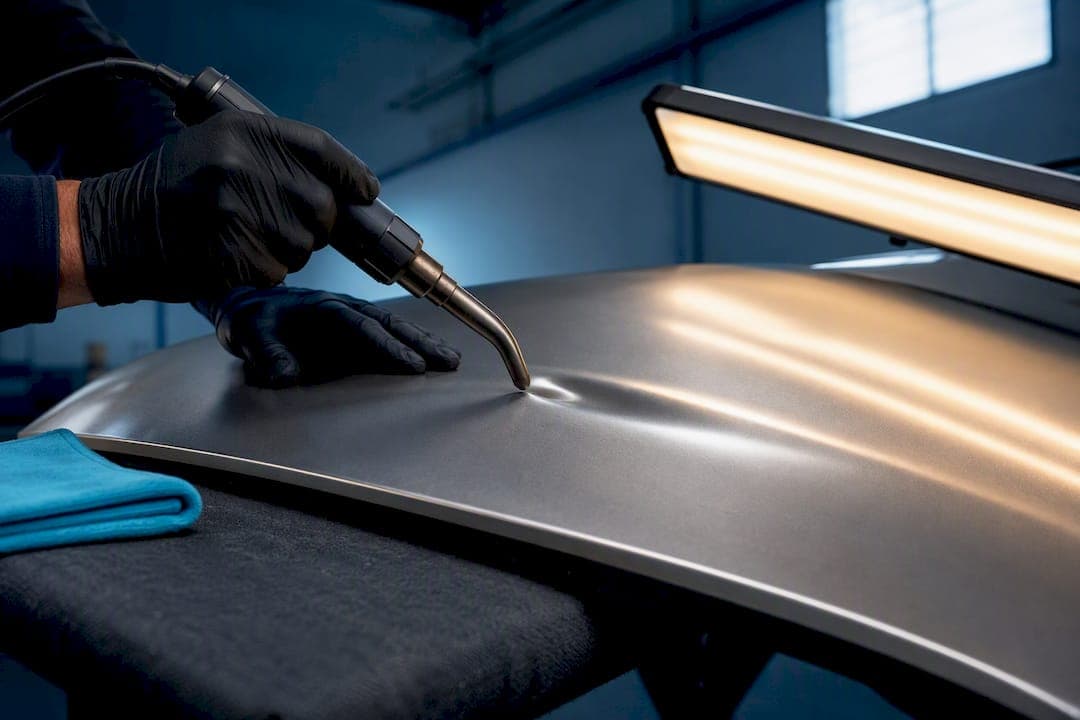
Paintless dent repair fixes most Tesla dents when the paint is intact and the panel is reachable from behind, but aluminum construction and nearby ADAS sensors mean the job isn't identical to PDR on a steel Honda. Get a Tesla-experienced technician to inspect the dent before you book anything, and ask for written documentation of the paint check and any sensor work.
TL;DR:
- Aluminum Tesla panels require specialized PDR techniques, including careful inspection, limited heat application, and isolated tools to prevent contamination.
- Dent eligibility depends on paint integrity, dent depth, accessibility, and absence of prior bodywork or proximity to sensors, with specific focus on avoiding structural damage.
- Repair costs range from $75 to over $800, depending on dent size, panel access complexity, and whether sensor calibration or ADAS checks are needed afterward.
- Only technicians experienced with Tesla aluminum repairs and certified in modern vehicle standards should attempt PDR, ideally with documented inspection and strict process adherence.
- PDR is unsuitable for cracks, oil-canning, stretched metal, or damage directly over sensors, which must often be fixed through traditional methods or panel replacement.
Table of Contents
- Why Tesla Dent Repair Is Different: Aluminum, Hybrids, and Paint Systems
- Which Dents Qualify for PDR?
- How PDR Is Performed on Tesla: Aluminum-Specific Methods
- Cost Ranges and How Long Tesla PDR Takes
- How to Pick a Tesla-Capable PDR Tech
- When PDR Is Not Appropriate: No-Go Conditions
- Dent Boys' Approach to Tesla PDR
- What We Actually See in Tesla PDR Jobs
- Get a Free Estimate for Tesla Dent Repair
- Sources
Why Tesla Dent Repair Is Different: Aluminum, Hybrids, and Paint Systems
Steel wants to return to its original shape. Aluminum doesn't. It has no "memory," and every time a technician pushes or taps it, the metal work-hardens a little more, which means fewer passes and more precision than a steel repair allows.
Tesla's own repair guidance for aluminum body panels backs this up. The Tesla tech note on aluminum cosmetic damage walks through specific pull-tab and heat procedures built around aluminum's behavior, not steel's.
Model matters too. Model S and Model X use largely aluminum outer panels, while Model 3 and Model Y mix materials, and Tesla's Model Y construction differs from the Model 3 enough that reaching the back of a panel sometimes means pulling interior sound-deadening or working around sensors first.
A few other factors change the calculus:
- Tesla's factory paint runs thin, which raises the risk of micro-cracking if a technician pushes too aggressively; learning how to remove swirl marks from your car's paint can offer insight into paint care and damage prevention.
- Reputable shops check panels under 30x magnification before and after the repair to catch cracks invisible to the naked eye.
- Tools used on steel panels can transfer contamination to aluminum, so serious aluminum work uses isolated tool sets.
Which Dents Qualify for PDR?
Run through this checklist before you call anyone:
- Paint is fully intact. No chips, no cracking, no touch-up paint layered over the damage.
- The dent is shallow to moderate. Deep creases that have folded the metal past its elastic limit usually won't pull back cleanly.
- A technician can reach the backside. Access panels, door skins, and fenders with removable liners are prime candidates; structural areas welded shut are not.
- The dent sits away from the hem flange or panel edge. Metal near a fold or seam behaves unpredictably under pressure.
- There's no sign of prior filler or bodywork. Filler hides the true shape of the metal and can crack or pop loose during PDR.
- The dent isn't sitting directly over a camera, radar, or ultrasonic sensor housing. These spots may still qualify for PDR, but they usually trigger an ADAS check afterward, a process Vehicle Hub's shop guidance treats as a standard, billable step rather than an afterthought.
How PDR Is Performed on Tesla: Aluminum-Specific Methods
A Tesla-capable technician starts with an inspection, not a tool. That means checking the paint under bright, raking light, mapping how to access the panel's back side, and noting any sensors nearby that might need a post-repair check.
From there, the actual repair on aluminum panels typically looks like this:
- Push the dent out from behind using specialized rods, or
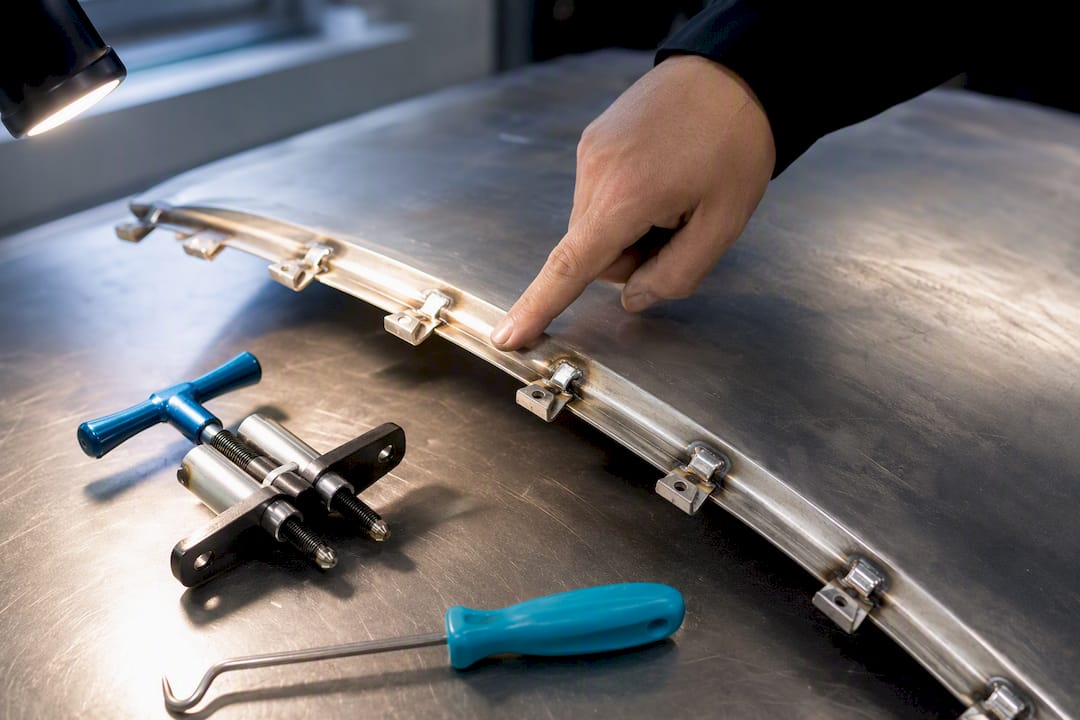
- Weld small pull tabs to the face of the panel and gently draw the metal back into shape, following the pull-tab and heat-limit guidance in Tesla's aluminum repair note
- Knock down any remaining high spots with fine, controlled taps
- Grind or file tab-weld areas and finish with the correct sanding grit, since aggressive grit can fracture aluminum's surface
Tesla's own note also flags heat limits around adhesive joints, generally capping temperatures well under boiling, and it specifies disconnecting 12V or high-voltage systems before certain procedures near the battery pack or wiring harnesses.
Pro Tip: Ask the shop to show you the pull-tab weld points before they grind them smooth. A technician who's done aluminum work before will explain exactly why the tabs went where they did.
Cost Ranges and How Long Tesla PDR Takes
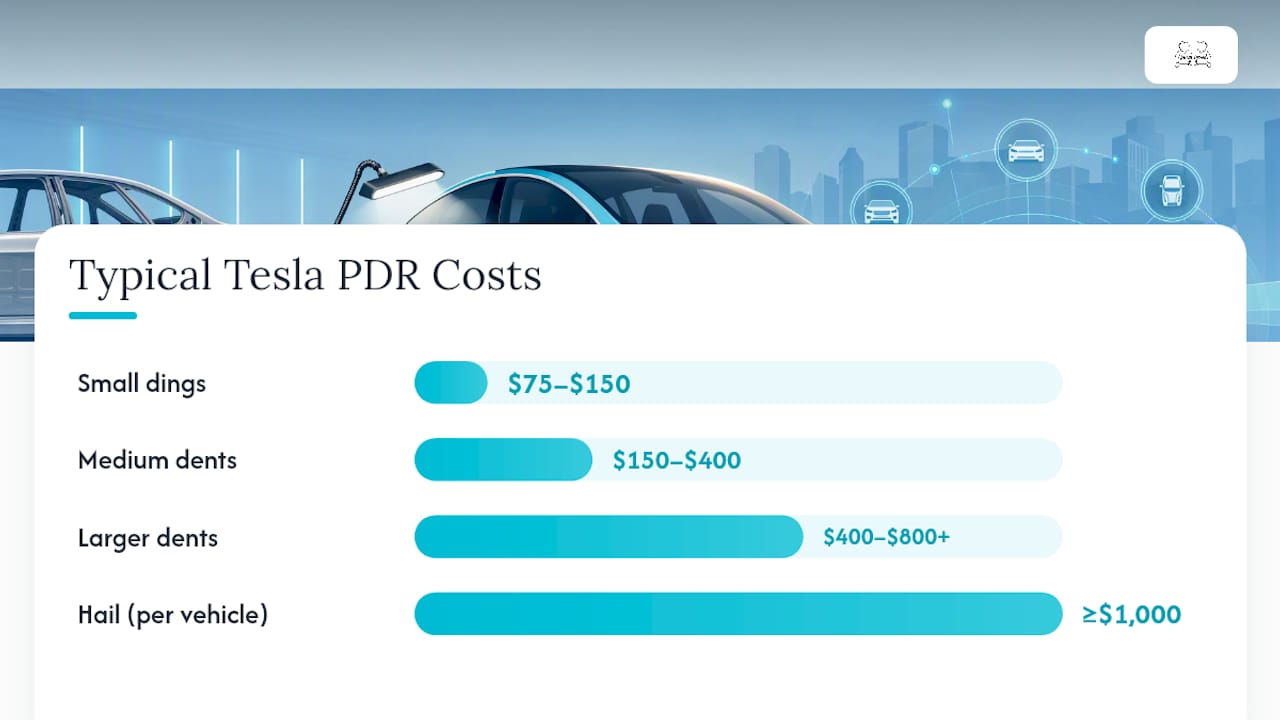
Prices vary by region, but most Tesla PDR jobs in the US fall into rough bands:
- Small door dings and creases: often $75 to $150
- Medium dents (golf-ball to fist-sized): commonly $150 to $400
- Larger dents or those needing pull-tab work: $400 to $800 or more
- Hail damage, per vehicle: cost guides for Tesla dent repair put multi-dent hail jobs well above single-dent pricing, often running into four figures depending on panel count
What pushes a quote higher: panel access work, pull-tab welding and grinding, and any ADAS scan or recalibration tacked onto the invoice. A single door ding might take under an hour on a mobile visit. A hail job with a dozen dents across multiple panels can mean a full day or more in a shop bay.
Insurance claims add a layer, too. When you present PDR to an adjuster, documented photos and a clear scope of work matter. This is also where a $0-deductible structure, when a shop like Dent-boys handles the insurance conversation directly, saves you from paying out of pocket while the claim processes.
How to Pick a Tesla-Capable PDR Tech
Before you hand over your keys, ask a few pointed questions:
- "Have you worked on Tesla aluminum panels specifically?" Steel-only experience doesn't transfer cleanly.
- "Do you inspect the paint at 30x before and after?" If they've never heard of this standard, keep looking.
- "What's your policy on 12V or high-voltage disconnects during aluminum repairs?" A shop following Tesla's own repair note should have a straight answer.
- "Do you keep separate tools for aluminum work?" Cross-contamination from steel tools is a real, avoidable problem.
- "Who handles ADAS recalibration if the dent is near a sensor?" In-house is a plus; a clear referral process is acceptable, silence is not.
Training credentials from I-CAR's Gold Class program are a decent proxy for a shop that keeps up with modern vehicle repair standards, including aluminum and ADAS-adjacent work.
Pro Tip: A shop that says "we work on all cars" without a single Tesla example to show you is a red flag, not a reassurance.
When PDR Is Not Appropriate: No-Go Conditions
Some dents simply aren't PDR candidates, and a shop that tells you this upfront is doing you a favor. Industry guidance on PDR limitations lays out the clearest boundaries: cracking visible at 30x magnification, damage within roughly one inch of a hem flange, sharp creases where the metal has folded rather than dented, and any panel made from ultra-high-strength steel.
- Paint that's already cracked or chipped at the damage site
- Oil-canning, where the panel has lost its structural stiffness and flexes loosely
- Prior filler or bodywork hiding the true metal shape
- Damage directly over a sensor housing that can't be safely worked without risking calibration
Once metal has stretched past its elastic limit, no amount of careful pushing brings it back. A teardown-level look at oil-canning and stretched aluminum confirms this is one of the few PDR failure points that conventional bodywork or panel replacement has to solve instead. A good shop documents the reason for refusal rather than forcing a repair that won't hold.
Dent Boys' Approach to Tesla PDR
Dent-boys builds its process around the realities above: aluminum-capable technicians, a lifetime warranty on completed repairs, free estimates before you commit to anything, and pick-up and delivery so you're not stuck arranging your own drop-off. A rental vehicle option and $0-deductible insurance assistance round out the service for owners who'd rather not front the cost while a claim processes.
Before work starts, ask for before-and-after photos, written ADAS notes if a sensor was nearby, and the specific warranty terms in writing. For more on the mechanics behind these repairs, see how metal reshaping techniques compare across panel types.
What We Actually See in Tesla PDR Jobs
Owners are usually surprised by two things: how much longer access takes on a Model 3 or Y compared to a Model S, and how often a sensor-adjacent dent triggers an ADAS referral nobody mentioned on the phone. Get photos and a written scope before any tool touches the panel.
— Martin
Get a Free Estimate for Tesla Dent Repair
Dent-boys is built for exactly the scenario this article just walked through: aluminum-capable repair, a lifetime warranty, pick-up and delivery, a rental vehicle while your car is in the bay, and $0-deductible support if you're filing through insurance. You skip the guesswork of vetting tool isolation and 30x inspection habits yourself, because that's already baked into how the team works.
To get an accurate free estimate, have your VIN, clear photos of the dent from a couple of angles, the panel location, and your vehicle's model and year ready. Head to the Dent Boys landing page to submit those details and schedule an inspection.
Sources
- Repairing Aluminum Cosmetic Damage (Tesla tech note)
- PDR limitations: Technical analysis of when paintless dent repair won't work
- ADAS and PDR: What every shop owner must know
- Tesla Dent Repair: PDR, DIY Methods & Cost Guide | Tesla DIY Repair