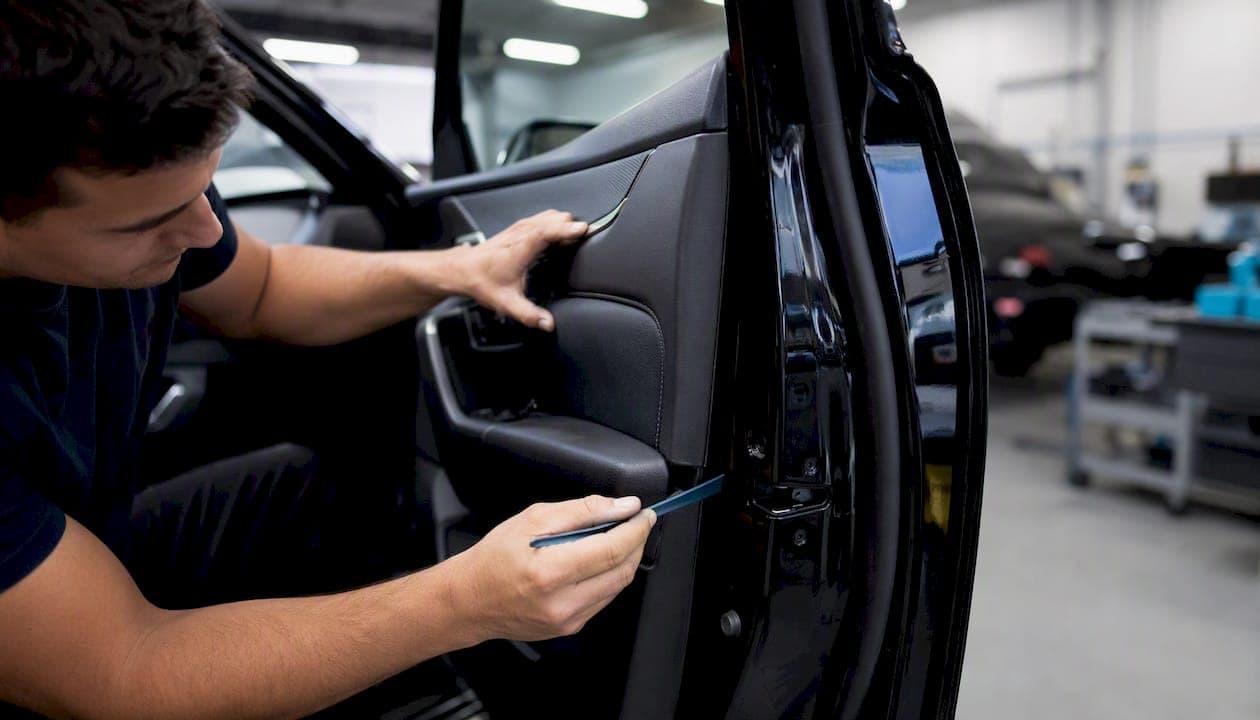
Panel access is the deciding factor in whether paintless dent repair can restore your car without touching the paint. If a technician can reach the backside of a dented panel through an OEM-approved opening, PDR preserves your factory finish and original metal geometry. Without that access, the repair either requires more invasive methods or isn't appropriate at all.
- Repair quality: Backside access gives technicians millimeter-level control to push metal precisely, avoiding paint cracking or over-correction.
- Cost and time: Simple access means faster, cheaper repairs; complex disassembly adds labor hours and parts costs.
- Safety and compliance: Drilling access holes is prohibited by I-CAR guidance and many OEM procedures, so the access route a shop chooses directly affects your car's safety systems.
Key Takeaways
Panel access is the single most important variable in whether PDR delivers a factory-quality result or falls short.
| Point | Details |
|---|---|
| Access determines PDR success | Backside or OEM-approved access gives technicians the control needed for precise metal reshaping. |
| Drilling is prohibited | I-CAR guidance and many OEM procedures ban drilling access holes; any shop that proposes it is a red flag. |
| Access complexity drives cost | Trim, lamp, or headliner removal adds legitimate labor; a flat estimate with no access notes is a warning sign. |
| Glue-pulling has limits | It reduces disassembly but cannot match rod PDR precision on complex or sharp dents. |
| Dent-boys documents every step | OEM-procedure checks, photo records, and factory-spec reassembly back every repair with a lifetime warranty. |
Table of Contents
- Why panel access matters in PDR: the quality connection
- Common access points by panel: what a technician checks first
- When access is limited: OEM rules and what shops can do instead
- What those tool names actually mean
- How access complexity changes your estimate and timeline
- What to ask before you book: a shop vetting checklist
- When PDR is the right call and when it isn't
- How Dent-boys approaches access and OEM compliance
- Dent-boys handles the hard access jobs
- Sources
Why panel access matters in PDR: the quality connection
Technicians begin PDR by gaining access to the panel's backside; when full removal isn't possible, they work through existing openings. That starting point shapes everything about the repair.
Physical backside access lets a technician place a rod or pick at the exact origin point of the dent and apply controlled, graduated pressure outward. Without it, the tool has to approach at an angle or from a distance, reducing leverage and making it harder to avoid high spots. On a simple door ding, that difference might be a few extra minutes. On a complex crease, it can be the difference between a factory-quality result and a repair that needs a body shop to finish.
Panel construction changes the equation significantly. Single-skin steel panels, common on doors and hoods, usually offer multiple built-in access routes. Double-skinned rear quarters, where an inner and outer skin are bonded or welded together, leave almost no room for a rod and often require glue-pulling or, in severe cases, conventional repair. Aluminum panels add another layer of complexity: aluminum work-hardens faster than steel, so imprecise tool placement during a limited-access repair can lock a dent in rather than release it.
- Single-skin steel: most forgiving, multiple access routes usually available
- Double-skin quarters or pillars: limited or no rod access, higher risk of needing replacement
- Aluminum panels: requires precise access; work-hardening risk increases with poor tool placement
- Foam-filled structural sections: PDR is generally not appropriate
OEM procedures and I-CAR curriculum guidance exist for a reason: a shop that skips those checks isn't just cutting corners on quality, it may be compromising your airbags.
BMW documented that drilling holes for PDR or using incorrect replacement clips can alter door pressure sensor behavior and affect airbag timing. That's not a fringe case; it's a documented OEM caution that applies across many modern vehicles with sensor-equipped door cavities.
Common access points by panel: what a technician checks first
Common access points include removable rubber grommets and drain holes in doors, wheel-liner removal for fenders, headlamp removal for front fenders, insulation removal for hoods, and interior panel removal for tailgates. A good technician works from least invasive to most.
- Doors: Window lowered first to open the top gap; then rubber grommets or drain plugs removed for rod entry; interior trim pulled only if grommets don't give enough angle.
- Front fenders: Wheel liner pulled back for lower dents; headlamp removed for upper or forward dents near the lamp housing.
- Hood: Insulation pad lifted or removed; adjuster bolts sometimes loosened to flex the panel slightly for better rod angle.
- Roof: Headliner removal required for most rod work; this is one of the more labor-intensive access jobs.
- Rear quarter panels: Often double-skinned with limited or no rod access; glue-pulling is frequently the only PDR-compatible option.
- Tailgates and trunks: Interior trim or lamp cluster removal opens access; wiring harnesses must be handled carefully.
For hail damage, the process is more systematic. Hail repair workflows map each panel individually, assess the access route and tool choice per panel, and document any stop conditions before work begins. A shop that skips this mapping step and goes straight to pulling is one to watch carefully.
Pro Tip: Ask the shop to walk you through their access plan before they start. A technician who can name the specific grommets or trim pieces they'll remove is demonstrating real familiarity with your vehicle's construction.
When access is limited: OEM rules and what shops can do instead
I-CAR guidance is explicit: do not drill access holes for PDR, and do not alter structure or remove foam insulation in ways that compromise safety systems. This isn't a recommendation, it's a safety standard.
When backside rod access isn't available, shops have two main alternatives.
| Method | Best for | Limitations |
|---|---|---|
| Glue-pulling | Panels with no rod access; shallow to medium dents | Less geometric precision than rod PDR; finish risk on thin clear coat |
| Backside rod PDR | Single-skin panels with clear access routes | Requires disassembly; not possible on double-skin or foam-filled sections |
Industry reporting confirms that glue-pulling reduces the need for disassembly but does not replace the precision of direct backside tool access for complex repairs. For a shallow hail dent on a roof, glue-pulling often works well. For a sharp crease on a door, it usually can't match rod work.
When neither method is appropriate, conventional body repair or panel replacement is the right call. That applies to:
- Dents in structural sections (pillars, rocker panels, frame rails)
- Panels with airbag or pressure sensors in the cavity where access would be needed
- Damage that has cracked or chipped the paint, removing the PDR advantage
- Areas where foam fill or bonded construction blocks all tool paths
What those tool names actually mean
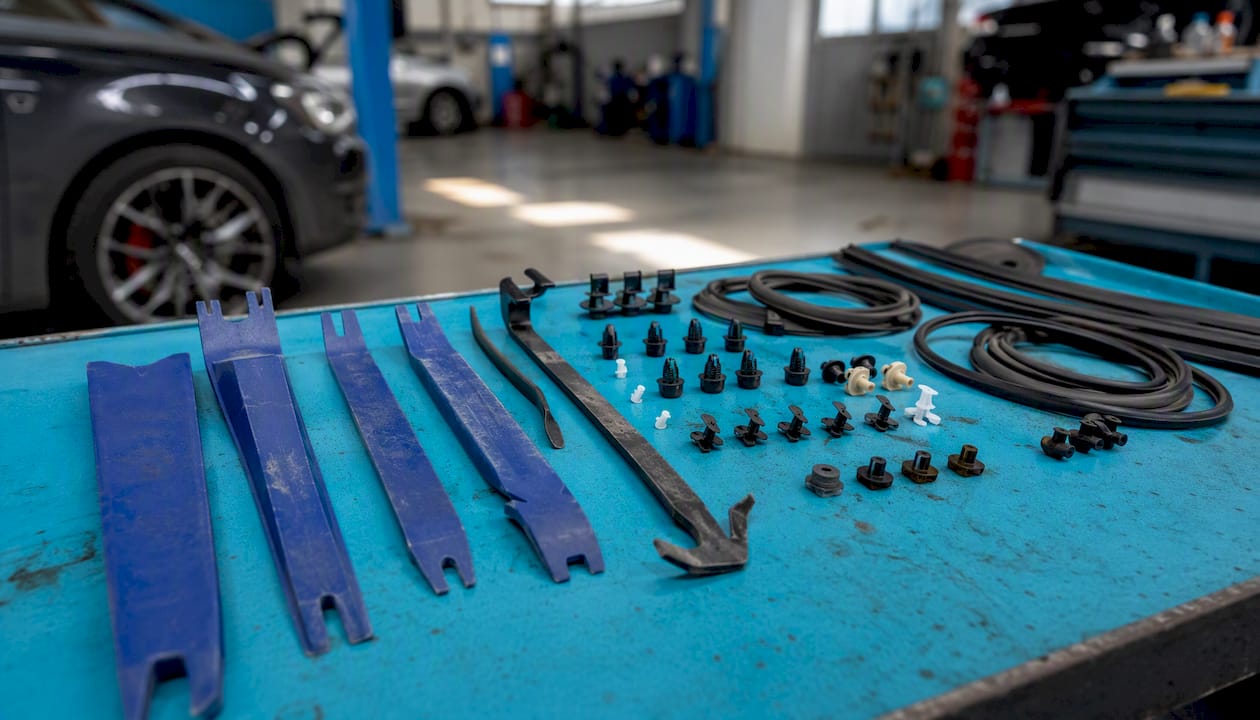
Technicians use rods, door bars, S-hooks with O-rings, Magnetic Roller Tip systems, and glue tabs to reach and work dents from behind or outside the panel. Here's what each one does.
- Rods and picks: Long, shaped steel tools inserted through access openings to push from behind. The shape of the tip and the angle of the rod determine what dents are reachable.
- Door bar: A rigid bar that braces across the door opening, giving the technician a fulcrum to apply controlled pressure with a rod tip.
- S-hook and O-ring: Hang points that let a technician suspend or position a rod inside a cavity when there's no solid surface to brace against.
- Magnetic Roller Tip (MRT) systems: A magnetic ball placed inside the panel and a corresponding external magnet the technician moves on the outside. The internal ball follows the external magnet, letting the technician locate the rod tip precisely without a direct line of sight.
- Glue tabs and bridge pullers: Adhesive tabs bonded to the dent's surface; a bridge puller applies outward tension to draw the metal back. Used when rod access isn't available.
Pro Tip: MRT systems are particularly useful on hoods and roofs where the insulation or headliner limits visibility. The technician can confirm exact tool placement before applying any pressure, which reduces the risk of over-correction.
How access complexity changes your estimate and timeline
Simple access, like a door grommet removal, adds minimal time. Complex access, like a headliner pull or lamp cluster removal, can add one to several hours of labor and may require replacement clips or seals. Skilled shops document access points, OEM torque specs for fasteners, and corrosion-control steps when panels are opened, and that documentation shows up as line items on a proper estimate.
For insurance claims, access complexity matters too. An insurer may approve PDR for a panel but then require documentation showing why a specific access method was chosen, or why a panel needed replacement instead. Shops that photograph access points and note OEM procedure references give adjusters what they need to approve the scope without back-and-forth.
When reading an estimate, look for line items labeled "trim removal," "lamp R&I" (remove and install), or "headliner R&I." Those are access-related labor charges and they're legitimate. A flat-rate estimate with no access notes on a complex panel is a sign the shop either hasn't assessed the job properly or plans to skip steps. For a realistic sense of how access work affects your overall repair timeline, factor in reassembly time equal to or greater than disassembly.
What to ask before you book: a shop vetting checklist
Questions to ask every shop before authorizing work:
- Which access points will you use for this panel, and have you checked the OEM procedure?
- Will you remove trim, grommets, or lamps, and will you replace clips and seals to OEM spec?
- Are you using rod PDR, glue-pulling, or a combination, and why?
- Do you have I-CAR training or equivalent credentials for PDR?
- What does your warranty cover, and does it include access-related reassembly?
- Will you provide photos of the access points and post-repair reflections?
Red flags to walk away from:
- Any mention of drilling a hole for tool access
- Vague estimates with no access notes or line items
- Unwillingness to check OEM procedures for your specific model
- No photo documentation offered for before, during, or after the repair
For owners of older or collector vehicles, access decisions carry additional weight because original fasteners and trim clips may not be available as replacements.
When PDR is the right call and when it isn't
PDR is the right choice when the panel has clear backside access or OEM-approved openings, the paint is intact, and the dent hasn't compromised structural metal. A specialist who can route a rod to the dent's origin point, or apply a controlled glue-pull on a panel without rod access, can restore factory geometry without touching the finish.
Decline PDR or seek conventional repair when:
- The panel is double-skinned with no rod or glue-pull path
- Airbag or pressure sensors occupy the cavity where access is needed
- The paint is cracked or chipped at the dent
- The damage is in a structural zone (pillar, rocker, frame)
- Any shop proposes drilling an access hole
The decision between PDR and panel replacement often comes down to access. A panel that looks like a PDR candidate from the outside may not be one once a technician maps the interior.
How Dent-boys approaches access and OEM compliance
At Dent-boys, proper panel access isn't a box to check. It's the foundation of every repair. The approach starts with checking OEM procedures before any trim or fastener is touched, using original-spec clips and seals on reassembly, and photographing access points as part of the standard quality record.
That commitment to process is why Dent-boys backs every repair with a lifetime warranty. It's also why the service includes pick-up and delivery, a rental vehicle during repair, and $0 deductible support for insurance claims, so access-intensive jobs don't become a logistical burden for you while the car is in the shop.
Dent-boys handles the hard access jobs
When a dent is in a panel that requires lamp removal, trim disassembly, or a careful glue-pull because rod access isn't available, Dent-boys has the trained technicians and the documented process to handle it correctly. Every job includes OEM-procedure verification, photo documentation of access points, and reassembly to factory specs.
Request a free estimate from Dent-boys and get a clear, documented access plan before any work begins. Upload photos of the damage and the team will assess which access method applies to your panel and your vehicle's OEM requirements.
Sources
- I-CAR curriculum guidance (PDR access and safety)
- Focus On: Paintless Dent Repair | Vehicle Service Pros
- Access points for paintless dent removal | Learn PDR Online
- Power-TEC PDR tool kit instructions (S-hook, O-ring, MRT and pry-bars)
- Hail Damage Repair FAQ: Inspection, Dent Counting, Tool Choice, and Shop Workflow | Super PDR