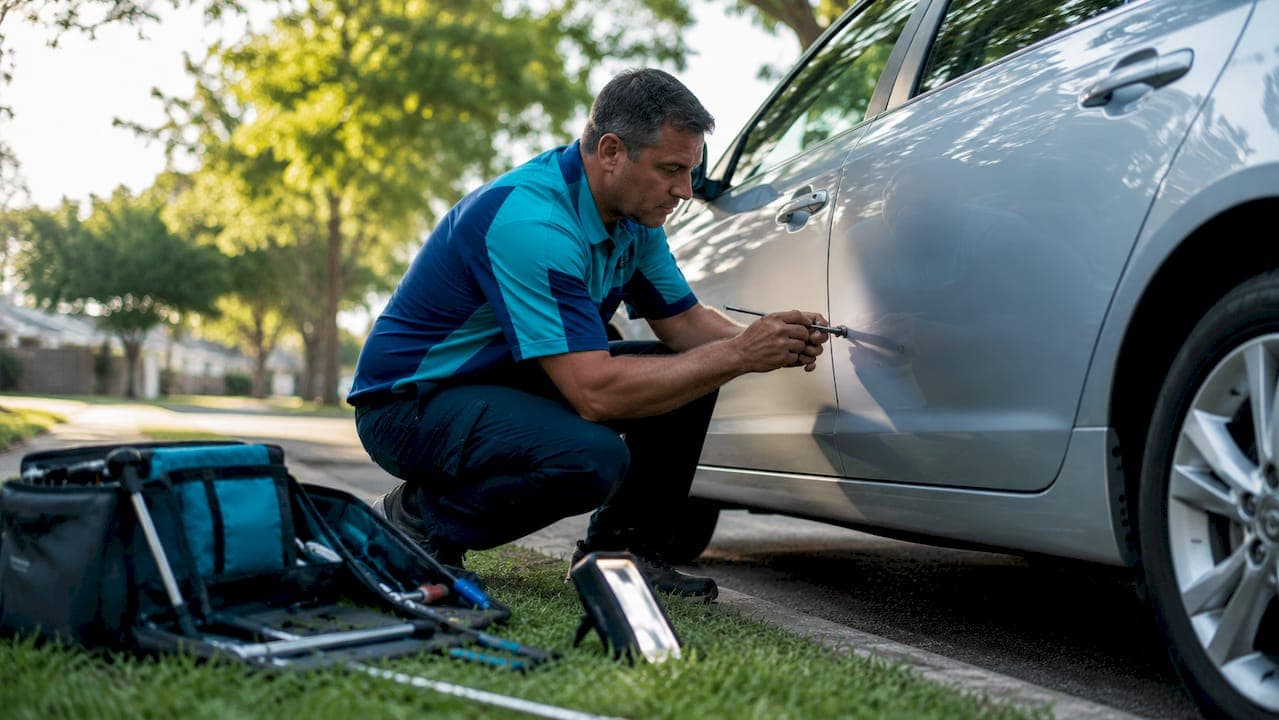
Mobile dent repair is a service that fixes minor vehicle dents on location using Paintless Dent Repair (PDR), restoring metal panels without touching the original paint. The industry term is PDR, and it is the recognized standard for this type of work. A technician comes to your home, office, or parking lot with specialized tools and massages the damaged metal back to its original shape. No fillers, no primers, no repainting. For car owners who want a fast, affordable fix without losing days to a body shop, mobile dent removal is the most practical option available in 2026.
What is mobile dent repair and how does it differ from body shop work?
Mobile dent repair is defined as on-site PDR service performed at a location chosen by the car owner, rather than at a fixed repair facility. Traditional body shop repairs involve sanding, filling, priming, and repainting the damaged panel. PDR skips all of that. No fillers or paint are used, which means the factory finish stays intact from start to finish. That distinction matters more than most car owners realize, because factory paint is thicker, more durable, and color-matched in ways that aftermarket repaints rarely replicate perfectly.
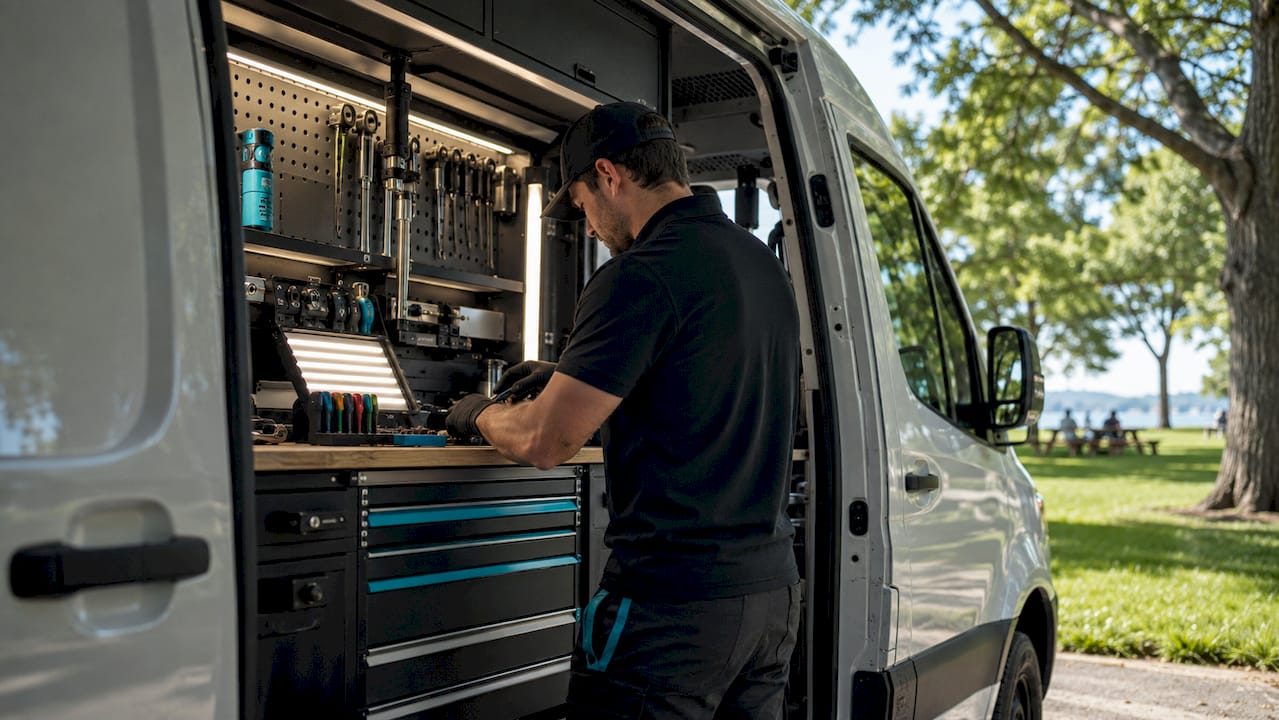
The mobility factor is the second major difference. A body shop requires you to drop off your vehicle, arrange alternate transportation, and wait days for the work to be completed. A mobile PDR technician arrives at your location with a full kit of rods, picks, and glue-pull equipment. The repair happens while you work, run errands, or simply wait nearby.
How does mobile dent repair work?
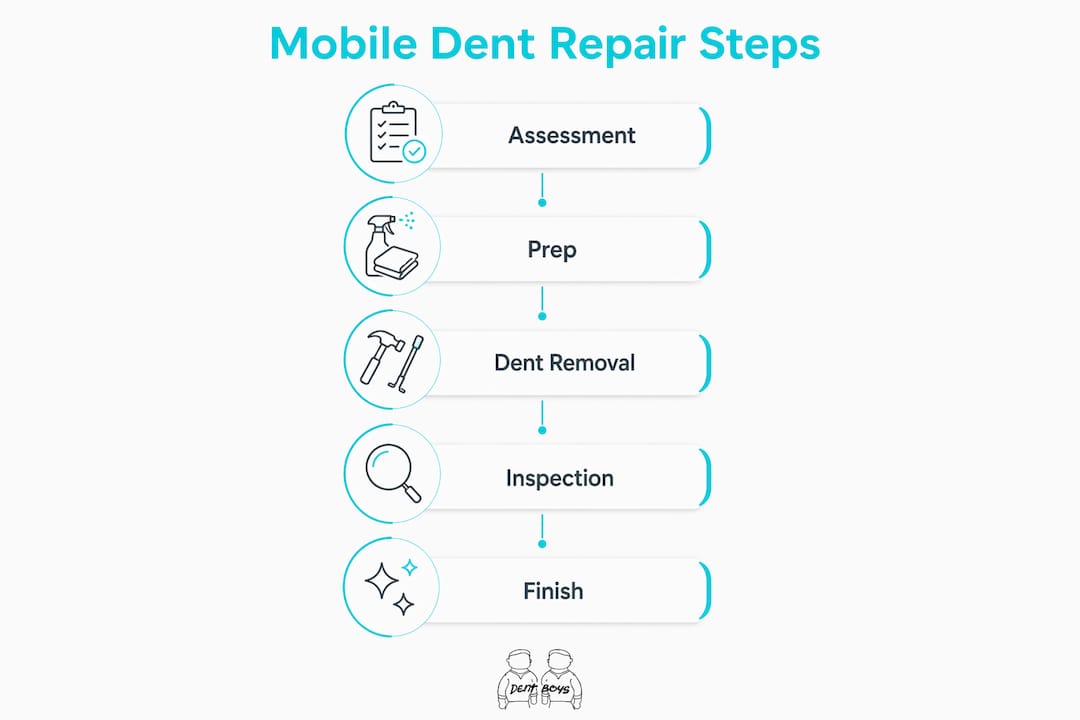
The PDR process follows a clear sequence. Understanding each step helps you know what to expect and how to evaluate whether a technician is doing the job correctly.
- Damage assessment. The technician inspects the dent under specialized lighting, often a reflector board or LED light panel, to map the exact depth and edges of the damage. This step determines whether PDR is feasible.
- Access point identification. The technician locates the best entry point behind the panel. This may require removing a trim piece, a taillight, or a door panel to reach the back of the dent.
- Pushing from behind. PDR uses two main methods: pushing the metal from behind using long metal rods, and pulling it from the front using glue tabs. Pushing works best when the back of the panel is accessible. The technician applies slow, steady pressure at precise points to lift the metal gradually.
- Glue pulling. When panel access from behind is limited, such as on a door edge or a roof panel, the technician attaches plastic glue tabs to the dent's surface and uses a slide hammer or pulling bridge to draw the metal outward.
- Finishing and blending. Once the metal is back to its original contour, the technician uses a tapping tool to knock down any high spots. The result is a smooth, paint-intact surface.
Most repairs take between one and three hours. Mobile services often return vehicles the same day, which is a stark contrast to the two to five days typical of a traditional body shop visit.
Pro Tip: Ask your technician to show you the dent under their reflector light before and after the repair. A skilled technician welcomes this. It is the clearest way to confirm the metal has been fully restored.
What are the advantages of choosing mobile dent repair?
Mobile PDR delivers benefits that traditional body shop repairs simply cannot match. The advantages stack up quickly once you compare the two approaches side by side.
- Factory paint preservation. Preserving the original factory paint is the single most important reason PDR outperforms conventional repair for minor dents. Repainting risks color mismatch, visible panel boundaries, and reduced paint durability over time.
- Faster turnaround. Most mobile repairs are completed in a single visit. You do not lose your vehicle for days.
- Lower cost. Mobile dent repair costs significantly less than panel replacement or full repaint work. You pay for the repair itself, not for shop overhead, rental equipment, or paint materials.
- Convenience. The technician comes to you. Your driveway, your office parking lot, or any accessible location works.
- Resale value protection. Experts emphasize factory paint retention as critical for maintaining vehicle aftermarket value. A car with original paint in excellent condition commands a higher price than one with repainted panels.
"Paintless dent repair preserves the original factory paint, avoiding risks of color mismatch and maintaining long-term vehicle resale value. For most non-structural dents, mobile dent repair delivers results indistinguishable from the original finish."
The resale value point deserves extra attention. When a buyer or dealer inspects a used vehicle, repainted panels are a red flag. They suggest either a collision or poor maintenance. PDR leaves no such trace because the paint was never touched. That is a genuine financial advantage, not just a cosmetic one. For more on how dent repair without painting protects your vehicle's value, the principle applies directly here.
What types of dents can mobile dent repair fix?
Not every dent qualifies for PDR. The method works best on a specific category of damage, and a good technician will tell you honestly when a dent falls outside that range.
| Dent type | PDR suitable? | Notes |
|---|---|---|
| Parking lot ding | Yes | Shallow, small, paint intact |
| Hail damage | Yes | Multiple small dents, paint usually intact |
| Low-speed impact dent | Usually | Depends on depth and edge sharpness |
| Deep crease | No | Metal is stretched; PDR cannot restore shape |
| Dent with paint damage | No | Requires filler and repaint |
| Structural panel damage | No | Requires body shop intervention |
PDR works best on shallow to medium-depth dents with smooth edges and intact paint. Hail damage is one of the most common and ideal use cases, because hailstones create dozens of small, round dents that respond well to PDR tools. Shopping cart dings and door dings fall into the same category.
Structural damage, large creases, and paint damage require traditional body shop work. A dent that has cracked, chipped, or flaked the paint cannot be fixed with PDR alone. The metal may also be stretched beyond what pushing or pulling can correct if the impact was severe enough.
Pro Tip: Run your finger along the edge of the dent. If the paint feels cracked or you can see bare metal, PDR will not be enough on its own. Get a professional assessment before committing to any repair method.
A technician's assessment is the definitive answer. Reputable mobile PDR providers offer free estimates, which removes any risk from the evaluation step. Dent-boys, for example, provides free estimates so car owners know exactly what they are dealing with before any work begins.
How much does mobile dent repair cost?
Mobile dent repair pricing varies based on damage size, location on the vehicle, and the complexity of access required. There is no single flat rate, but the cost is consistently lower than traditional body shop repairs that involve repainting or panel replacement.
Several factors drive the final price:
- Dent size. A small door ding costs less than a large dent spanning half a panel.
- Dent depth. Deeper dents require more time and more precise tool work.
- Panel location. Dents on easily accessible flat panels cost less than those near edges, body lines, or areas requiring trim removal.
- Number of dents. Hail damage with dozens of dents is typically priced as a package rather than per dent.
- Paint condition. If the paint is intact, PDR is straightforward. Any paint damage adds complexity and cost.
The best way to get an accurate cost is to request a free, on-site estimate. A reputable mobile PDR provider will assess the damage in person and give you a firm quote before starting work. Be cautious of providers who quote prices over the phone without seeing the damage. That approach often leads to price changes once the technician arrives. For a detailed breakdown of what drives dent repair cost factors, the variables above apply across most repair scenarios.
Dent-boys offers a $0 deductible option and a lifetime warranty on repairs, which changes the cost equation significantly for car owners dealing with insurance claims or recurring dent concerns.
Key Takeaways
Mobile paintless dent repair is the most cost-effective and paint-safe method for fixing minor vehicle dents, and choosing a certified technician with a warranty is the single most important decision in the process.
| Point | Details |
|---|---|
| PDR preserves factory paint | No fillers or repainting means the original finish stays intact and resale value holds. |
| Mobile service saves time | Most repairs are completed on-site in one to three hours, often the same day. |
| Not all dents qualify | Structural damage, deep creases, and paint damage require traditional body shop work. |
| Cost depends on complexity | Dent size, location, and access difficulty are the main pricing variables. |
| Certification matters | Choose a technician with professional accreditation and a written warranty. |
Why I think most car owners wait too long to fix minor dents
Most car owners treat a small dent the way they treat a slow tire leak. They notice it, feel mildly annoyed, and then do nothing for months. That delay is a mistake, and not just for cosmetic reasons.
A dent that sits untreated is a dent that is more likely to develop paint stress over time. Temperature changes cause metal to expand and contract. A dent that was perfectly repairable with PDR in week one can develop hairline paint cracks by month six. At that point, you have moved from a $150 repair into a body shop job.
Accreditation and professional certification of technicians are the clearest quality signals available to car owners. I have seen too many cases where a car owner chose the cheapest option they found online, only to end up with a repair that looked fine for a week and then showed tool marks under sunlight. A certified technician uses industry-standard equipment and follows a process that produces consistent results.
My honest recommendation: get the dent fixed within 30 days of it happening. Use a provider who offers a free estimate, shows you the damage under proper lighting, and backs the work with a written warranty. Those three conditions filter out the bad actors quickly. Dent-boys checks all three, which is why I point car owners in that direction when they ask me who to trust.
— Martin
Dent-boys: mobile dent repair at your location
Dent-boys specializes in mobile paintless dent repair for car owners who want their vehicle restored without the hassle of a body shop visit.

Every repair comes with a lifetime warranty, a $0 deductible option, and free pick-up and delivery so you never have to rearrange your schedule around a repair appointment. Certified technicians handle everything from single door dings to full hail damage repair, using PDR tools and techniques that leave your factory paint untouched. Free estimates are available, so you know the cost before any work begins. If you have a dent that needs attention, Dent-boys makes the process straightforward from the first call to the final inspection.
FAQ
What is mobile paintless dent repair?
Mobile paintless dent repair is an on-site service where a certified technician uses specialized rods and glue tabs to massage dented metal back to its original shape without repainting or using fillers. The factory paint stays intact throughout the process.
How long does a mobile dent repair take?
Most mobile dent repairs are completed in one to three hours on-site. More extensive hail damage may take longer, but same-day service is standard for the majority of repairs.
Can mobile dent repair fix hail damage?
Yes. Hail damage is one of the most common and suitable applications for PDR. Hailstones create shallow, round dents with intact paint, which respond well to both pushing and glue-pull techniques.
Is mobile dent repair as good as a body shop?
For minor, non-structural dents with intact paint, mobile PDR produces results that are indistinguishable from the original finish. Body shop repairs are necessary only when the paint is damaged or the metal is structurally compromised.
How do I know if my dent qualifies for PDR?
A dent qualifies for PDR if the paint is intact, the edges are smooth, and the damage is not structural. The most reliable way to confirm is a free, in-person assessment from a certified PDR technician.