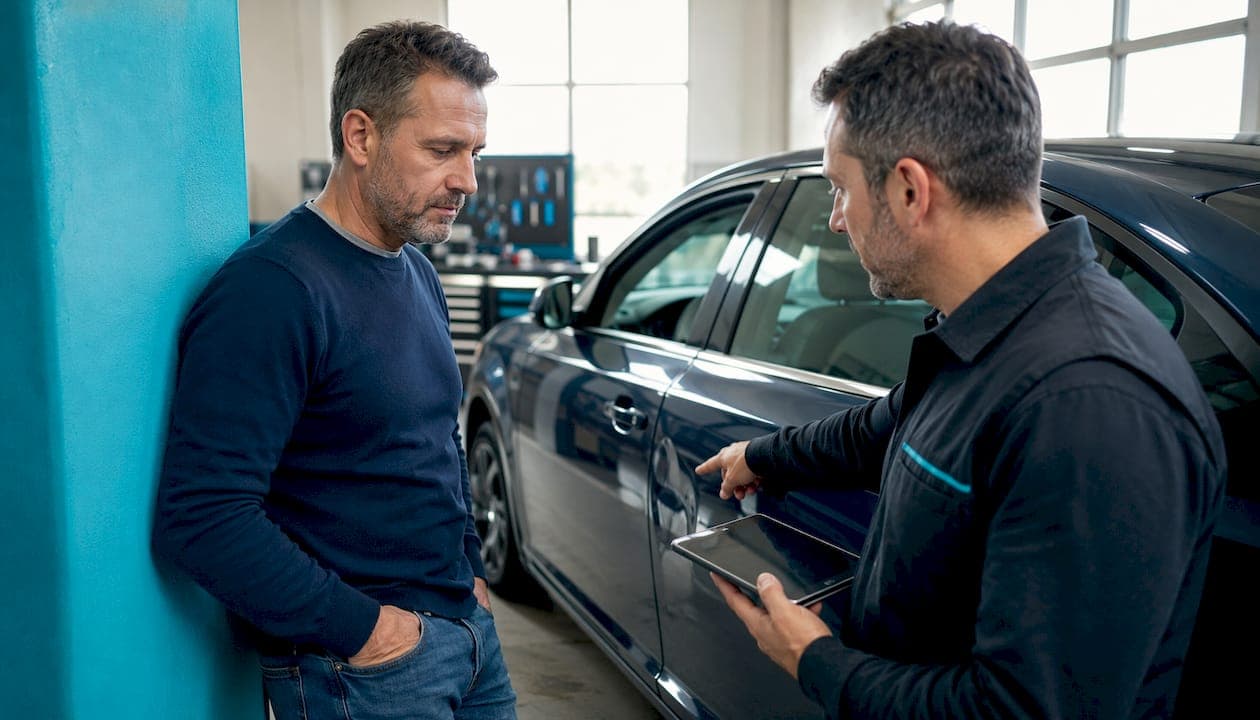
For most cost-conscious car owners, Paintless Dent Repair (PDR) and a handful of vetted DIY methods deliver the best combination of cost, speed, and finish quality. Here's the short version before the details:
Fastest affordable choices by budget:
- Free to $60: Hair dryer plus compressed air for plastic bumper dents; a basic suction cup or plunger for shallow metal dings
- $20–$100: Glue-pull or bridge puller kits for small-to-medium metal dents with intact paint
- $75–$400: Mobile PDR from a professional tech, often completed in 1–4 hours on-site
- $300–$1,500+: Full body shop repair with paint, required when paint is cracked or metal is stretched
Critical constraints up front: PDR only works when factory paint is intact. Sharp creases, torn paint, or dents near structural panels need a body shop regardless of budget.
Bottom line: Try a low-risk DIY method only for shallow, flat dents with no paint damage. For door dings, hail damage, or anything where resale value matters, call a PDR professional. Dent-boys offers free mobile estimates and a lifetime warranty, making it the recommended first call before you risk a DIY attempt on a borderline dent.
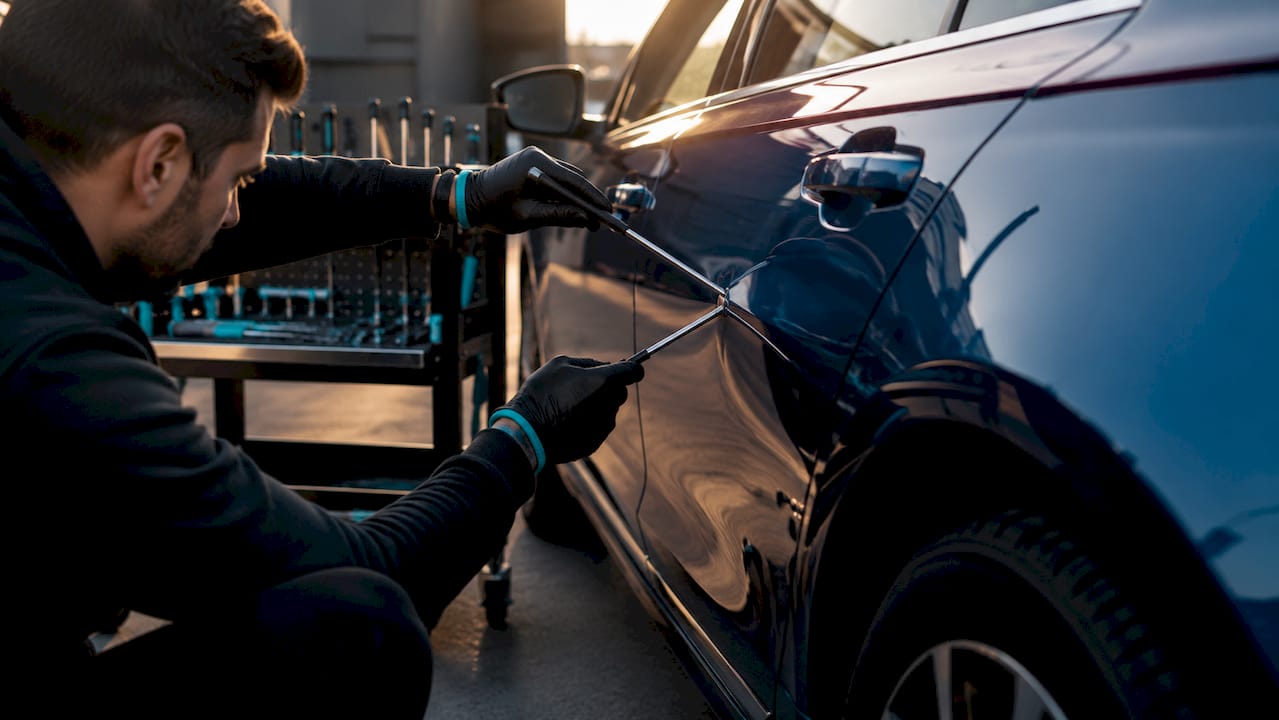
Table of Contents
- Is Paintless Dent Repair the best affordable dent fix option?
- What are the lowest-cost DIY dent repair methods that actually work?
- Which dents can't be fixed cheaply? Red flags that need a body shop
- What do dent repairs actually cost, and how long do they take?
- How do you decide between DIY and hiring a PDR professional?
- When does a cheap fix create a more expensive problem?
- Key Takeaways
- The case for PDR that most budget guides miss
- Dent-boys makes affordable PDR straightforward
- Sources and further reading
Is Paintless Dent Repair the best affordable dent fix option?
PDR is the industry's standard term for a technique where trained technicians use specialized rods and glue-pull systems to massage dented metal back to its original shape, without sanding, filling, or repainting. When paint is intact, it typically gives the best combination of low total cost, speed, and factory-original finish of any professional option.
The cost range for PDR runs roughly $50–$400 depending on dent size and location, with small door dings often landing at $60–$150. Mobile PDR technicians generally charge $75–$125 per hour, and most small repairs are done in 1–4 hours. Compare that to a full panel repaint, which can run $650–$800 or more for a single hood, and the math is obvious.
Why PDR preserves more than just money: Factory paint is worth protecting. A repainted panel never quite matches the original finish under certain lighting, and it can affect resale value on newer vehicles. PDR skips the paint booth entirely.
Where PDR falls short: It cannot fix cracked or flaking paint, heavy creases, or metal that has been stretched past its elastic limit. A dent on a body line or panel edge is also a harder case. A reputable PDR shop will tell you this upfront during a free estimate rather than attempt a repair that won't hold.
Trust signals to look for when booking a PDR tech:
- Free written estimate before any work begins
- Lifetime warranty on the repair
- Insurance handling support ($0 deductible facilitation where applicable)
- Mobile service with pick-up and delivery
Pro Tip: Ask for a before/after photo guarantee and a written warranty before you hand over the keys. Any shop that hesitates on either of those is worth skipping.
What are the lowest-cost DIY dent repair methods that actually work?
Low-cost DIY can work well for shallow dings and plastic bumper dents. On painted metal panels, the risk of making things worse is real, so start with the least invasive method and stop the moment you see paint stress.
Step-by-step DIY pathways (least invasive first)
- Clean and inspect. Wash the area thoroughly and examine the dent in raking light. Look for paint cracks, creases, or sharp edges. If you see any, skip DIY entirely.
- Heat and pop (plastic bumpers only). Use a hair dryer to heat the dent for 30–60 seconds, then hit it immediately with a short burst of compressed air. The thermal shock often pops shallow plastic dents back out. Cost: $20–$40 in materials if you don't already own a hair dryer.
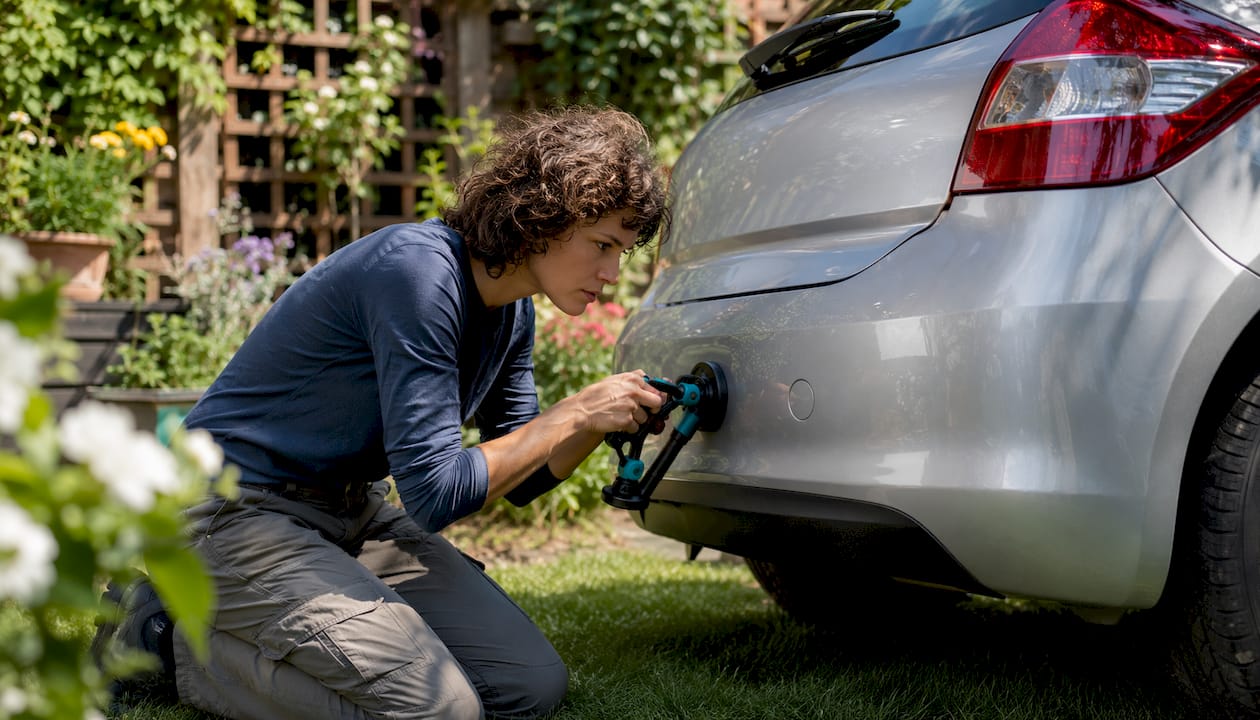
- Suction cup or plunger. For shallow, round metal dents with no crease, a rubber suction cup ($10–$30) or a clean toilet plunger can pull the metal back. Wet the surface first. This works best on large, flat panels like doors and hoods.
- Glue-pull or bridge puller kit. These kits ($35–$100) attach a plastic tab to the dent with hot glue, then use a bridge or slide-hammer mechanism to pull the metal out gradually. They work for many shallow dents but require patience. Bridge and glue-pull kits are widely available and can handle small-to-medium dents when used carefully.
- Body filler and touch-up paint (cosmetic cover only). Bondo and similar fillers start around $13. Touch-up paint kits run $49–$66. This approach hides a dent rather than fixing the metal, and it's only worth doing on a car you plan to keep long-term where appearance matters more than resale value.
When to stop and call a pro:
- Paint is cracking or flaking during the attempt
- The dent has a sharp crease or fold
- The metal feels stretched or "springy" when pressed
- You cannot access the backside of the panel
- A high spot appears after pulling (the metal is now higher than the surrounding surface)
Pro Tip: Before using a glue-pull kit, clean the surface with isopropyl alcohol and let it dry completely. Apply glue at the manufacturer's recommended temperature. Leaving glue on too long in hot weather increases the risk of clear-coat damage on modern finishes.
Which dents can't be fixed cheaply? Red flags that need a body shop
Some dents require professional metalworking and repainting — for heavily damaged vehicles, consider whether scrapping or selling is more economical as explained in affordable options for handling heavily damaged vehicles. Identifying them quickly saves you from a failed DIY attempt that turns a $150 PDR job into a $900 body shop bill.
Red flags that mean skip the cheap fix:
- Cracked or flaking paint. Once the paint breaks, PDR is off the table. The panel needs sanding, filler, and a repaint.
- Sharp creases or deep folds. Creases on body lines and sharp dents indicate the metal has been stressed beyond what rods or pullers can reverse cleanly.
- Stretched metal. If the metal feels soft or "oily" when you press around the dent, it has stretched past its elastic limit. Forcing it with a puller creates a high spot or fracture.
- Dents on panel edges or near seams. These areas have less flex and are more likely to crack during any pulling attempt.
- Dents hiding structural damage. A dent that lines up with a crumple zone or frame rail needs a structural inspection before any cosmetic work.
- Dents in areas repainted previously. Aftermarket paint behaves differently under heat and pulling; adhesion failure is common.
One insurance note: dents in these categories are more likely to qualify for a comprehensive claim, but check your deductible before filing. A repair that costs less than your deductible is almost always cheaper to pay out of pocket. Dents that affect your car's resale value are worth addressing sooner rather than later regardless of method.
What do dent repairs actually cost, and how long do they take?
DIY is cheapest upfront but can leave visible imperfections. PDR is usually the best low-cost professional option. A body shop is the most expensive and slowest route, reserved for cases where paint or structure is compromised.
| Repair Method | Typical Cost Range | Typical Timeline |
|---|---|---|
| DIY plastic bumper (heat/suction) | $0–$40 | Same day, 1–2 hours |
| DIY suction/plunger (metal) | $10–$30 | Same day, under 1 hour |
| Glue-pull or bridge puller kit | $35–$100 | Same day, 1–3 hours |
| Mobile PDR (professional) | $75–$400 | 1–4 hours on-site |
| Full body shop repair with paint | $300–$1,500+ | 2–7 days |
Two quick examples:
A door ding on a sedan with intact paint: DIY suction attempt costs $0–$30 and takes an hour. A mobile PDR tech handles the same job for $80–$150 in about an hour on your driveway. A hail-dented hood with intact paint: PDR runs $80–$100 versus $650–$800 for a full repaint of the same panel.
Insurance decision rule: If the repair estimate is at or below your deductible (commonly $500), pay out of pocket. Filing a claim for a $150 door ding can affect your record and potentially your premium. If the damage is well above your deductible, call your insurer, but ask about deductible handling options before you commit to a shop.
How do you decide between DIY and hiring a PDR professional?
Use this checklist before picking up a tool or booking a shop. Answer honestly, because the wrong call costs more in the long run.
Decision checklist:
- Is the paint cracked, chipped, or flaking anywhere on or around the dent? If yes, go straight to a body shop.
- Does the dent have a sharp crease or fold? If yes, PDR or body shop only, no DIY.
- Can you access the backside of the panel? If no, glue-pull is your only DIY option, and it may not work.
- Is the dent on a body line, edge, or near a seam? If yes, professional only.
- How long are you keeping the car? If selling within two years, protect resale value with PDR.
- Is the dent larger than a golf ball with any depth? If yes, skip DIY kits and get a mobile estimate first.
- Did a previous repair already touch this panel? If yes, DIY and PDR both carry higher risk.
- Is the repair cost likely below your insurance deductible? If yes, pay out of pocket.
| Option | Typical Cost | Finish Quality | Time | Warranty |
|---|---|---|---|---|
| DIY kits | $10–$100 | Variable | Same day | None |
| Mobile PDR | $75–$400 | Factory-original (when eligible) | 1–4 hours | Lifetime (reputable shops) |
| Body shop | $300–$1,500+ | Repainted (color match varies) | 2–7 days | Varies by shop |
Questions to ask any PDR shop before booking:
- Do you offer a free mobile estimate?
- Is there a written lifetime warranty on the repair?
- Can you handle insurance billing and $0 deductible facilitation?
- Will you provide before/after photos?
A shop that offers all four is worth trusting. Dent-boys checks every one of those boxes, including contactless mobile service and a rental vehicle during repair.
When does a cheap fix create a more expensive problem?
DIY can be cheaper upfront. It can also turn a $120 PDR job into a $700 body shop repair if something goes wrong. Here's where the math flips.
The most common DIY failure is the high spot: you pull a dent out slightly too far, and now the metal sits higher than the surrounding panel. High spots from over-pulling are harder to fix than the original dent because they require professional knockdown tools and measured tap-downs to level without cracking the paint. A body shop charges for that work on top of the original repair.
Glue-pull mistakes are the second most common issue. Applying glue at the wrong temperature, or leaving tabs on too long in summer heat, can lift the clear coat. That damage is cosmetic but permanent without a repaint.
The cost comparison that matters: A door ding handled by a mobile PDR tech costs roughly $80–$150 and takes an hour. A failed DIY attempt on the same dent, followed by a body shop visit to fix the high spot and repaint the panel, can run $500–$900. The professional PDR tools that prevent those outcomes take years to master.
Pro Tip: Before any DIY attempt on a metal panel, take diagnostic photos in raking light from multiple angles. If the repair goes wrong, those photos help a PDR tech or body shop understand what they're working with and quote accurately.
Key Takeaways
PDR is the most cost-effective professional option for dents with intact paint, typically costing $75–$400 versus $300–$1,500+ at a body shop.
| Point | Details |
|---|---|
| PDR beats repainting on cost | A hail-dented hood costs $80–$100 with PDR versus $650–$800 for a full repaint. |
| DIY works only for shallow dents | Suction and glue-pull kits ($10–$100) suit flat, paint-intact dents; stop if paint cracks or a high spot appears. |
| Cracked paint means body shop | Sharp creases, flaking paint, and stretched metal cannot be fixed cheaply — attempting it raises total cost. |
| Insurance math matters | If repair cost is at or below your deductible, pay out of pocket to protect your record. |
| Dent-boys for professional PDR | Dent-boys offers free estimates, lifetime warranty, $0 deductible support, and mobile service for budget-conscious owners. |
The case for PDR that most budget guides miss
Most budget-repair guides treat DIY as the default and professional PDR as the expensive fallback. That framing is backwards for most real-world dents.
The honest truth is that a $90 mobile PDR visit is often cheaper than a $60 kit that gets used wrong. Factory paint is genuinely hard to replace, and the resale math on a car with a repainted panel is worse than most owners realize. A buyer or dealer can spot a repainted panel in seconds with a paint-thickness gauge, and it raises questions about what else might have been damaged.
For clearly shallow, round dents on flat panels with zero paint damage, a suction cup or basic glue-pull kit is a reasonable first attempt. But for anything with depth, a crease, or proximity to a body line, the risk-adjusted cost of going straight to a PDR professional is almost always lower. That's not a sales pitch for any particular shop. It's just arithmetic.
For collector cars or vehicles where originality matters, the calculus is even clearer. Preserving factory paint is worth more than the cost of a professional repair, and classic car dent repair has its own set of considerations that DIY kits simply aren't built for.
Dent-boys makes affordable PDR straightforward
If you've worked through the checklist above and your dent has intact paint, Dent-boys is the kind of professional option this article is built around. The service covers paintless dent repair and hail damage restoration without painting or fillers, which keeps costs down and turnaround fast.
What makes Dent-boys a practical choice for budget-conscious owners: free estimates before any commitment, mobile pick-up and delivery so you're not without a car, a rental vehicle during repair, $0 deductible facilitation through insurance, and a lifetime warranty on every repair. There's no pressure to file a claim or spend more than the job requires.
For door dings, hail damage, or any dent where you want a factory-original result without a body shop bill, get a free estimate from Dent-boys and see what the repair actually costs before you decide anything.
Sources and further reading
The cost ranges, technique guidance, and expert cautions in this article draw from the following sources. Worth bookmarking if you want to dig deeper before making a repair decision.
- How To Fix Car Dents: Options and Costs To Consider — Synchrony: PDR pricing, mobile tech rates, and timeline anchors
- How To Fix Dents Yourself So You Can Avoid An Expensive Repair Bill — Jalopnik: DIY kit pricing, technique cautions, and expert perspective on DIY limits
- Paintless Dent Removal: Does It Work? — AutoZone: PDR vs. repaint cost comparison
- What Are My Car Dent Repair Options? — Insure On The Spot: red flags for non-PDR dents and insurance decision guidance
- Top Tools to Fix Your Car's Dents, Dings, and Bangs at Home — Car and Driver: glue-pull technique, clear-coat risks, and professional tool context
- Dent-boys free estimates and PDR services — for readers ready to get a professional quote
This article is general information, not professional repair or legal advice. Repair costs vary by location, vehicle, and dent severity. Confirm current pricing and insurance terms with your provider or a qualified technician before making a decision.