A single hail claim usually will not hit your wallet the way an at-fault accident does, but it is not free either. Comprehensive claims (which cover hail) are rated differently than collision claims where you caused the crash, and industry estimates put a single comprehensive claim's premium bump at a fraction of what an at-fault accident triggers, sometimes in the low single digits versus roughly 45% for an at-fault claim. The real risk is not the one claim, it is what happens around it.
Three things can still cost you:
- Lost claims-free discounts, which some insurers strip out after any claim, hail included.
- Claims frequency, since a second or third comprehensive claim inside a rolling three-to-five-year window makes underwriters nervous.
- Regional base-rate shifts, where insurers raise premiums across an entire zip code after a bad hail season, whether or not you personally filed anything.
State rules matter too. Texas and a handful of other states restrict how insurers can penalize not-at-fault weather claims, though Progressive's own guidance notes insurers still differ widely in how they handle repeat claims.
Key Takeaways
A hail claim rarely triggers a large surcharge on its own, but lost discounts, repeat claims, and regional rate hikes can still raise what you pay.
| Point | Details |
|---|---|
| Comprehensive claims are gentler | Hail claims typically cost far less in premium impact than an at-fault accident. |
| Deductible math decides it | File only when the estimate clears your deductible plus a few hundred dollars of buffer. |
| Frequency is the real risk | A second or third comprehensive claim in a few years is what triggers surcharges or nonrenewal. |
| Documentation drives outcomes | Photos, estimates, and receipts strengthen both claims and future coverage reviews. |
| PDR limits the damage two ways | Dent-boys' paintless dent repair avoids salvage-title risk and often beats replacement costs. |
Table of Contents
- Does Filing a Hail Claim Raise Rates With Every Insurer?
- Should You File This Particular Hail Claim?
- How Do You Limit the Premium Hit From Hail Damage?
- What Do You Do If Your Rate Goes Up or You Get Nonrenewed?
- How Dent-boys Helps You Handle a Hail Claim
- Sources
Does Filing a Hail Claim Raise Rates With Every Insurer?
Not in a predictable way, which is the frustrating part. Comprehensive coverage exists specifically for events you didn't cause, hail, falling branches, theft, so insurers generally treat it with more leniency than an at-fault collision. But "more leniency" does not mean "no consequence."
Every claim you file gets logged into your claims history, and that history follows you for years, even across carriers through shared industry databases. State Farm is explicit that whether a claim moves your premium depends on claim type, state rules, and each insurer's own rating formula. That is a lot of moving parts for one dent.
Here's the pattern that actually costs people money: it's rarely claim one. It's claim two or three. Most carriers have internal thresholds, unpublished, but real, where a second comprehensive claim in a short window starts looking like a pattern rather than bad luck. That is when surcharges, non-renewal reviews, or a dropped discount become likely.
Hail now accounts for a large share of insured losses from severe convective storms, and insurers have responded by raising rates, trimming coverage, and pushing deductibles higher across affected regions, according to NPR's coverage of Midwest storm losses.
The deductible math backs this up in a very concrete way. Insurify's research found average wind-and-hail deductibles running quite high in some states, including Texas, a sign that insurers are pushing more of the storm-loss burden onto policyholders rather than absorbing it through claims payouts. If your deductible is relatively high, a single hail claim may barely register with underwriting math at all, because your out-of-pocket share is already doing the work a surcharge would otherwise do.
Some states go further and legally limit how insurers can use not-at-fault weather claims in rating decisions. If you live somewhere with strong consumer protections on comprehensive claims, ask your agent directly whether hail claims count against you at renewal. The answer varies by carrier even within the same state, according to LegalClarity's breakdown of hail claim rules.
Should You File This Particular Hail Claim?
Run the numbers before you call your agent. This is not complicated math, but skipping it is how people lose money on a "free" insurance claim.
- Get a repair estimate first. A body shop or PDR technician quote tells you the real number you are working with, not a guess.
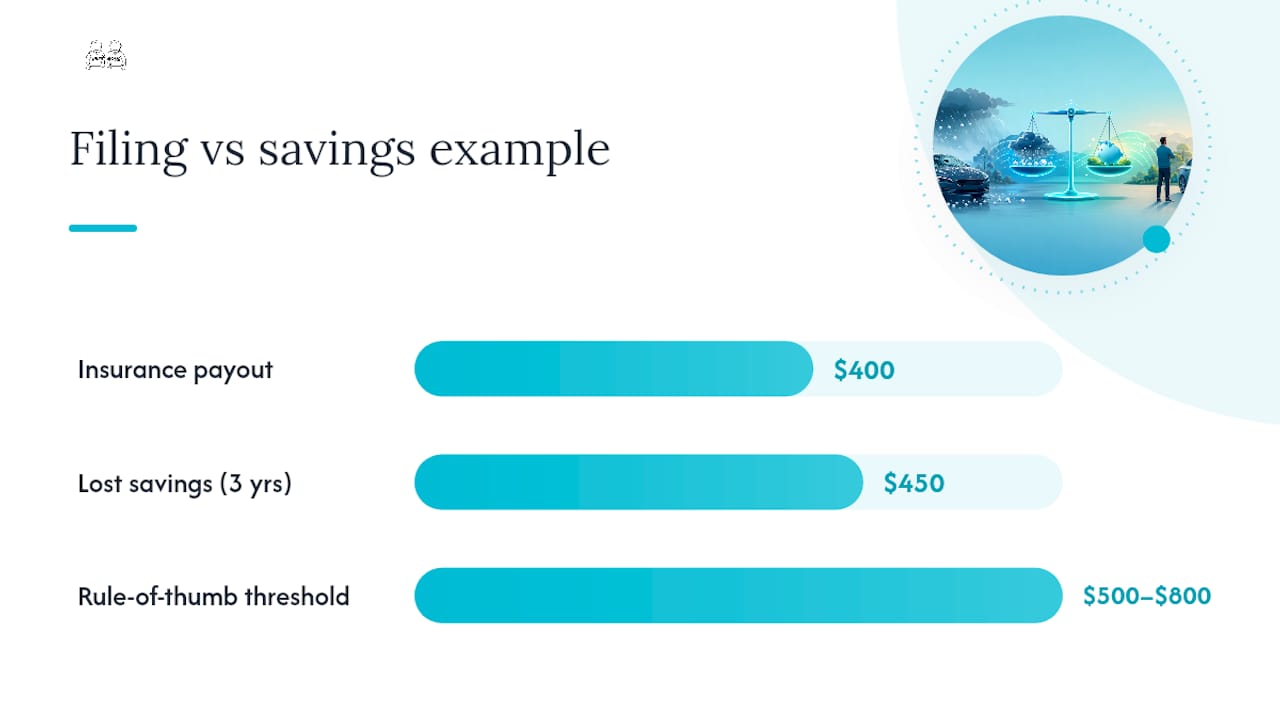
- Add a buffer to your deductible. A common rule of thumb: don't file unless the estimate clears your deductible by $500 to $800, since a razor-thin payout rarely justifies the claims-history hit.
- Check your claims history for the past three to five years. One prior claim changes the math; two changes it a lot.
- Confirm your state's rules on comprehensive claim surcharges. A quick call to your agent or your state insurance department settles this fast.
- Ask your agent point-blank if this claim is "chargeable" for rating purposes. Some will tell you straight; get it in writing if you can.
Here's a real-world version of the math. Say your estimate comes back at $1,400 and your deductible is $1,000. Insurance pays $400. But if filing costs you a claims-free discount worth $150 a year for three years, that's $450 in lost savings against a $400 payout. You lost money by filing.
Pro Tip: When your repair estimate lands only marginally above your deductible, paying cash almost always beats filing. Do the three-year discount math before you touch the claim line.
How Do You Limit the Premium Hit From Hail Damage?
A few actions genuinely move the needle on premium impact:
- Document everything before you call your insurer: dated photos, a written estimate, and a repair receipt once the work is done.
- Get an independent PDR estimate first, before you decide whether filing is even worth it.
- Choose repair over replacement when the damage allows it. PDR typically costs less than panel replacement, which matters if you're paying out of pocket.
- Leave nothing unrepaired. Insurers can restrict future coverage on a vehicle with known, unaddressed hail damage, according to TD Insurance's guidance on hail coverage.
Dent-boys built its service around exactly this calculation. Free estimates mean you know your number before deciding whether a claim makes sense at all, and $0-deductible support through insurance billing means the math often works in your favor when a claim is genuinely worth filing. A rental vehicle during the repair and pick-up/delivery service take the logistics off your plate, and the lifetime warranty means the fix stays fixed.
Pro Tip: Get the independent PDR quote before you pick up the phone with your insurer, not after. It's the single number that makes the rest of this decision easy.
| Point | Details |
|---|---|
| PDR preserves value | Paintless repair keeps factory paint intact, avoiding the resale hit of a repaint. |
| Documentation protects you | Photos, dated estimates, and receipts support both claims and future underwriting reviews. |
| Small claims rarely pay off | A payout close to your deductible can cost more in lost discounts than it delivers. |
What Do You Do If Your Rate Goes Up or You Get Nonrenewed?
Don't just accept the renewal notice. Ask your insurer in writing for the specific rating reason code behind the increase, and if it looks off, file a complaint with your state insurance department. That paper trail matters if you decide to escalate.
Shopping around works, and it works better with paperwork in hand. Compare at least three quotes, and consider running them through a broker every two to three years since baseline pricing shifts fast after a bad storm season. Your repair receipts and PDR estimates aren't just for the original claim, they help you negotiate with a new carrier by showing the damage was handled professionally and permanently.
Nonrenewal is the harsher outcome, and it tends to follow multiple claims or steep regional losses rather than one hail event. If it happens, look at specialty or non-standard markets, or accept a higher deductible in exchange for keeping coverage.
Pro Tip: Keep every storm-related document, photos, estimates, receipts, in one folder. It cuts quote time in half when you're shopping four carriers at once.
What Dent-boys Sees on the Ground
We see the same pattern on nearly every hail season repair we handle: drivers overthink small claims and underthink unrepaired damage. Our rule of thumb is simple. File when the repair estimate clearly exceeds your deductible plus a real buffer, or when the damage is severe enough to risk a salvage title. Otherwise, get the PDR quote and decide from there.
How Dent-boys Helps You Handle a Hail Claim
Dent-boys is built for exactly the moment this article walks you through: the point where you need a real number before deciding whether a claim is worth filing. We offer paintless dent repair that preserves your factory finish, free estimates so you're never guessing, and $0-deductible support where we work directly with your insurer's billing. You get a rental vehicle while your car is in the shop, pick-up and delivery so you never have to rearrange your day, and a lifetime warranty on every repair we complete.
That combination matters most for hail damage specifically, since PDR keeps a hail-hit vehicle from sliding toward salvage-title territory and often costs less than panel replacement, which changes your entire cost-benefit math from the checklist above. If you're staring at hail dents right now, get a free estimate from Dent-boys before you call your insurance company. It's the one number that makes the rest of the decision easy.
Sources
- Does car insurance cover hail damage? — Progressive
- Hailstorms: the next insurance crisis? — Insurify
- Insurance, tornadoes and hail in the Midwest — NPR
- Will my insurance increase after a claim? — State Farm
- Will claiming hail damage increase my car insurance rates? — LegalClarity
For rules specific to your policy, contact your state insurance department directly. Rating practices around comprehensive claims vary enough between insurers and states that a quick phone call beats guessing.
This article is general information, not a substitute for advice from a qualified financial advisor. Consult a qualified financial professional about your own circumstances before acting on anything here.