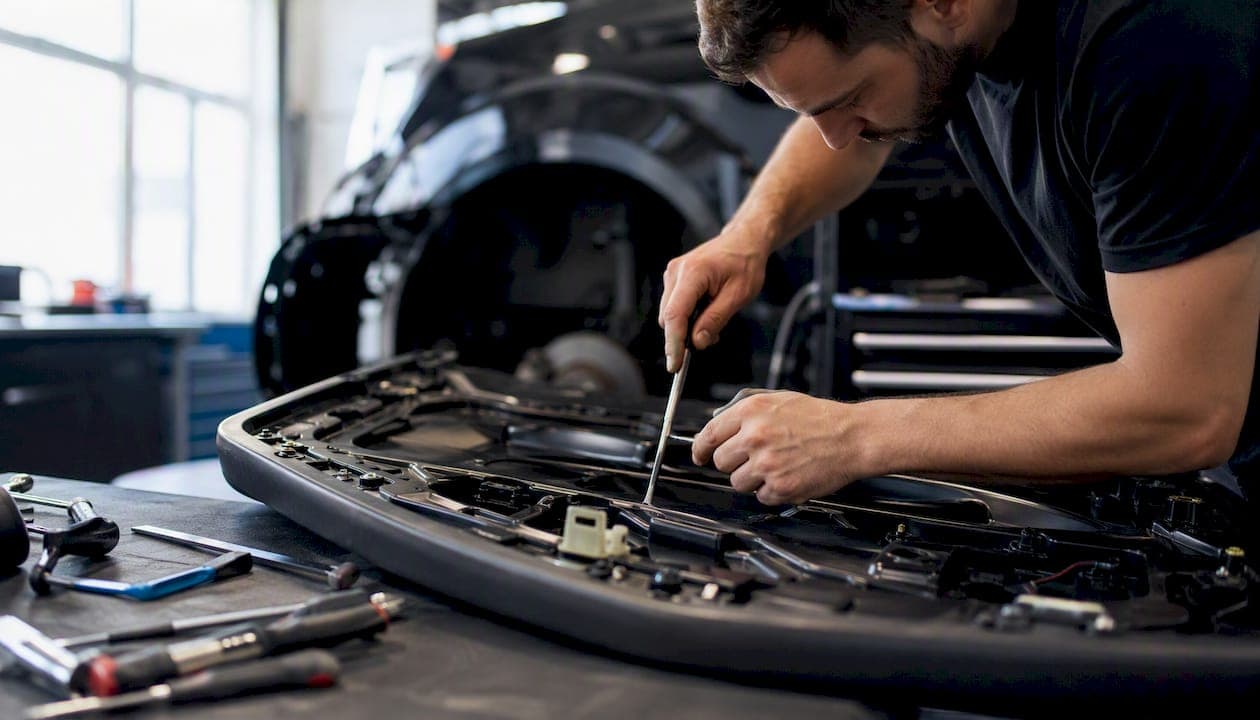
Paintless dent repair (PDR) is the repair method that restores dents and hail damage without repainting, as long as the factory paint is still intact. Before calling a body shop, run through this quick check: paint feels smooth with no cracks or chips, the dent is rounded rather than sharply creased, the panel can be accessed from behind or on a flat surface for glue-pull, and hail dents are shallow and clustered. When all four conditions are met, PDR typically costs $75–$600 depending on dent count, and most jobs finish the same day or within 1–2 days. Comprehensive or hail coverage through your insurer often applies.
- Paint intact (no cracks, chips, or exposed metal)
- Dent is rounded, not sharply creased
- Panel accessible from behind or flat enough for glue-pull
- Hail dents are shallow and spread across the panel
Key Takeaways
PDR is the right repair when factory paint is intact and the dent is rounded — it preserves finish, cuts cost, and typically finishes in hours rather than days.
| Point | Details |
|---|---|
| PDR eligibility check | Paint intact, dent rounded, panel accessible — all three must be true for PDR to work. |
| Cost vs. repaint | PDR runs $75–$600; traditional repaint-based repair starts around $300 and can exceed $1,500. |
| Insurance tip | Comprehensive coverage applies to hail; compare your deductible to the estimate before filing a claim. |
| Provider questions | Ask about aluminum experience, warranty length, before/after photos, and insurer coordination. |
| Dent-boys recommendation | Free estimates, lifetime warranty, $0 deductible support, and pickup/delivery make Dent-boys a practical first call. |
Table of Contents
- What is paintless dent repair and how does it work?
- What PDR methods do technicians actually use?
- When does PDR work — and when does it not?
- Why do insurers and technicians often prefer PDR for hail damage?
- Costs, time, and insurance: what to expect in the U.S.
- How to choose a PDR provider: questions to ask and red flags to avoid
- What happens during a PDR repair?
- Real outcomes: what PDR typically delivers
- Quick verdict: PDR or repaint?
- Why PDR is usually the smarter call for everyday dents
- Dent-boys: PDR with a lifetime warranty and $0 deductible support
- Sources
What is paintless dent repair and how does it work?
PDR reshapes metal from behind the panel so the original paint never gets touched. A technician gains access through door jambs, trunk openings, or wheel wells, then uses specialized rods to gently massage the metal back into its factory position. No sanding, no filler, no color-matching guesswork.
The process breaks into three broad steps: rod work from behind the panel, glue-pull tabs for areas where back access is limited, and a tap-down pass to correct any tiny high spots left by the pulling process. PDR eliminates sanding, fillers, and repainting, which cuts both materials cost and labor time compared to conventional auto-body work. It also skips the paint products and solvents that conventional refinishing requires, making it a lower-waste option.
Key benefits at a glance:
- Factory finish preserved — no color-match risk, no visible repaint line
- Faster turnaround — small jobs often done in hours
- Lower cost — no materials markup for paint, primer, or filler
- Better resale value — factory paint retained outperforms a repaint on a used-car inspection
Pro Tip: Avoid DIY dent-pulling kits from a hardware store. Basic suction tools can leave oil-canning distortions or stress the clearcoat. A trained PDR technician reads the metal as they work and adjusts pressure continuously — something a $30 kit cannot replicate.
What PDR methods do technicians actually use?
Two core approaches cover most dent scenarios. The first is push-from-behind with rods: the tech selects a rod shape matched to the dent's depth and curve, inserts it through an access point, and works the metal outward in small, controlled movements. The second is glue-pull with tabs: a plastic or metal tab is bonded to the dent's center with hot glue, then a slide hammer or puller draws the metal forward. After pulling, a tap-down tool corrects any small high points that remain.
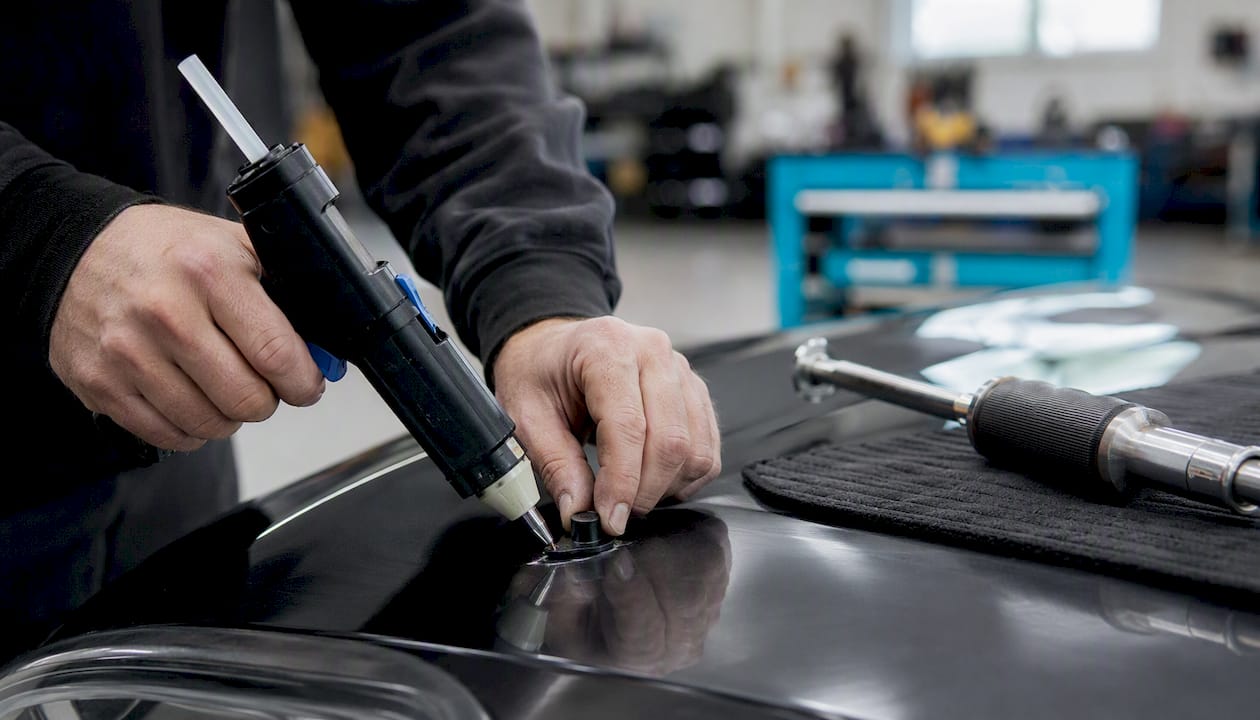
Glue-pull tabs are the practical complement to rods — used on flatter panels where getting a rod behind the metal is not possible. Technicians switch between methods based on dent shape, not preference.
What to look for when watching a tech work:
- Multiple rod shapes selected for a single dent (sign of skill, not confusion)
- Glue tabs sized to match the dent's diameter
- A light board or LED lamp used to read the panel surface
- Finishing tap tools with polished tips to avoid paint contact
Pro Tip: Ask to see the technician's light board setup before work begins. A quality PDR tech uses a reflection board to spot every micro-high-point. A shop that skips this step is likely to miss them too.
When does PDR work — and when does it not?
PDR works when the paint is unbroken, the metal is not sharply creased, and the dent is reachable from behind or flat enough for glue-pull. That covers a wide range of everyday damage: parking-lot door dings, shopping-cart strikes, and hail.
Decision checklist:
- Run your fingernail across the dent — if the paint feels smooth, PDR is likely viable.
- Look at the dent's shape — rounded and bowl-like qualifies; a sharp fold or crease does not.
- Check the panel location — center of a door or hood is accessible; damage at a seam or body edge is harder.
- Note the metal type — aluminum panels are stiffer and require more advanced technique and an experienced technician.
When PDR is not the right call:
- Paint is cracked, chipped, or showing bare metal
- The dent has a sharp crease where metal has stretched beyond elastic recovery
- Damage sits at a panel seam, body edge, or structural area
- Scraped or gouged surface that needs filler for a smooth finish
Creased dents and edge damage generally require body filler and repainting for a durable result. Pushing a creased panel with PDR rods risks tearing the paint from the inside. When in doubt, get a written assessment from a PDR tech before committing to either path. For cases where a panel is too far gone, see this guide on dent repair vs. panel replacement to understand your options.
Why do insurers and technicians often prefer PDR for hail damage?
Hail leaves clusters of small, shallow dents across hoods, roofs, and trunk lids — exactly the damage profile PDR handles best. When paint is intact across all those dents, a skilled tech can work through an entire panel without a single drop of paint or filler. That speed and low material cost is why insurers often prefer PDR for large hail claims — it settles the claim faster and at lower cost than a full respray.
For mass-hail events, shops deploy mobile teams to handle volume, pricing jobs by dent count and size rather than a flat rate.
Insurance callout:
- Comprehensive coverage typically applies to hail and other non-collision perils
- Compare your deductible to the repair estimate before filing — if the estimate is $200 and your deductible is $500, paying out of pocket protects your premium
- Some insurers will steer you toward PDR specifically for hail; ask your adjuster directly
A typical hail job involving dozens of dents across a hood and roof often takes a day or two from estimate to pickup, compared to a week or more for a full respray.
Costs, time, and insurance: what to expect in the U.S.
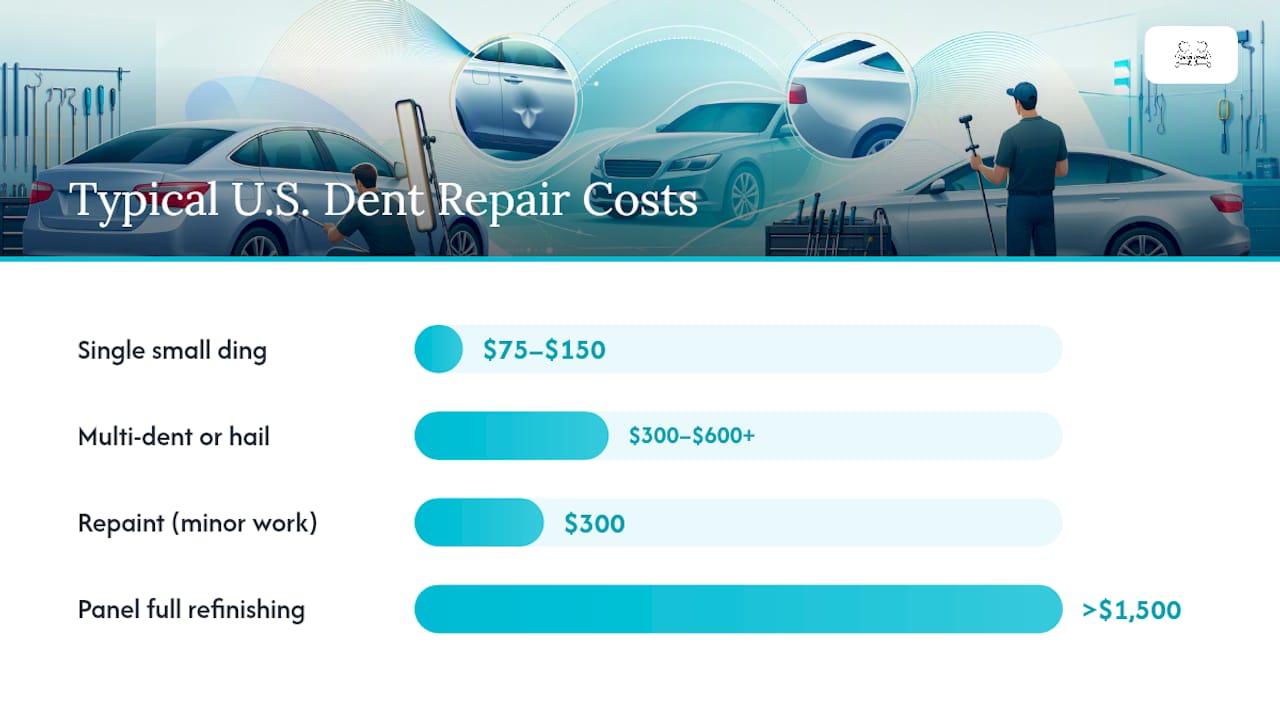
A single small ding commonly runs $75–$150. Larger multi-dent or hail jobs land in the $300–$600+ range. Traditional repaint-based repair starts around $300 for minor work and can exceed $1,500 for panels that need full refinishing. PDR's cost advantage comes from skipping paint, primer, and the labor hours those materials require.
What shifts the price:
- Number and size of dents
- Panel accessibility (roof vs. door edge)
- Steel vs. aluminum (aluminum takes longer)
- Mobile service vs. in-shop (mobile sometimes carries a travel fee)
- Regional labor rates
For insurance jobs, comprehensive or hail coverage applies — not collision. Before filing, weigh the estimate against your deductible and consider whether a claim affects your rate. Get at least two estimates, including a free inspection, before deciding. For a broader look at affordable dent fix options, comparing PDR quotes with body-shop quotes side by side is the clearest way to decide.
How to choose a PDR provider: questions to ask and red flags to avoid
Choose a provider with verifiable PDR experience, documented before/after photos, a written warranty, and the ability to coordinate with your insurer. That combination filters out most of the bad outcomes.
Questions to ask before booking:
- Do you have experience with aluminum panels?
- What does your warranty cover, and how long does it last?
- Do you offer mobile service, pickup, and delivery?
- Are estimates free and in writing?
- Can you coordinate directly with my insurance company?
- Can I see before/after photos from similar jobs?
- Where did your technicians train?
Red flags:
- Recommends repainting without explaining why PDR won't work
- No before/after photos or only stock images
- No written warranty or vague verbal promises
- Cash-only with no paperwork
- Cannot show tools or explain their process
Warranty callout: A lifetime warranty on PDR work is the clearest trust signal in this industry. It means the shop stands behind the repair permanently — not just for 90 days. Pair that with insurance coordination and you have a provider worth trusting.
Pro Tip: Ask specifically: "Will you handle the supplement process with my insurer if additional damage is found during repair?" A shop that says yes has done this before. One that looks confused probably hasn't.
What happens during a PDR repair?
Most small PDR jobs finish in a few hours. Larger hail jobs run 1–3 days. Here is the typical sequence:
- Free estimate and inspection — tech examines paint condition, dent count, and access points
- Access panels located — door jambs, trunk, or wheel-well liners removed as needed
- PDR performed — rods and/or glue-pull tabs used, working from the dent's edge toward center
- Tap-down pass — finishing tools correct any remaining high spots
- Final polish and inspection — panel wiped down, light board used for a final surface check
- Warranty paperwork — written warranty issued before you drive away
For larger jobs, mobile service brings the tech to your driveway. In-shop service suits jobs needing full panel access or multiple vehicles. Pickup and delivery, plus a rental vehicle for multi-day repairs, are options worth asking about — they make a 2-day hail job far less disruptive. After the repair, preserving your car's exterior long term starts with keeping the repaired area clean and waxed.
Real outcomes: what PDR typically delivers
When PDR is the right fit, panels return to near-invisible condition. A door ding from a parking lot — the kind that catches light at every angle — is often gone in under two hours, with no trace visible under a light board. A hail job covering a hood and roof with 50+ shallow dents typically takes 1–2 days and leaves the factory paint exactly as it was.
Trust signals worth verifying before you commit:
- Before/after photos from actual customer vehicles (not stock)
- Customer testimonials with specific job details
- Free written estimate with dent count and method noted
- Lifetime warranty in writing
Dent-boys documents before/after results for every job, giving customers a visual record of the repair alongside their warranty paperwork.
Quick verdict: PDR or repaint?
- Choose PDR when paint is intact, the dent is rounded, and the panel is accessible
- Choose traditional repaint when paint is cracked, metal is creased, or damage reaches a seam or body edge
Get a free PDR estimate first. If the tech says PDR won't work, ask for the specific reason in writing, then get a body-shop repaint quote to compare.
Why PDR is usually the smarter call for everyday dents
Factory paint is one of the most underrated assets on a used car. Dealers and private buyers both run paint-thickness gauges during inspections — a repainted panel registers thicker and flags immediately as prior damage. PDR sidesteps that entirely. The repair is invisible to a gauge because the original paint never moved.
The cost and time arguments for PDR are real, but the resale argument is the one most car owners miss until they're at the trade-in counter. A car with its full factory finish intact is worth more than the same car with two repainted panels, even if the repaint was done well. For everyday dents where the paint is still good, PDR is not just the cheaper option. It's the one that protects the car's value over the long run.
Dent-boys: PDR with a lifetime warranty and $0 deductible support
Dent-boys delivers PDR with free estimates, mobile and in-shop service, pickup and delivery, and a lifetime warranty on every repair. For hail damage specifically, the team coordinates directly with your insurer and supports $0 deductible options when available — so the paperwork doesn't land on you.

Every job includes before/after documentation and a written warranty you keep. For multi-day repairs, a rental vehicle is available so you're not without transportation. The process is straightforward: request a free estimate, get a written dent assessment, and let Dent-boys handle the insurer communication from there.
Get your free PDR estimate and find out whether your dent qualifies — most inspections take under 30 minutes.
Sources
- Why Paintless Dent Repair Is a Smart Choice for Modern Vehicle Owners
- Does car insurance cover scratches? | Progressive