Expect a scheduling wait ranging from a few days up to a couple of weeks under normal conditions, but after a major hailstorm flooding local shops with claims, wait times can extend to about a month or longer. The actual repair, once your car is on a lift, usually takes hours to three days for paintless dent repair (PDR), or three to seven-plus days if paint and body work are involved. File your claim and book an estimate within 24 to 72 hours of the storm. That single move does more to shorten your total wait than anything else on this list.
TL;DR:
- Wait times for hail repair scheduling can range from one to three weeks normally, but can extend to four to eight weeks after major storms.
- The severity and number of dents, paint damage, parts availability, shop capacity, and insurer processes significantly influence repair timelines.
- Active repair work for paintless dent repair typically takes hours to a couple of days, while conventional repairs and glass calibration can add several days or weeks.
- Filing the insurance claim and estimate within 24 to 72 hours of the storm largely determines how quickly repairs begin, often more than shop backlog.
- Early claim submission, requesting mobile repair options, photographing damage, and confirming rental limits can substantially shorten total repair time.
Table of Contents
- How Long Is the Typical Wait for Hail Repair Scheduling?
- What Makes Some Hail Repairs Take Longer Than Others?
- What Happens Once the Repair Actually Starts?
- How Does Filing an Insurance Claim Change Your Timeline?
- How Can You Shorten Your Own Wait Time?
- Why Everyone Underestimates the Scheduling Gap
- Get Your Hail Repair Scheduled Faster With Dent Boys
- Sources
How Long Is the Typical Wait for Hail Repair Scheduling?
The gap between "I called the shop" and "my car is actually being worked on" is where almost all the frustration lives. In quiet periods, when no storm has just rolled through your region, shops can often get you on the schedule within a week or two. That's the best case, and it's realistic if you're repairing an isolated dent from a parking-lot mishap or a small, localized hail event that didn't slam every shop within fifty miles at once.
The typical case, based on shop backlog data through 2025, runs closer to one to three weeks. Reporting from Autobody News found many shops carrying a backlog under two weeks by April 2025, a meaningful improvement over prior years but still no guarantee of a same-week slot.
Then there's the storm backlog case. After a significant regional hailstorm, wait times commonly stretch to four to six weeks or longer, simply because every PDR shop in the area is booked solid with the same influx of vehicles.
- Best case: Same week to two weeks (low local demand)
- Typical case: One to three weeks (normal shop backlog)
- Storm backlog case: Four to eight weeks, sometimes longer, after a major regional hail event
Here's the part most articles skip: averages lie to you. When a shop quotes an "average" wait, that number gets dragged upward by a handful of extreme outliers, like a vehicle waiting three months for a rare part. The median wait, meaning the point where half of customers wait less and half wait more, is a far better planning number. Repair-time distributions across the broader repair industry consistently show this same skew: a long tail of slow cases pulling the average well above what a typical customer actually experiences.
What Makes Some Hail Repairs Take Longer Than Others?
Not every hail-damaged car sits in the same queue. Several variables push your timeline toward the short end or the long one, and knowing which ones apply to your vehicle lets you estimate your own range instead of guessing.
- Dent count and severity. A handful of shallow dents on the hood is a quick job. Fifty or more dents across the roof, hood, and trunk takes real technician hours, even with PDR.
- Cracked paint. If the hail cracked the clear coat or base paint, you're out of PDR territory and into conventional body work, which adds days.
- Parts and paint matching. Metallic and pearl finishes require careful color matching, and backordered trim or panels can add weeks regardless of labor availability.
- Shop capacity. A four-bay independent shop and a fifteen-bay regional operation handle storm surges very differently. Bigger capacity generally means shorter queues.
- Insurer workflow. Photo-based estimating tends to move faster than waiting for an in-person adjuster visit.
- Mobile PDR availability. A technician who comes to you can skip the drop-off queue entirely, though usually at a premium price.
Pro Tip: Ask the shop directly whether your dents qualify for PDR before you assume you need a full repaint. Cracked paint disqualifies a panel, but plenty of hail damage looks worse than it is and PDR handles it fine.
What Happens Once the Repair Actually Starts?
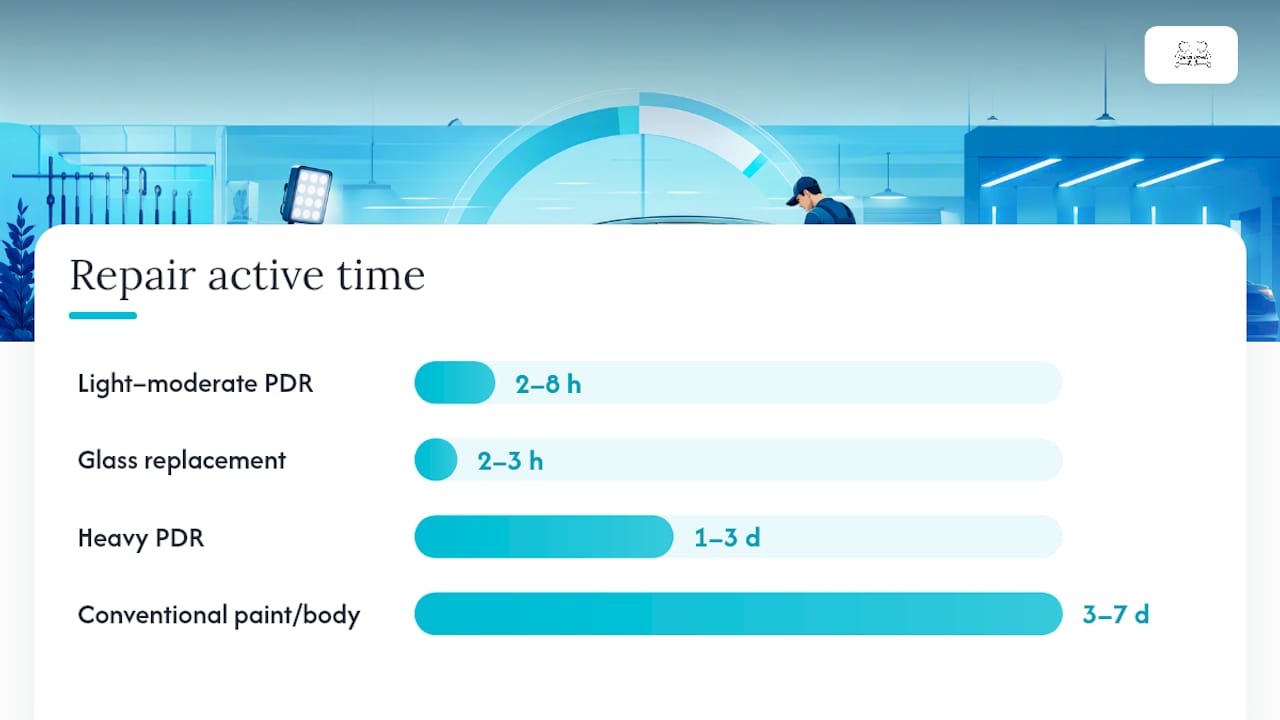
This is where the "hours versus weeks" distinction really clicks into place. Paintless dent repair on a moderately hailed sedan typically runs three to five hours of active labor, and heavier damage with dozens of dents can push that to one or two full shop days. Conventional body and paint work runs on a different clock entirely: panel removal, priming, paint booth scheduling, and multi-hour cure times routinely add up to three to seven days or more.
Glass replacement complicates things further. A cracked or shattered windshield takes about two to three hours to swap, but vehicles with driver-assist cameras often need ADAS calibration, which can tack on another hour or require an entirely separate appointment with a specialist.
- Light to moderate PDR: 2 to 8 hours of active labor
- Heavy dent count PDR: 1 to 3 shop days
- Conventional paint/body work: 3 to 7-plus shop days
- Glass replacement: 2 to 3 hours, plus possible ADAS calibration visit
The real time sink shows up when your car needs more than one vendor. Body shop, glass shop, and calibration specialist each work fast on their own, but coordinating three separate calendars stretches your total repair window well beyond any single vendor's actual labor time.
How Does Filing an Insurance Claim Change Your Timeline?
Photo-based estimating can move a claim along in a day or two, while damage that requires an in-person adjuster visit adds time before repairs even get scheduled. The gap between "estimate approved" and "car in the shop" still depends mostly on backlog, not paperwork.
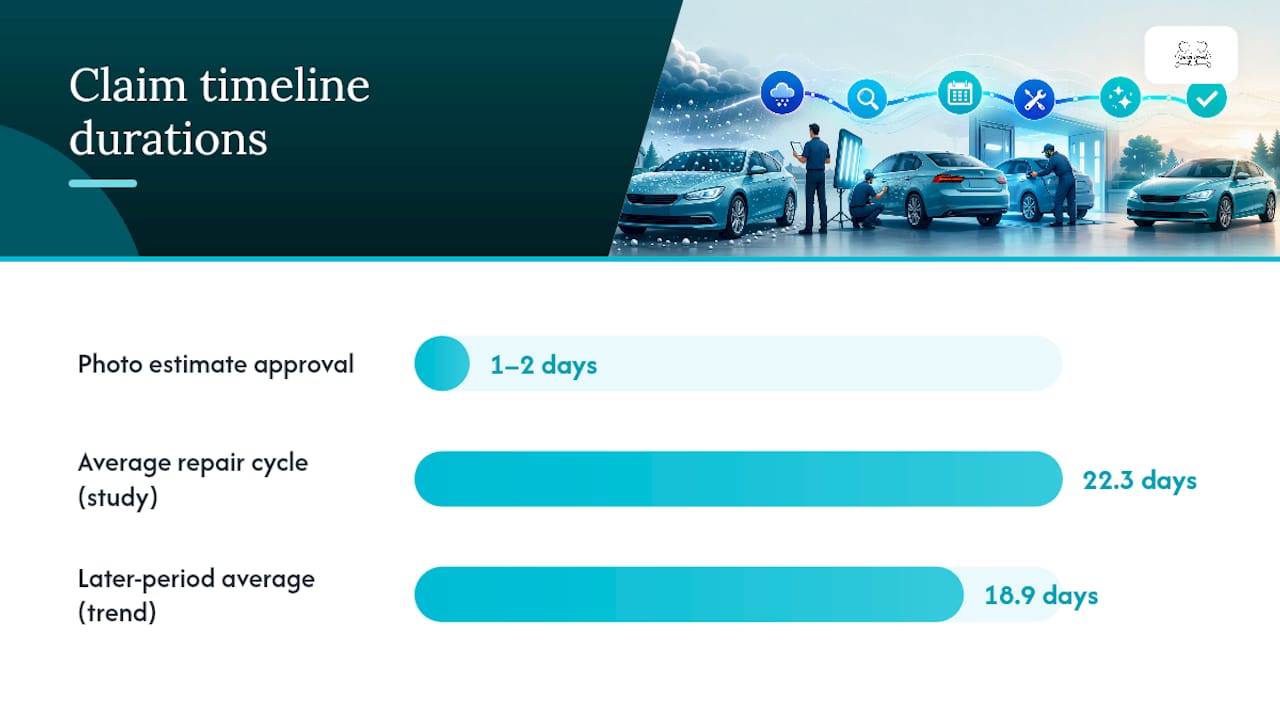
Industry benchmarks give a useful reference point here. The J.D. Power 2024 U.S. Auto Claims Satisfaction Study found an overall average repair-cycle time near 22.3 days, with claims that entered the process later in the study period averaging closer to 18.9 days, a sign that cycle times have been trending down even as average repair costs rose 26% over two years.
Rental coverage matters just as much as the repair clock. Most policies cap rental reimbursement at a set number of days or a dollar limit, not an open-ended window tied to however long your repair actually takes.
- Confirm your rental-day cap with your insurer before you drop off the car
- Submit clear, well-lit photos immediately to speed up estimate approval
- Use app-based claim approval where your insurer offers it
- Follow up within a few days if you haven't heard back on approval status
How Can You Shorten Your Own Wait Time?
You can't control shop backlog after a regional storm, but you control how fast you move through your own part of the process. That's the leverage point most owners never use.
- File your claim and request an estimate within 24 to 72 hours of the storm. Early movers get earlier slots.
- Ask directly whether PDR applies and whether mobile service is available. A mobile PDR appointment can skip the shop queue entirely, though it may cost more than drop-off service.
- Photograph every panel with a timestamp and have your VIN ready. Clean documentation prevents insurer back-and-forth that eats calendar days.
- Confirm your rental-day cap and coordinate pickup and drop-off logistics in advance.
- Weigh cost against speed. Faster mobile service isn't always cheaper, but it can save you a month of downtime.
Pro Tip: If your car has visible hail damage and you're worried about resale value or a salvage-title risk, don't sit on the claim. Timely repairs are one of the few things that keep storm-related damage from turning into a title problem.
Why Everyone Underestimates the Scheduling Gap
Most owners fixate on how long the repair takes once it starts, when the real variable is the gap before it starts. That gap is almost entirely a function of shop backlog, not the complexity of your specific dents.
The uncomfortable truth is that a two-hour PDR job and a two-day body repair can carry the exact same six-week wait if they land in the same storm surge. Dent Boys sees this pattern every storm season: free estimates move fast, pick-up and delivery cut out a wasted trip, and $0 deductible support with insurers keeps paperwork from becoming its own bottleneck. None of that erases backlog, but it removes every delay that isn't backlog, which is usually more than half the total wait.
— Martin
Get Your Hail Repair Scheduled Faster With Dent Boys
Waiting on hold with an insurer or driving between three different shops for estimates adds days you don't need to lose. Dent-boys handles the whole loop from one point of contact: free estimates, pick-up and delivery so you never sit in a shop lobby, rental coordination while your car is out, $0 deductible support on qualifying insurance claims, and a lifetime warranty on every repair.

Requesting a free estimate takes minutes. Send photos of the damage and your VIN, get a repair timeline back, and confirm whether PDR fits your case before you commit to anything. If a storm just hit your area, that head start is the single biggest lever you have over your own wait time.
Get your free hail damage estimate started today and lock in your spot before the backlog does.
Sources
- The Hail Repair Wait: Why Your Two-Hour PDR Job Takes Six Weeks — Hail Protector
- J.D. Power 2024 U.S. Auto Claims Satisfaction Study