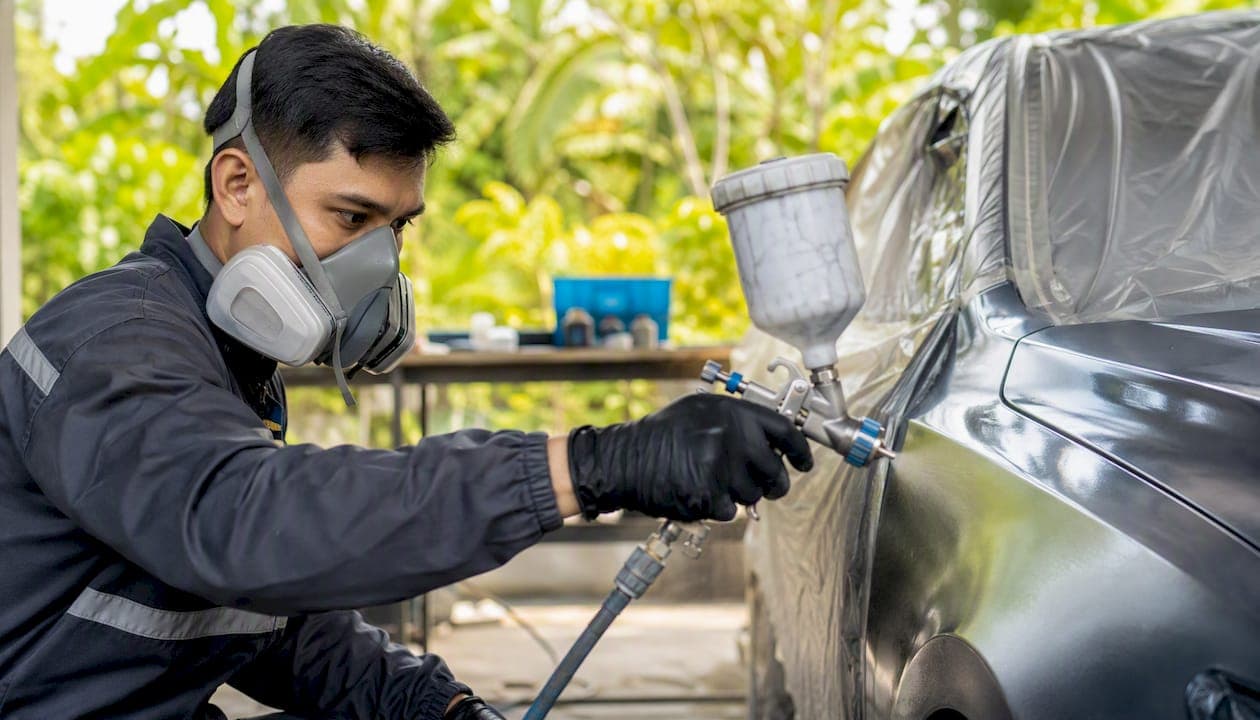
The main types of paint for cars break into two categories: finishes and chemistries. Finishes describe what you see: solid (non-metallic), metallic, pearlescent, and matte. Chemistries describe how the paint is built and cured: single-stage, basecoat/clearcoat acrylic polyurethane (the current standard), and lacquer, which is essentially obsolete on modern vehicles. Pick a finish for looks, a chemistry for how long that look survives.
If you want the lowest repair bill and the easiest color match, a solid basecoat/clearcoat system wins. If you want depth and shimmer for a show car, pearlescent or tri-coat systems deliver it, at a real cost in blending difficulty. If you're patching a fleet vehicle fast and cheap, single-stage still has a place. For nearly everyone else, a two-component ("2K") acrylic polyurethane basecoat under a high-density clearcoat is the sweet spot between durability, cost, and repairability.
Here's how the common scenarios shake out:
- Daily driver, budget-focused: Solid color, basecoat/clearcoat acrylic polyurethane.
- Show car or resale-focused restoration: Pearlescent or tri-coat, professionally applied and blended.
- Fleet or quick turnaround repaint: Single-stage enamel or urethane.
- DIY touch-up on a small chip or scratch: Solid or metallic touch-up pen matched to your factory paint code.
Pro Tip: Before you commit to any finish, check whether the damage even needs paint at all. A lot of dents, dings, and hail damage can be pulled back out without touching the clearcoat, which saves you the color-match headache entirely.
Key Takeaways
The right paint choice balances finish (solid, metallic, pearlescent, matte) against chemistry (single-stage versus 2K basecoat/clearcoat), and neither decision should happen without checking whether repainting is even necessary in the first place.
| Point | Details |
|---|---|
| Match finish to priority | Choose solid for easy repairs, pearlescent or tri-coat for depth and show-car appeal. |
| Favor 2K polyurethane for longevity | Two-component basecoat/clearcoat systems resist UV, chemicals, and abrasion better than 1K or single-stage. |
| Waterborne is now the standard | VOC regulations have pushed most OEMs and many shops toward waterborne basecoats. |
| Find your paint code before buying touch-up product | Check the door jamb, trunk, or glovebox, and give shops the exact code, not just the color name. |
| Check for paintless repair first | Dent Boys repairs dents and hail damage without touching factory paint, backed by a lifetime warranty and $0 deductible insurance support. |
Table of Contents
- How Modern Automotive Paint Systems Are Layered
- What Do Solid, Metallic, Pearlescent, and Matte Finishes Look Like?
- Which Paint Chemistry Should You Choose?
- How Long Does Each Paint Type Actually Last?
- How Is Car Paint Applied, and Does It Change Anything?
- How Do You Find Your Car's Paint Code?
- Why Are Waterborne Paints Becoming the Industry Standard?
- When Does Repainting Actually Make Sense?
- When Should You Skip the Repaint Entirely?
- Where to Learn More About Automotive Paint
- Frequently Asked Questions
- Sources
How Modern Automotive Paint Systems Are Layered
A factory paint job isn't one coat of color. It's four distinct layers, each with a separate job, and understanding that stack explains why a full respray costs so much more than a touch-up pen and a prayer.
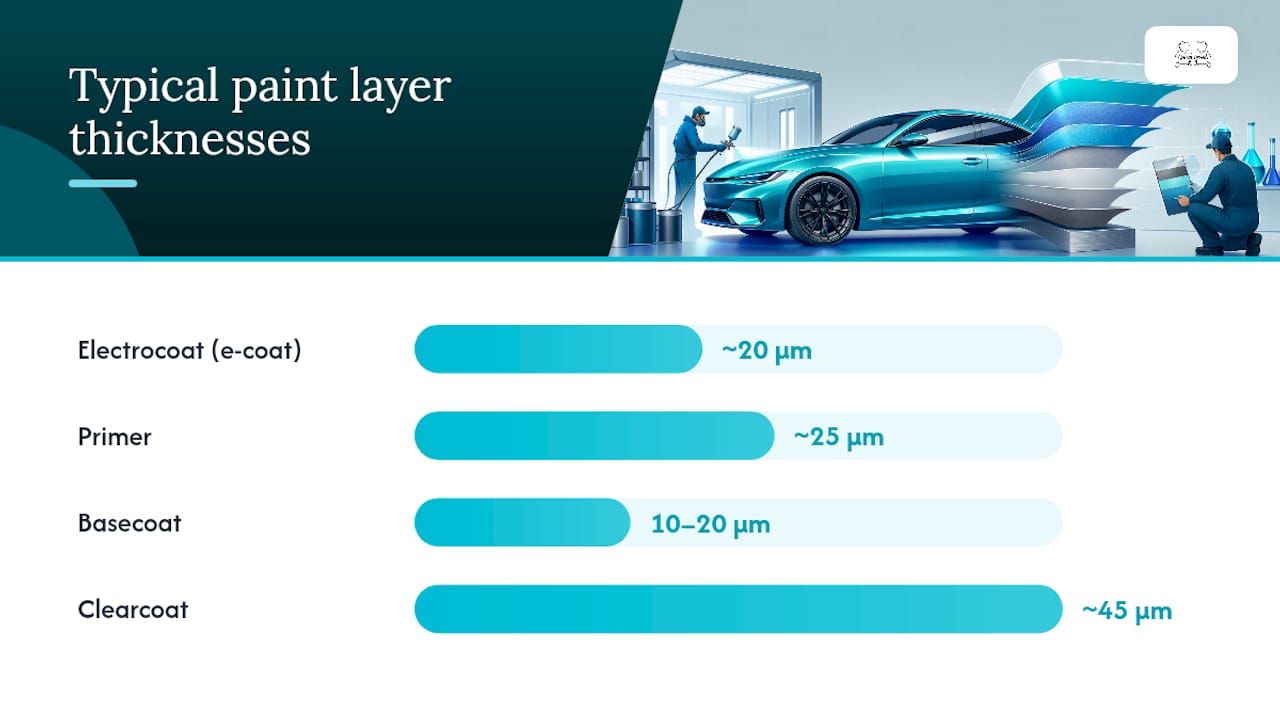
The base layer is electrocoat, or e-coat, applied by dipping the entire body shell into a charged tank so paint particles bond electrically to bare metal. It exists purely for corrosion protection. Above that sits the primer, which smooths out microscopic surface imperfections and gives the basecoat something to grip. The basecoat carries the actual color and any metallic or pearlescent effect. On top goes the clearcoat, a transparent layer that provides gloss, UV protection, and the sacrificial surface you polish or wet-sand when scratches show up.
Typical thicknesses run surprisingly thin for the protection they provide. According to NIST's review of OEM paint processes, e-coat runs about 20 microns, primer around 25 microns, basecoat 10 to 20 microns, and clearcoat roughly 45 microns. Stack them together and the entire finish is still thinner than a sheet of paper.
| Layer | Typical thickness | Primary function |
|---|---|---|
| Electrocoat (e-coat) | ~20 microns | Corrosion protection on bare metal |
| Primer | ~25 microns | Adhesion, leveling, surface prep |
| Basecoat | 10–20 microns | Color and visual effect |
| Clearcoat | ~45 microns | Gloss, UV resistance, scratch protection |
Body panels made of steel or aluminum get this full four-layer treatment. Trim pieces like bumpers and fascias, often molded from flexible plastics such as TPO, need different resin systems and conductive primers so the paint film can flex without cracking. This is one reason a bumper repaint can look slightly off from the adjacent fender if a shop cuts corners on primer selection.
- E-coat protects against rust from the inside out, not just the surface.
- Basecoat carries color; clearcoat carries protection. Damage the clear layer and the color underneath is exposed to UV and oxidation.
- Flexible trim needs flexible primer systems, not the rigid formulas used on steel body panels.
The ScienceABC explainer on automotive paint confirms this multi-layer structure across virtually every OEM production line, which is why matching a factory finish with a rattle can rarely holds up long term.
What Do Solid, Metallic, Pearlescent, and Matte Finishes Look Like?
Each finish comes from a different additive mixed into the basecoat, and that additive determines how light bounces off the panel.
Solid, or non-metallic, finishes use pure pigment with no reflective particles. Light hits the surface and scatters evenly, which gives you flat, consistent color with zero sparkle. It's the easiest finish to spray evenly and the easiest to touch up, because there's no flake pattern to accidentally mismatch.
Metallic finishes suspend tiny aluminum flakes in the basecoat. Those flakes catch and reflect light at different angles depending on how they land during spraying, which creates the shimmer you see on most modern vehicles. The catch: flake orientation varies with spray technique, air pressure, and even humidity, so blending a metallic repair into an existing panel takes real skill.
Pearlescent (pearl) finishes go a step further, using mica or ceramic-based particles that both reflect and refract light. This creates a shifting, almost iridescent quality where the color seems to change slightly depending on viewing angle. Pearls are frequently applied as a tri-coat, meaning a pearl layer goes over a base color, then gets sealed under clearcoat, which adds an extra step and extra cost to every repair.
Matte (flat) finishes trade gloss for a satin, low-reflection look, typically achieved with a specialized flattening agent in the clearcoat rather than the basecoat itself. They look striking on the right car and are brutally unforgiving of mistakes: matte panels can't be polished or buffed like glossy ones without leaving a shiny patch that never blends back in.
Specialty effects like candy paints, chrome-look finishes, and chameleon coatings layer multiple translucent or interference pigments to create effects that shift dramatically with light and angle. They're gorgeous, and they're also the hardest and most expensive finishes to repair, often requiring a full panel respray rather than a spot blend.
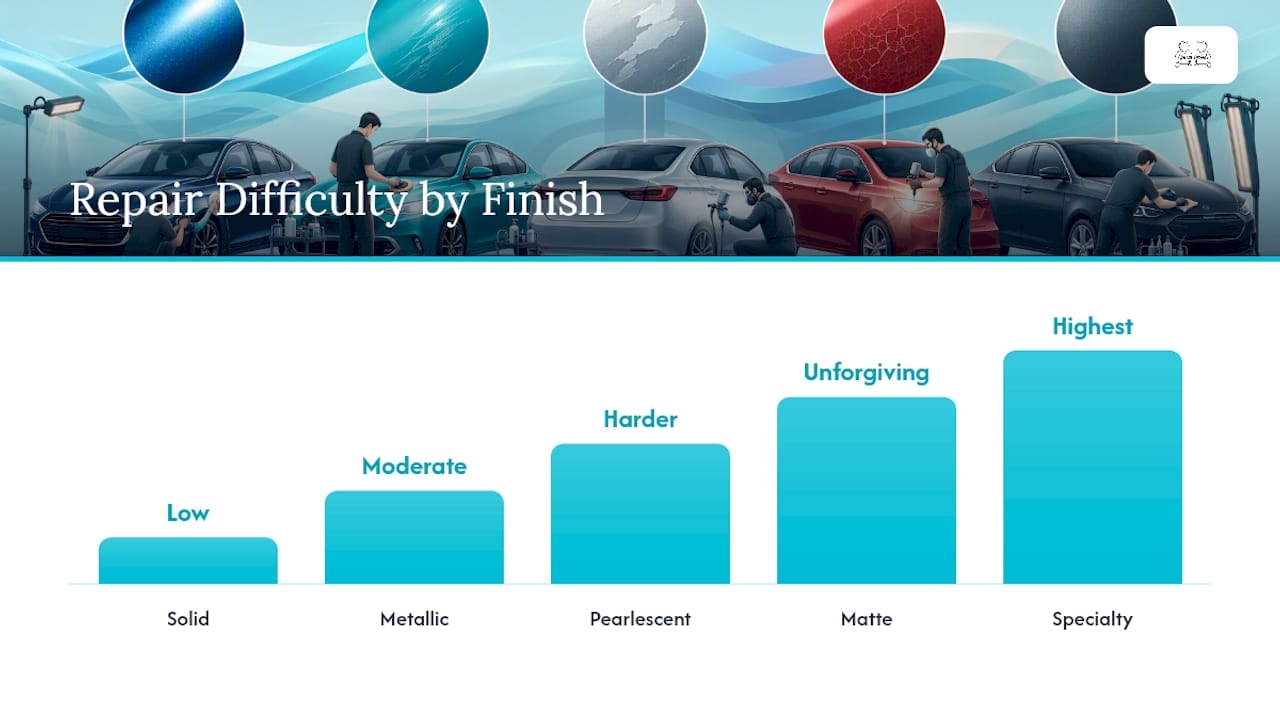
- Solid: flattest look, cheapest to fix, easiest color match.
- Metallic: sparkle from suspended flakes, moderate repair difficulty.
- Pearlescent: light-shifting depth, usually tri-coat, harder to blend.
- Matte: no polishing allowed, unforgiving of surface contamination.
- Specialty (candy, chrome, chameleon): dramatic effect, highest repair cost and complexity.
Pro Tip: Metallic and pearlescent repairs live or die on flake orientation. A shop that rushes the spray pattern or skips a proper blend zone will leave a visible seam even with a perfect color match. Ask any body shop how they handle blend panels before you commit to a metallic or pearl repair.
| Finish | Visual effect | Repair difficulty |
|---|---|---|
| Solid | Flat, uniform color | Low |
| Metallic | Sparkle from aluminum flake | Moderate |
| Pearlescent | Iridescent, angle-shifting | High |
| Matte | Satin, non-reflective | High (no polishing) |
If you're restoring a vehicle with a custom finish, the maintenance routine matters as much as the repair itself. A guide to caring for custom-painted cars covers the specific washing and polishing habits that keep specialty finishes looking right for years instead of months.
Which Paint Chemistry Should You Choose?
The chemistry underneath the finish determines how long that finish lasts, and it splits into a few distinct categories that matter for anyone comparing options or budgeting a repair.
Lacquer was the dominant automotive chemistry through the mid-20th century, but it's essentially extinct in modern shops. Lacquer dries by solvent evaporation alone, no chemical curing, and according to Wikipedia's entry on automotive paint, up to 85% of that solvent evaporates directly into the air during application. That's an enormous VOC load, which is a major reason lacquers got phased out.
Enamel cures through a combination of evaporation and oxidation, giving it more durability than lacquer, though it's still largely surpassed by newer systems in professional refinish work.
Single-stage paint combines color and gloss in one product, no separate clearcoat. It's faster and cheaper to apply, which is why fleet vehicles and older restorations still use it, but it offers noticeably less UV and chemical resistance than a basecoat/clearcoat system.
Basecoat/clearcoat acrylic polyurethane is what nearly every car on the road wears today. The Wikipedia summary on automotive paint confirms basecoats are now categorized almost exclusively as solid, metallic, or pearlescent pigment systems, always finished with a separate protective clearcoat.
The chemistry also splits by component count. 1K (one-component) paints dry through evaporation and don't need a hardener, making them simpler to apply but generally less durable. 2K (two-component) systems require mixing in a hardener or activator right before spraying, which triggers a chemical cross-linking reaction. The ScienceABC breakdown of automotive paint chemistry notes that 2K systems typically produce a harder, more durable, more chemical-resistant film than 1K alternatives, which is why professional shops lean on 2K clearcoats for anything meant to last.
Then there's the waterborne versus solvent-borne divide. Waterborne basecoats have become the standard at most OEM plants and a growing share of collision shops, largely for environmental reasons covered in more depth below. Solvent-borne coatings haven't disappeared. Many refinish shops still favor them for specific handling characteristics, particularly in certain climates or repair scenarios.
| Chemistry | Appearance/effect | Durability (UV/abrasion) | Repairability | Relative cost | Environmental/VOC impact |
|---|---|---|---|---|---|
| Lacquer | Deep gloss, dated look | Low | Easy to blend | Low | High VOC |
| Single-stage | Flat or slight gloss | Moderate | Easy | Low | Moderate |
| Basecoat/clearcoat (1K) | Full gloss, factory look | Moderate to good | Moderate | Medium | Moderate |
| Basecoat/clearcoat (2K) polyurethane | Full gloss, factory look | Best | Moderate (requires skill) | Medium to high | Depends on solvent vs waterborne |
A few practical takeaways sit below that table. 2K clearcoats hold their gloss longer than 1K alternatives, but they require stricter mixing ratios, proper ventilation, and respirator use, since the isocyanate hardeners in many 2K products are genuinely hazardous to breathe unprotected. Single-stage still makes sense for utility vehicles where appearance takes a back seat to speed and cost. And if you're comparing quotes from different shops, ask specifically which chemistry they're quoting. A "full respray" estimate can vary by hundreds of dollars depending on whether it's single-stage or 2K basecoat/clearcoat.
How Long Does Each Paint Type Actually Last?
Durability comes down to a combination of chemistry and finish, and the two interact in ways that surprise a lot of first-time buyers.
2K acrylic polyurethane with a high-density clearcoat is the most durable combination available for regular refinish work, resisting UV fading, chemical fallout, and minor abrasion better than any 1K or single-stage alternative. Solid finishes under that same clearcoat tend to age the most gracefully of all, simply because there's no flake pattern to fade unevenly. Metallic and pearlescent finishes can develop a mottled or blotchy look over time if the flakes weren't oriented consistently during the original spray, a defect that shows up months or years later under direct sunlight.
Cost bands track pretty predictably with complexity:
- Touch-up (chip or small scratch): Low cost, DIY-friendly with solid or metallic paint pens.
- Single-panel respray: Medium cost, straightforward for solid or metallic; harder to match on pearl or tri-coat.
- Full vehicle respray: Medium to high cost depending on chemistry, with 2K systems commanding a premium over single-stage.
- Tri-coat or specialty effect (candy, chrome, chameleon): Highest cost, often requiring a full panel or full vehicle approach to avoid visible seams.
A detailed look at bodywork costs breaks these ranges down further if you're budgeting a specific repair.
Repairability follows its own logic separate from cost. Metal flakes and pearl pigments both make blending dramatically harder than solid color, because a shop has to match not just hue but flake density and orientation across a seam. Tri-coats compound that problem with an extra layer to align. When damage is severe enough or spans enough of a panel, most experienced techs will recommend a full panel recoat rather than attempting a spot blend that risks a visible line.
Maintenance differs sharply by finish, too. Glossy clearcoats can be machine-polished to remove light scratches and swirl marks, which is exactly why clearcoat condition matters so much for long-term appearance. Matte finishes are the opposite story: no polishing, no buffing, no clay bar treatments that involve abrasive compounds, since any of those will create a shiny patch that stands out permanently against the surrounding satin surface.
Pro Tip: If your car has a factory clearcoat in good condition, protecting it is usually cheaper than fixing it later. A quality ceramic coating or ongoing wax routine costs far less than the panel respray you'll eventually need if you let oxidation set in.
How Is Car Paint Applied, and Does It Change Anything?
Where the paint gets sprayed, and with what equipment, changes the final result more than most owners realize.
OEM production lines apply paint in sealed, filtered spray booths using robotic arms with precisely controlled fluid delivery, followed by oven bake cycles that fully cross-link 2K coatings at elevated temperatures. That combination of climate control and heat curing is a major reason factory paint outperforms most aftermarket work straight out of the gate.
Collision and refinish shops replicate a scaled-down version of that process: professional spray guns (usually HVLP, or high-volume low-pressure, for better transfer efficiency and less overspray), ventilated and filtered paint booths, and infrared or forced-air curing lamps standing in for a factory oven. Temperature and humidity control still matter enormously here. Paint that goes on in a cold, damp garage cures slower and often softer than paint applied in a controlled booth.
Consumer-level options sit at the bottom of the equipment scale: aerosol touch-up cans, brush-on touch-up bottles, and small handheld spray guns for the more ambitious DIYer. According to a guide on choosing automotive paint types, matching the paint system to your actual skill level and use case matters more than chasing the fanciest product on the shelf.
- Surface prep (sanding, degreasing, masking) determines more of the final result than the paint product itself.
- Small chips and scratches with intact clearcoat around them are the best DIY candidates.
- Large panels, metallic or pearl finishes, and anything needing clearcoat blending usually need a shop.
- Garage-cured 2K paint, without proper heat curing, often stays softer and less chemical-resistant than shop-cured equivalents.
Pro Tip: A step-by-step DIY touch-up guide is worth reading before you buy anything. Most DIY touch-up failures come from skipping surface prep, not from picking the wrong paint.
How Do You Find Your Car's Paint Code?
Every factory-painted vehicle carries a paint code somewhere on the body, and finding it is the first step to any accurate touch-up or respray.
- Check the driver's side door jamb first. Most manufacturers place a build sticker there listing the paint code alongside VIN and trim details.
- If it's not on the door jamb, check the trunk lid, the trunk floor under the spare tire cover, or inside the glovebox.
- Some manufacturers place the code under the hood, on the radiator support or the underside of the hood itself.
- Write down the exact code (it's usually a short alphanumeric string) and cross-reference it with your manufacturer's paint code chart, available through most dealership parts departments or major auto paint suppliers.
- Use that code when ordering touch-up pens, aerosol cans, or a custom-mixed basecoat from a paint supplier or body shop.
When you talk to a body shop about a repair, give them the code directly rather than just the color name. "Midnight Blue" can cover several distinct factory formulations across model years, but the alphanumeric code narrows it to exactly one mix.
Pro Tip: Metallic, pearlescent, and tri-coat matches almost always need a professional spray-out test before committing to a full panel. Ask your shop to spray a test card in the same lighting you'll view the finished repair under. Photos taken indoors under fluorescent light can look completely different from the same panel outdoors in direct sun.
Why Are Waterborne Paints Becoming the Industry Standard?
Regulation, not preference, is driving the industry-wide shift toward waterborne basecoat systems. Global VOC limits designed to cut airborne solvent emissions have pushed most OEMs and a growing share of collision shops toward water-based acrylic polyurethane basecoats, according to a UTI overview of automotive paint. Solvent-borne systems haven't vanished. Plenty of refinish shops still use them for specific handling and drying characteristics that work better in certain conditions.
The health case behind this shift is straightforward. Older solvent-heavy formulations, including lacquers that lose up to 85% of their solvent to evaporation, historically used heavy metals and aggressive solvent chemistries. Government toxicology resources like NLM's TOX Town flag those older pigments and solvents as genuine occupational and environmental hazards, which is exactly why current regulations restrict both VOC content and certain heavy metals in paint formulations.
What does this mean if you're getting a car painted in 2026? Most reputable shops will now specify "waterborne basecoat" or "2K clearcoat" directly on your estimate. That's worth asking about if you don't see it listed.
- Waterborne basecoats are now standard at most OEM plants and many collision shops.
- Solvent-borne systems persist in refinish work where specific handling properties are preferred.
- Color-matched waterborne mixes are widely available through professional paint suppliers, so switching to waterborne rarely limits your color options.
- DIYers using aerosol or solvent-based products should expect somewhat different handling and drying behavior compared to what a professional waterborne system delivers.
When Does Repainting Actually Make Sense?
Most cars don't need a repaint. That's the uncomfortable truth a lot of body shops won't lead with, because a full respray is a bigger ticket than the alternative most owners actually need.
Repainting genuinely makes sense in a few specific situations: extensive corrosion that's compromised the metal underneath, severe panel damage from a real collision, or a deliberate full color change. Outside of those scenarios, a lot of what drives people toward a repaint is cosmetic anxiety over something that never broke the clearcoat in the first place. Hail damage, parking-lot dings, and shopping-cart dents almost always fall into this second category. The paint layer is intact; it's just the metal underneath that's deformed.
That distinction matters because paintless dent repair (PDR) works by gently massaging the metal back into shape from behind the panel, without cutting into the clearcoat or basecoat at all. When that's technically feasible, it preserves the original factory finish, which is worth more at resale than a repainted panel, even a well-matched one, since factory paint reads as "unrepaired" to a trained inspector or a paint-thickness gauge.
One thing owners consistently overlook: chasing a "perfect" cosmetic result on a panel that could have been PDR-repaired often costs more in resale value than it gains in appearance. A guide on show-quality repair standards walks through exactly what "like new" actually means for a factory finish, and why matching that standard through repainting is harder than most people assume.
Dent Boys built its entire service model around this principle: fix the metal, leave the paint alone whenever the damage allows it.
When Should You Skip the Repaint Entirely?
Not every dent needs a paint job, and that's exactly where paintless dent repair earns its keep. PDR works by accessing the back of a damaged panel and massaging the metal back into its original shape, and it's the right call whenever the paint itself hasn't cracked, chipped, or peeled at the damage site. Hail damage is the textbook case: dozens of dents across a hood or roof, paint fully intact, metal deformed.
The math on this is simple. A repaint means stripping, priming, basecoat, clearcoat, and cure time, potentially days in the shop. PDR on the same panel often takes hours, skips the color-match risk entirely, and keeps your factory finish exactly as the automaker built it, which matters at resale time in a way a repainted panel never quite does. Dent Boys backs every repair with a lifetime warranty, provides a rental vehicle while your car is in the shop, and works directly with insurance at $0 deductible on qualifying hail claims, with free estimates and pick-up and delivery so you're not the one driving the damaged car around. If you're weighing a repaint against a repair, comparing your appearance upgrade options first is worth the five minutes. Start with a free estimate at Dent Boys and find out whether your dent even needs paint at all.
Where to Learn More About Automotive Paint
- UTI's collision blog on automotive paint covers the waterborne shift and shop-level chemistry decisions in plain language.
- NIST's technical review of OEM paint processes breaks down factory layer thicknesses and application methods in detail.
- Wikipedia's automotive paint entry is a solid starting reference for basecoat pigment categories and the historical shift away from lacquer.
- ScienceABC's explainer on automotive paint chemistry clarifies the 1K versus 2K distinction for readers weighing DIY versus professional application.
Frequently Asked Questions
What type of paint is used on cars? Nearly all modern vehicles use a basecoat/clearcoat system built on acrylic polyurethane chemistry. The basecoat carries color as a solid, metallic, or pearlescent pigment, and a separate clearcoat provides gloss and UV protection on top.
What paint should I use for a DIY touch-up? For small chips and scratches, a touch-up pen or aerosol matched to your factory paint code works well on solid and most metallic finishes. Pearlescent, tri-coat, and matte finishes are much harder to blend convincingly without professional spraying.
How much does it cost to paint a car? Cost scales with both chemistry and finish complexity. Touch-ups are cheapest, single-panel resprays run medium cost, and full resprays or specialty tri-coat jobs command the highest prices, particularly with 2K polyurethane systems.
Is 2K paint better than 1K for a car? Yes, for durability. 2K (two-component) systems use a hardener to chemically cross-link the paint film, producing better UV resistance, gloss retention, and chemical resistance than 1K products, though they require more careful mixing and ventilation.
Do I need to repaint my car after hail damage? Usually not. If the hail dents haven't cracked or chipped the paint, paintless dent repair can restore the panels without any repainting, which preserves your factory finish and typically costs far less than a respray.
Sources
- UTI — Automotive paint (collision blog)
- NIST — Paint materials and processes from an automotive OEM perspective
- Wikipedia — Automotive paint
- ScienceABC — What Is Automotive Paint?