
Yes, dents commonly cause rust because they breach the protective paint and clearcoat, exposing bare steel to moisture and oxygen. The chemical reaction starts faster than most car owners expect. Your first move: clean the dented area with soap and water, dry it completely, and apply touch-up paint or a clear-coat pen to seal the exposed metal. Then book a professional estimate before the next rainstorm. Dent-boys offers free estimates with pickup and delivery, so there's no reason to wait.
Table of Contents
- Why dents rust over time: the paint breach that starts it all
- How fast does a dent actually rust?
- Which dents are most likely to rust first?
- What to do right now to stop a dent from rusting
- Repair choices that stop rust: PDR vs. paint and body work
- Why leaving a dent to rust costs you far more later
- What repair shops actually see: real-world rust from dents
- Key Takeaways
- The repair window is shorter than most owners think
- Dent-boys stops rust before it starts
- Useful sources and further reading
Why dents rust over time: the paint breach that starts it all
Your car's exterior is a layered system, not just a coat of paint. From the outside in, it runs: clearcoat → color coat → primer → electrocoat (a factory-applied corrosion barrier) → bare steel. Each layer exists for a reason. Once a dent or scratch breaks through even the clearcoat, moisture and road grime reach the layers below, and the clock starts.
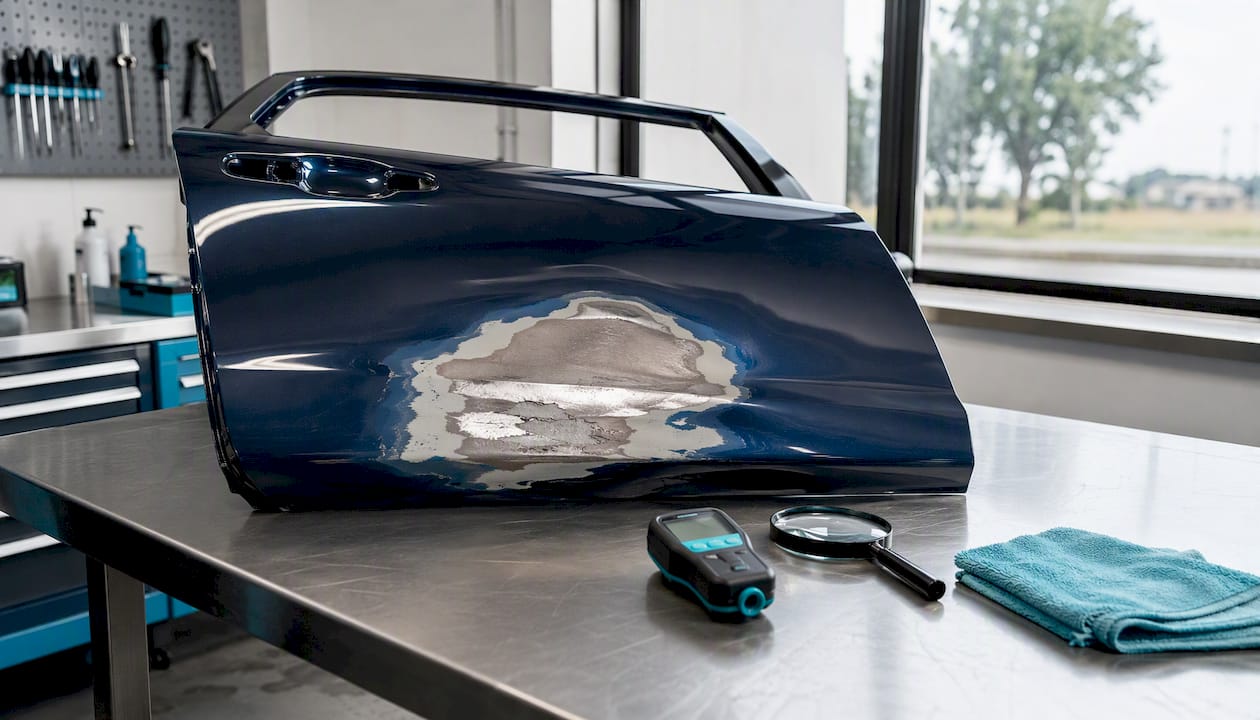
The chemistry is straightforward. Iron in the steel reacts with water and oxygen to form iron oxide, which is rust. Road salt accelerates this by acting as an electrolyte, speeding up the electrochemical reaction. A dent makes things worse in two ways: the impact itself creates chips and microcracks that open gaps in the coating, and the physical low point of the dent traps water that would otherwise run off a flat panel.
Microfractures and displaced seam sealers are the hidden part of this problem. An impact that looks minor on the surface can crack the sealer along a body seam, letting corrosion start inside a cavity where you can't see it. By the time rust appears on the outside, it's already been working from the inside out.
The chain looks like this:
- Paint breach (chip, crack, or displaced seam sealer)
- Moisture contacts bare steel
- Iron + water + oxygen → iron oxide (rust)
- Salt and freeze–thaw cycles accelerate the reaction
- Rust spreads laterally under intact paint, lifting it from below
Pro Tip: Run your fingernail across the dented area. If you feel a ridge or catch on the paint edge, you likely have a microcrack even if the damage looks superficial. A flashlight at a low angle across the panel will also reveal hairline fractures invisible in normal light.
How fast does a dent actually rust?
Speed depends almost entirely on environment. Visible rust can appear within a variable timeframe depending on conditions after a paint breach, a range that reflects how dramatically climate affects the reaction rate.
| Environment | Typical time to visible rust | Key accelerators |
|---|---|---|
| Harsh winter with road salt | Days to a few weeks | Salt, freeze–thaw cycles, moisture |
| Coastal / high humidity | Weeks to 2–3 months | Salt air, constant humidity |
| Moderate (rain, no salt) | 2–6 months | Rain, temperature swings |
| Dry inland climate | 6 months to several years | UV degradation, occasional rain |
A fractured paint sealant from a dent is especially vulnerable to precipitation and road salt, which is why a dent that sits through a single Midwest winter can look dramatically worse by spring than the same dent would in Arizona after two years.
Key point: Rust onset can be very rapid during a salted-road winter, not seasons. Car owners in northern states and coastal regions face a genuinely short window between a fresh dent and a repair that's far more expensive.
Dent depth and paint damage severity also matter. A shallow dent with no visible paint break on a dry-climate car may stay rust-free for years. A sharp crease that chips paint on a car driven through Chicago winters? Weeks.
Which dents are most likely to rust first?
Not all dents carry equal risk. Prioritize inspection and repair based on these factors:
| Dent type / location | Rust risk | Why |
|---|---|---|
| Paint-chipped dents | Highest | Steel is directly exposed from day one |
| Sharp creases and edge dents | High | Creases crack paint along the fold; edges lose coating easily |
| Deep punctures | High | Multiple coating layers breached; often near seams |
| Hairline cracks (no visible chip) | Moderate–high | Water infiltrates under intact paint |
| Smooth shallow dents (no chip) | Lower | Paint may remain intact; risk rises with time |
| Rocker panels, wheel wells, door bottoms | High regardless of dent type | Low points collect water and salt; factory seam sealers often present |
| Trunk lips and undercarriage seams | High | Hidden cavities; corrosion starts inside before surface signs appear |
Factory seam sealers and hidden coatings can be cracked by impact, even when the outer paint looks fine. A dent near a body seam is higher priority than the same dent on a flat door center, because the sealer failure is invisible and the cavity behind it holds moisture.
What to do right now to stop a dent from rusting
Speed matters more than perfection here. A temporary seal applied today beats a perfect repair scheduled for next month.
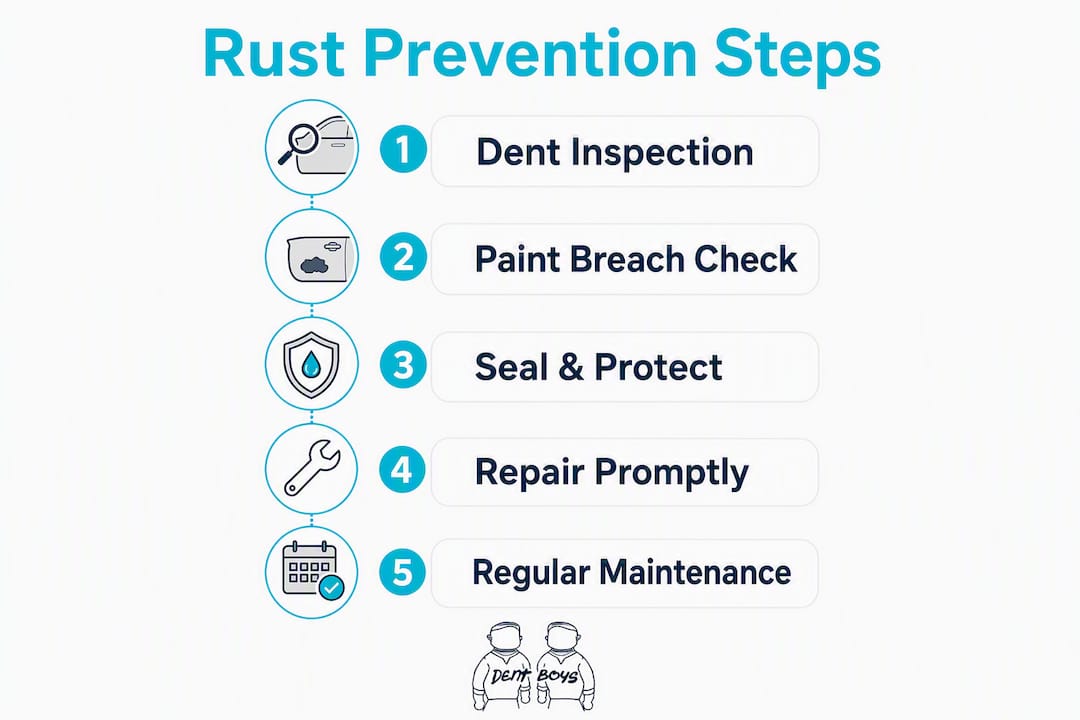
- Clean the area. Wash with mild soap and water, rinse thoroughly, and remove any road salt or grime from the dent and surrounding paint. Salt left under a sealant accelerates corrosion.
- Dry completely. Use a clean microfiber cloth, then let the panel air-dry for 15–20 minutes. Sealing over trapped moisture defeats the purpose.
- Apply a temporary seal. For paint chips, a manufacturer-matched touch-up paint kit or clear-coat pen (available at any auto parts store) is the best short-term option. For a dent with no visible chip, a rust-inhibitor spray like Rust-Oleum Stops Rust or a clear automotive lacquer adds a barrier. Quality waterproof tape works for a day or two in an emergency, but it's not a substitute for a proper seal.
- Avoid stickers, decals, or vinyl wraps over the damage. Adhesives trap moisture and accelerate oxidation; removing them later often peels surrounding paint and reveals worse corrosion underneath.
- Skip amateur sanding without proper prep. Dry-sanding a dent without applying primer and a corrosion barrier afterward leaves bare metal more exposed than before.
- Schedule a professional estimate. Temporary measures buy time; they don't fix the underlying breach.
Pro Tip: Photograph the dent from multiple angles with a timestamp before applying any sealant. That documentation protects you for insurance claims and gives a repair shop a baseline for assessing rust progression. Store the photos in a cloud folder labeled with the date and panel location.
Repair choices that stop rust: PDR vs. paint and body work
The right repair depends on whether the paint is still intact.
Paintless dent repair (PDR) works when the paint hasn't been breached or when microcracks are minimal. A technician uses specialized tools to massage the metal back to its original shape from behind the panel, preserving the factory clearcoat, paint, and primer. Because the factory coatings stay intact, PDR is the best rust-prevention outcome when it's applicable. No repainting means no risk of a color-match gap or a thin repaint that weathers faster than the original.
Traditional paint and body work is necessary when:
- The dent has visible paint chips or bare metal
- Rust has already started (even surface rust needs chemical treatment before repainting)
- The dent is near a seam where sealer has been displaced
- Deep pitting has already formed
For paint and body work, ask specifically about rust-inhibiting primer (epoxy primer is the standard), seam-sealer reapplication on any affected joints, and whether the shop offers a warranty on corrosion prevention. A shop that skips primer and goes straight to color coat is cutting a corner that will show up in 18 months.
Quick decision guide:
- Paint looks intact, no chips, no bare metal visible → PDR is likely appropriate
- Any visible chip, bare steel, or existing rust → paint and body work required
- Dent near a seam or body edge → have a technician inspect for sealer damage before deciding
- Hail damage with multiple dents across panels → PDR is often the most efficient route when paint is intact
Why leaving a dent to rust costs you far more later
Surface rust is cheap to fix. Structural rust is not.
Rust spreads from a localized spot to larger panel areas and eventually reaches inner panels if left untreated. What starts as a touch-up repair can escalate significantly in cost once pitting sets in. Frame or structural rust pushes costs into the range where the repair exceeds the car's market value.
- Panel thinning: Modern steel panels are engineered to specific thicknesses; rust pitting permanently reduces that thickness, weakening the panel's ability to absorb impact in a collision.
- Resale value: Visible rust is one of the fastest ways to lose trade-in value. Buyers and dealers discount heavily for any corrosion, even surface-level.
- Inspection and registration risk: Some states fail safety inspections for structural rust on frame rails, floor pans, or suspension components.
- Spread to adjacent panels: Rust travels. A rocker panel that starts corroding will work its way into the door sill and floor pan if ignored.
Technicians consistently report that a small initial corrosion spot spreads along body panels and reaches inner panels, compounding repair cost and cutting resale value. Owners who assume rust is an "old car problem" are often surprised when a three-year-old vehicle needs panel replacement because a minor dent was left untreated through two winters. At some point, the repair-versus-scrap calculation shifts, and extensive rust is one of the clearest signals that a vehicle has crossed that line.
What repair shops actually see: real-world rust from dents
The timeline and mechanism described above aren't theoretical.
A hairline crease on a door edge is one of the most common examples. The outer paint looks intact to the owner, but the fold has cracked the coating along the inside radius. Water sits in the crease, salt concentrates there, and corrosion starts from the fold outward. By the time rust is visible, it's already spread several inches under the paint in both directions.
Collision centers note that small dents and dings exposing metal are a primary early source of corrosion that leads to costly repairs when ignored. Climate is the multiplier: the same dent that takes two years to rust in a dry inland state can rust visibly in under a month in a coastal or heavy-salt environment.
Key Takeaways
Dents cause rust because they breach the paint system and trap moisture against bare steel, a process that starts within days in harsh climates and can reach structural panels if left untreated.
| Point | Details |
|---|---|
| Paint breach starts the clock | Any chip, crack, or seam displacement exposes steel to moisture and oxygen immediately. |
| Timeline is climate-driven | Rust appears quickly in salted-road winters and more slowly in dry climates. |
| Act before the next rain | Clean, dry, and seal the dent with touch-up paint or clear coat as a temporary measure. |
| PDR preserves factory coatings | When paint is intact, paintless dent repair is the best rust-prevention repair option. |
| Dent-boys offers free estimates | Dent-boys provides PDR with pickup/delivery, $0 deductible support, and a lifetime warranty. |
The repair window is shorter than most owners think
The part that surprises people most isn't that dents rust. It's how fast the window closes on the cheap fix. A dent that's a straightforward PDR candidate in October can require a full repaint by March if it sits through a salted winter. The cost difference isn't marginal; it's often three to five times higher once rust treatment and primer work are added to the job.
What I'd tell any car owner: don't treat a dent like a cosmetic nuisance you'll get to eventually. Treat it like a slow leak. The damage is happening whether you're watching it or not, and the repair cost compounds with every freeze–thaw cycle. A free estimate takes 20 minutes. Waiting six months can cost you a panel.
Dent-boys stops rust before it starts

A fresh dent with intact paint is the ideal candidate for paintless dent repair, and that window doesn't stay open long. Dent-boys handles the full job without repainting: technicians restore the panel to its original shape, preserving the factory clearcoat and corrosion barriers that keep rust out. No filler, no color-match risk, no thin repaint that weathers in two seasons.
The service is built around convenience: free estimates, pickup and delivery, $0 deductible support through your insurance, and a lifetime warranty on every repair. You don't have to drive to a shop or rearrange your week. Request a free estimate at dent-boys.com and get the dent assessed before the next rain does the deciding for you.
Useful sources and further reading
- Auto Body Tips: How to Stop Rust After a Dent or Scratch — explains the paint-to-substrate corrosion chain and how dents trap moisture
- Rust After a Collision: Hidden Seam and Coating Failures — covers microfractures, displaced seam sealers, and inside-out corrosion
- How Long Does It Take for a Car to Rust? — practical timeline ranges by environment
- How Dents Can Lead to Rust on Your Vehicle — collision-center field guidance on trapped moisture and salt effects
- Identifying Surface Rust vs. Deep Rust — explains panel thinning, pitting, and structural implications
- Can You Wrap a Vehicle With Rust or Existing Damage? — why stickers and wraps over damage accelerate corrosion
- Touch-Up Paint Around Dents: A DIY Guide — step-by-step product guidance for temporary sealing
- Why Prompt Dent Repair Matters for Your Car's Value — resale value and cost-escalation context