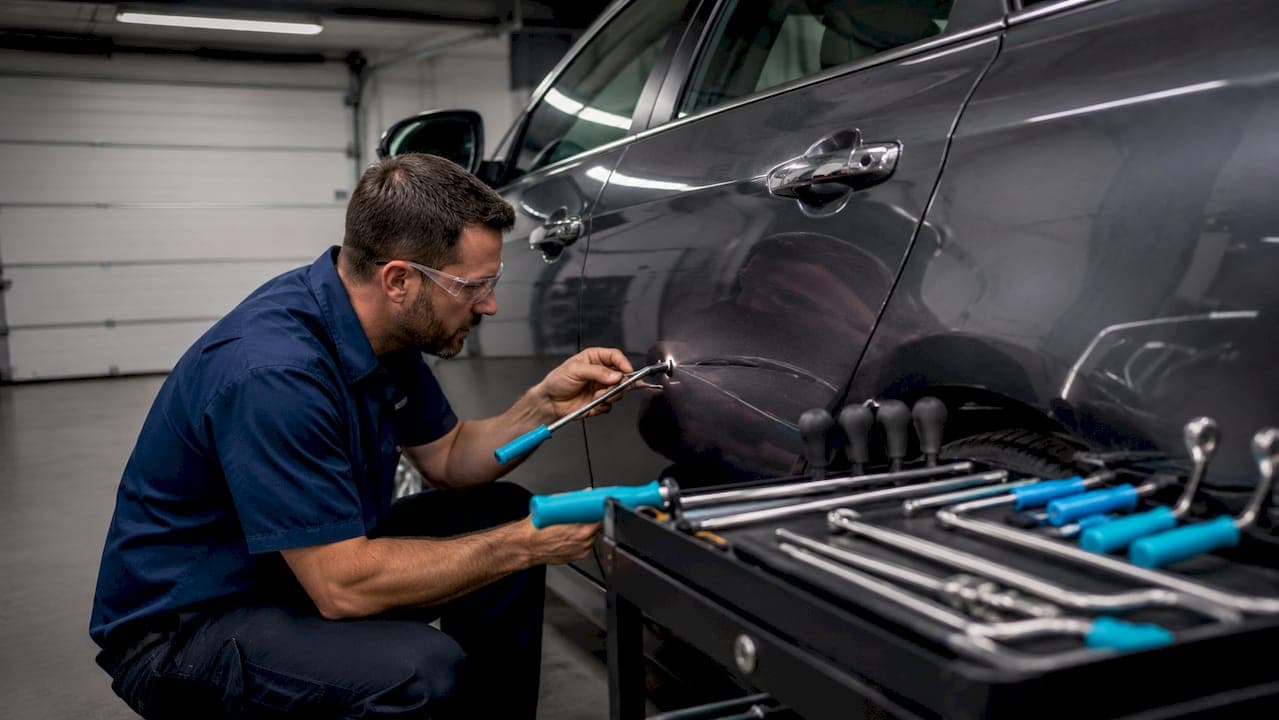
Why crease dents are harder to fix than round dents
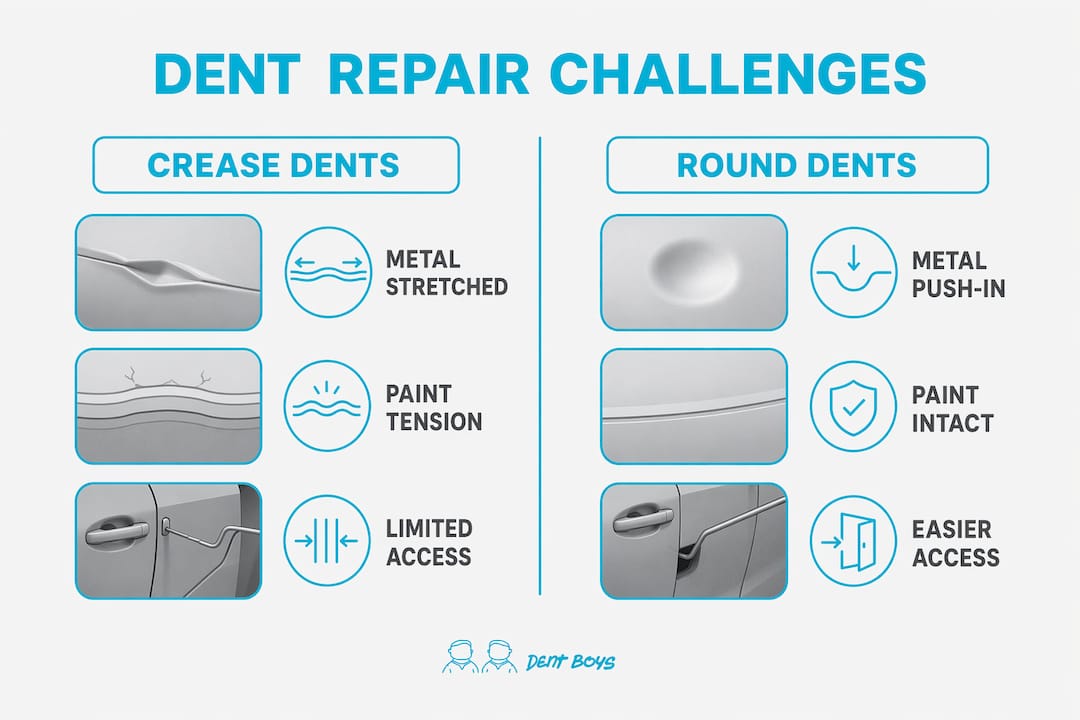
Crease dents are significantly harder to repair than typical round dents because the metal has been stretched beyond its elastic limit, not just pushed inward. A round dent bends the metal; a crease folds and stretches it along a sharp line. That distinction changes everything about how a technician approaches the repair.
Here is what makes crease repairs so demanding:
- Stretched metal requires tension release first. Before any reshaping can happen, a technician must carefully work out the tension built up along the fold line. Skip that step and the metal pops unevenly, leaving a visible ridge.
- Paint integrity is at serious risk. The paint over a crease is already under extreme tension from the initial impact. Pushing the metal back up adds more tensile strain, and if the paint has already been stretched close to its breaking point, it can crack during repair.
- Access behind the panel is often blocked. Creases frequently run along body lines, door edges, or reinforced structural zones where getting a tool behind the panel requires removing trim, window mechanisms, and other components.
- Repair time far exceeds a standard dent. A round door ding may take 30–60 minutes with Paintless Dent Repair (PDR), while a sharp crease can take three to five hours or more depending on length and severity.
- Skill requirements are higher. The technician must simultaneously manage the crease line and the raised "crowns" on either side of it, all while keeping the paint warm and avoiding overstretching the panel.
What makes crease dents structurally different from other dent types
A round dent pushes the metal inward while largely preserving its grain structure. A crease does something fundamentally different: it folds the metal along a line, forcing the material to stretch and compress simultaneously. The result is a panel that has been permanently deformed at the molecular level.
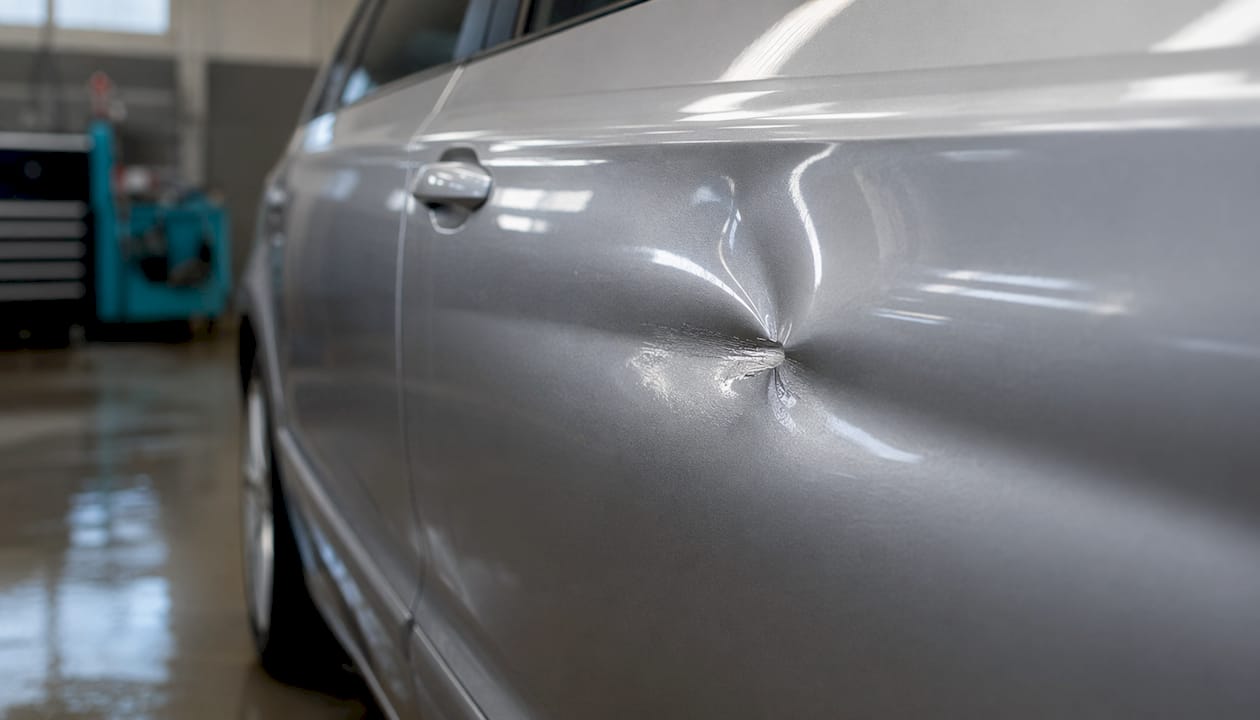
When metal folds sharply, it creates raised areas called crowns on either side of the crease line. These crowns are not cosmetic. They represent stored tension in the surrounding metal, and if a technician works only the crease itself without addressing the crowns, the repair will look wrong. Fixing a crease means working the main fold line and releasing tension in the surrounding metal at the same time.
The paint layer compounds the problem. During dent formation, paint in the crease trough is placed under extreme tension. PDR then induces further tensile strain as the metal is pushed back. If the initial impact already stretched the paint close to its elongation limit, the repair process can push it past the point where the polymer chains snap. That is why paint condition is the first thing any qualified technician checks before touching a crease.
Access is the third structural challenge. Round dents on flat door panels are often reachable through an open door or hood. A crease near a body line, wheel arch, or reinforced pillar may require significant disassembly just to position a tool. The longer the crease runs, the more complex that access problem becomes.
Factors affecting whether PDR can fix a crease dent
PDR is not automatically ruled out for crease dents, but the conditions for success are narrow. Professionals evaluate five factors before committing to a repair approach: paint condition, metal geometry, panel material, location and reinforcement, and access route.
- Paint condition is the first gate. The finish must be fully attached with no visible cracks, lifting, or chipping. Micro-cracking that is only visible under magnification immediately disqualifies PDR. The panel must be sanded to the substrate and refinished using conventional methods instead.
- Crease depth determines repairability. Shallow creases with a low depth-to-width ratio involve gentle stretching over a larger area and respond well to PDR. Deep, sharp creases concentrate stress at a narrow point and often exceed what PDR can fully restore.
- Panel material changes the equation. Steel has memory and tends to spring back toward its original shape. Aluminum hardens quickly and lacks that memory, meaning technicians must push aluminum past flush to achieve a level surface. Repeated pressure on aluminum can cause cracking or tearing.
- Location and reinforcement matter. Creases near structural welds, pillars, or reinforced body lines are harder to access and riskier to work. Ultra-high-strength steel (UHSS) zones are effectively no-repair areas for PDR because the material resists hand tools and can fracture under force.
- Access route must be clear and safe. If a technician cannot identify a protected path to the back of the panel, the correct answer is not to improvise. It is to stop and escalate to conventional repair.
Pro Tip: Before any PDR attempt on a crease, inspect the full stress zone under good lighting, not just the center of the dent. Edge lift, prior repaint, or body filler anywhere in the repair area changes the risk profile entirely.
What the repair process for a crease dent actually looks like
Repairing a crease dent is not a single motion. It is a staged process that requires constant reassessment, and rushing any step produces a worse result than leaving the dent alone.
- Initial assessment and paint inspection. The technician examines the crease under a line board or reflection board to map the low points, crowns, and crease ends. Paint is checked across the entire stress zone, not just the center.
- Tension release before reshaping. The technician works the tension out of the surrounding metal first, softening the crowns before addressing the crease line itself. Skipping this step causes the metal to pop unevenly.
- Continuous heat application. Keeping the panel warm throughout the pushing process maintains paint flexibility and significantly reduces the risk of the clear coat cracking under pressure. A heat gun or hair dryer applied consistently is standard practice.
- Glue pulling and backside pushing. Depending on access, technicians use glue-pull tabs on the outer surface or specialized rods and bars from behind the panel. Door creases often require removing interior trim to reach the backside.
- Gradual, controlled metal movement. Each push is deliberate. Overstretching the panel creates an "oil-canning" effect where the metal becomes so weak it pops in and out with any pressure, making further repair extremely difficult.
- Crown management alongside the crease. As the crease lifts, the technician taps down the surrounding high spots. Body lines can hide tension on either side, so cross-checking the work from multiple angles is necessary throughout.
- Extended repair duration. A crease repair is a repetitive, iterative process. The technician may open and close the dent multiple times before the metal settles into the correct position.
You can learn more about the tools professionals use for this kind of work, including the specialized bars and tips designed for crease and body line repairs.
When traditional body work is the only real option
PDR has real limits, and a good technician knows when to stop rather than push through conditions that will produce a poor result or cause additional damage. Several scenarios make conventional auto body repair the only defensible choice.
- Cracked, chipped, or delaminated paint. Once the paint has failed along the crease line, PDR cannot restore a factory finish. The area must be sanded, primed, color-matched, and clear-coated.
- Metal stretched or torn beyond its elastic limit. When the grain structure of the metal has been fractured by a severe fold, full restoration without filler is physically impossible. Industry consensus from I-CAR and NAPDRT holds that once metal is folded over itself, 100% restoration without filler is not achievable.
- Creases near structural welds, pillars, or hem flanges. The perimeter of closure panels (doors, hoods, trunks) where the outer skin folds over the inner shell creates triple-thickness rigid metal. PDR tools cannot physically fit in this zone, and forcing them risks breaking the adhesive bond that holds the panel together.
- Previous body filler under the dent area. Attempting PDR on a panel with existing filler causes the filler to crack and separate, often resulting in the paint and filler detaching together. What started as a minor crease becomes a full repaint job.
- Work-hardened aluminum panels. Some aluminum creases have been stressed past the point where PDR pressure can move the metal without cracking it. These panels require conventional repair or, in severe cases, panel replacement.
- ADAS sensor zones. Advanced Driver Assistance Systems create no-repair zones on bumpers and body panels where radar transparency is more important than cosmetic straightening. Metal alteration in these areas can disrupt sensor calibration.
For guidance on when conventional repair is the right call for older or classic vehicles, the classic car dent repair guide covers the specific considerations that apply.
What drives the cost of repairing a crease dent
Crease dent repairs cost more than round dent repairs for straightforward reasons: they take longer, require more skill, and carry a higher risk of needing additional work. Understanding the cost drivers helps you evaluate any estimate you receive.
- Labor time is the primary cost factor. A crease repair that takes three to five hours costs proportionally more than a 30-minute door ding, regardless of the repair method.
- Crease length and severity multiply costs. The longer and deeper the crease, the more labor and the higher the risk of paint failure or metal complications.
- Paint condition determines whether repainting is required. A crease with intact paint can often be handled with PDR alone. Cracked or chipped paint adds sanding, priming, color matching, and clear coating to the bill.
- Panel material affects labor and risk. Aluminum panels require more careful handling, specialized tools, and often longer repair times than steel, which typically raises the cost.
- Access complexity adds time. Creases that require removing interior trim, window mechanisms, or other components add disassembly and reassembly time to the total labor cost.
- Diagnostic and teardown steps are not free. A proper assessment of paint condition, metal geometry, and access route takes time before any repair work begins.
- Body filler and paint work escalate costs significantly. When PDR is not viable, the repair shifts to conventional bodywork, which involves more materials, more labor, and a longer turnaround time.
For a clearer picture of what to expect from start to finish, the vehicle dent repair timeline breaks down the process and typical durations for different dent types.
Professional evaluation criteria and repair best practices
Qualified technicians do not eyeball a crease and make a call on instinct. They work through a structured evaluation before committing to any repair method.
The five-point repairability checklist covers paint condition, metal geometry, panel material, location and reinforcement, and access route. Each factor must support a controlled repair outcome. If any one of them raises a red flag, the technician either adjusts the plan or escalates to conventional repair.
- Paint inspection goes beyond the visible. Micro-cracking that is invisible to the naked eye can disqualify PDR entirely. Inspecting the full stress zone, including areas adjacent to the crease, is standard practice before any tool touches the panel. Paint correction specialists, like those at AMB Pro Detailing, often assist in assessing paint condition when the damage is near the edge of PDR viability.
- Metal geometry tells the full story. The technician maps lows, highs, crowns, and crease ends using a reflection board. A long crease with a displaced crown or oil-canning behavior signals that the metal has been stressed beyond what PDR can safely address.
- Material identification is non-negotiable. UHSS and bonded hem flanges create physical barriers that prevent successful PDR near certain panel edges. If the technician cannot confirm the material, the correct answer is to stop and get the information before proceeding.
- The stop-and-escalate principle. Industry experts are clear on this: when repair conditions are unsafe or uncertain, the right move is to stop, not to try harder. Forcing a repair under bad conditions turns a manageable crease into a costly paint failure.
- Continuous heat is a best practice, not optional. Keeping the panel warm throughout the pushing process is what separates a clean repair from a cracked clear coat.
Pro Tip: If you suspect a panel has had previous body filler work, always check before attempting PDR. A simple tap test or inspection under raking light can reveal filler beneath the surface. Attempting PDR on a filled panel risks cracking the filler and detaching the paint, turning a minor repair into a full respray.
Dent-boys handles crease dents the right way
Crease dents sit at the harder end of the PDR spectrum, and the difference between a clean repair and a costly paint failure comes down to the technician's judgment and technique. That is exactly where Dent-boys delivers.

Dent-boys specializes in paintless dent repair for all dent types, including crease dents, with technicians who know when PDR is the right call and when it is not. Every repair comes with a lifetime warranty, a $0 deductible, and a rental vehicle so your schedule does not have to change. Free estimates and pick-up and delivery service mean you get a professional assessment without any upfront commitment. If your crease dent qualifies for PDR, Dent-boys restores your car to factory condition without touching the paint. If it does not, they will tell you straight. Get your free estimate today at dent-boys.com.
Key Takeaways
Crease dents are harder to fix than round dents because stretched metal requires tension release before reshaping, and paint integrity, access, and material type all determine whether PDR is even viable.
| Point | Details |
|---|---|
| Stretched metal is the core problem | Crease dents fold and stretch metal beyond its elastic limit, requiring tension release before any reshaping can begin. |
| Repair time is significantly longer | A sharp crease repair may take three to five hours or more depending on length and severity, compared to 30–60 minutes for a typical round door ding repair. |
| Five factors determine PDR viability | Paint condition, metal geometry, panel material, location, and access route all must support a controlled repair outcome. |
| Aluminum and UHSS panels raise the stakes | Aluminum hardens quickly and lacks steel's memory; ultra-high-strength steel zones are effectively no-repair areas for PDR. |
| Dent-boys offers expert crease dent assessment | Dent-boys provides free estimates and lifetime-warranted PDR, with honest guidance on when conventional repair is the better path. |