
Insurance can cover a door ding, but only under specific conditions, and whether it makes sense to file at all is a separate question from whether it's technically covered. Collision, comprehensive, and liability coverage each handle different scenarios, and every one of them comes with a deductible that often costs more than the repair itself.
TL;DR:
- Filing a claim for a small door ding is often unnecessary since repair costs typically fall below the common deductibles of $250 to $1,000.
- Insurance coverage depends on the cause; collision covers damage from hitting objects or vehicles, while comprehensive handles non-collision incidents like vandalism or hail.
- An identified at-fault driver’s liability insurance usually covers repairs without involving your deductible, but hit-and-run or uninsured situations require collision or uninsured motorist coverage.
- Document damage thoroughly with photos, police reports, and estimates before filing, as proper evidence increases the chance of claim approval.
- Choosing paintless dent repair can save time and money when paint remains intact, but body shop repair is necessary for cracked paint or major damage.
Table of Contents
- Which insurance types cover door dings?
- Is it worth filing a claim for a small dent?
- What happens if you know who hit your car?
- How do you document and file a door ding claim?
- PDR vs. body shop: which repair actually fits your dent?
- Will a door ding claim raise your insurance rates?
- How does Dent-boys make the claims process easier?
- Where to verify these coverage details yourself
- What actually matters when deciding on door ding coverage
- Sources
Which insurance types cover door dings?
Four types of coverage can apply to a door ding, and knowing which one fits your situation changes everything about how the claim plays out.
Collision coverage pays for damage from hitting another vehicle or object, including a hit-and-run where you can't identify who did it. Comprehensive coverage handles damage from causes other than a collision with another car, such as a shopping cart rolling into your door, hail, or vandalism. Liability coverage belongs to the other driver, not you, and pays for damage they cause to your vehicle. Uninsured motorist property damage (UMPD), available in some states, steps in when an identified driver hits you but carries no insurance.
Real-world scenarios usually sort themselves into one of these buckets:
- A stranger's door dings yours in a parking lot and drives off: collision coverage (if you carry it).
- Someone keys your door out of spite: comprehensive coverage.
- A tree branch or falling object dents your door: comprehensive coverage.
- An identified driver hits your door and has insurance: their liability coverage pays.
- An identified driver hits you but has no insurance: UMPD, where your state and policy allow it.
Standard policies exclude normal wear and tear, and insurers explicitly exclude pre-existing damage from any dent or scratch claim. If you can't tie the damage to a specific event, don't expect a payout.
Is it worth filing a claim for a small dent?
This is where the math actually matters more than the coverage question. A dent is technically insurable and still not worth reporting.
A quick statistic to anchor the decision: typical paintless dent repair for a small door ding runs about $50 to $200, while most auto insurance deductibles sit between $250 and $1,000. Do the subtraction, and a lot of door dings simply don't clear the deductible threshold.
Here's the break-even logic in practice:
- When repair costs are below your deductible, paying out of pocket usually makes sense.
- If repair costs modestly exceed the deductible, the benefit of filing a claim may be outweighed by potential premium increases.
- For more extensive damage well above the deductible, filing a claim is generally beneficial.
The insurance industry generally treats these repairs as cheaper to pay for directly than to run through a claim once you weigh the deductible against a possible rate bump. Insurers also don't treat every claim the same on your record. Whether the incident gets coded as collision or comprehensive can shape whether it's flagged as a surcharge-triggering event, so it's worth asking the adjuster directly how they plan to classify it before you commit to filing. Our guide on why filing a claim for dents breaks this down further if you're weighing a specific dollar amount.
What happens if you know who hit your car?
An identified at-fault driver changes the entire equation in your favor.
- If the other driver is identified and clearly responsible, their property damage liability coverage typically pays for your repair, and you don't touch your own deductible at all.
- If the driver fled the scene (a classic parking lot hit-and-run), you'll need your own collision coverage, or UMPD if your state and policy include it, since there's no at-fault party to pursue.
- Check for security cameras nearby (store entrances, ATMs, traffic cams) before you leave the scene. Footage can turn an unknown hit-and-run into an identified-driver claim.
- File a police report for hit-and-run incidents. Some insurers require one to process a UMPD or uninsured motorist claim at all.
State rules on UMPD vary widely; some states bundle it automatically, others make it optional, and a few don't offer it. Call your agent and ask directly whether your policy includes it, because assuming it's there when it isn't leaves you covering a hit-and-run out of pocket.
How do you document and file a door ding claim?
Good documentation is what separates a smooth claim from a drawn-out argument with an adjuster. Work through this in order:
- Photograph everything. Take wide shots showing the dent's location on the vehicle and close-ups with something for scale. Timestamp them if your phone doesn't do it automatically.
- Collect witness and camera information. Names, phone numbers, and the location of any nearby security cameras all strengthen your case later.
- Note the time and place. Parking lot, level, row, and approximate time all help if you need to request camera footage afterward.
- File a police report when appropriate, especially for hit-and-run damage. Prompt evidence collection and a timely police report meaningfully improve your odds of a successful UMPD or hit-and-run claim.
- Get repair estimates, including from a paintless dent repair specialist, not just a body shop. PDR estimates tend to run lower and faster.
- Contact your insurer and provide photos, the estimate, and any police report number. Adjusters generally want documented proof before approving payment.
Pro Tip: Ask your insurer if they'll accept an independent PDR estimate instead of forcing you through their preferred shop network. Many will, and it often gets your car fixed faster.
PDR vs. body shop: which repair actually fits your dent?
The repair method you choose affects both your out-of-pocket cost and how fast you get your car back, regardless of who's paying.
Paintless dent repair (PDR) works by gently manipulating the metal from behind the panel, and it's the right call whenever the paint hasn't cracked. It preserves the factory finish, typically completes in one to three hours for a single small dent, and usually costs $50 to $200 depending on size and location.
Traditional body shop repair becomes necessary when paint is cracked, metal is creased too sharply for PDR, or a panel needs filler. Costs climb past $300 quickly once you factor in color matching, filler, primer, and a full repaint, and turnaround stretches to days instead of hours.
A few things worth weighing before you pick a shop:
- PDR preserves original factory paint, which matters for resale value.
- Body shop work is unavoidable once paint is cracked or metal is torn.
- Ask about direct billing with your insurer either way. It avoids you fronting the repair cost and waiting on reimbursement.
- A lifetime warranty on the repair (something not every shop offers) protects you if the same panel dents again down the road.
Curious about the technical line between the two? Our breakdown of dent repair without painting covers exactly when PDR stops being an option. And if a panel is bent badly enough that repair alone won't cut it, our repair vs. panel replacement guide lays out that decision too.
Will a door ding claim raise your insurance rates?
Filing a claim doesn't automatically mean a rate hike, but the classification behind the scenes matters more than most drivers realize.
Claims where you're clearly not at fault (someone else's liability pays, or a comprehensive claim for vandalism) are less likely to surcharge you than a collision claim where fault is ambiguous. Progressive notes that how the claim gets coded, collision versus comprehensive, directly affects whether it's treated as a rate-impacting event, so don't assume every payout looks the same to your insurer.
Before you file, ask your agent:
- Will this be coded as an at-fault or not-at-fault claim?
- How long does a claim like this stay on my record?
- Does my policy offer accident forgiveness, and does this qualify?
If the math doesn't favor filing, you have real alternatives. Pay out of pocket for anything under your deductible, ask the other driver's insurer to pay directly when they're at fault, or take a larger loss to small-claims court if the at-fault driver is uninsured and the damage is significant. For a deeper look at how filing history follows you, see our guide on when filing a dent claim actually pays off.
How does Dent-boys make the claims process easier?
Dent-boys built its process around paintless dent repair specifically because it removes most of the friction drivers hit when dealing with insurance. Every job starts with a free estimate, and Dent-boys handles pick-up and delivery so you're not stuck without a car mid-repair, backed by a rental vehicle while the work gets done.
For insurance-funded jobs, Dent-boys works directly with adjusters and supports $0 deductible assistance where your policy allows it, cutting out the back-and-forth that normally slows a claim down. Every completed repair carries a lifetime warranty, so if a panel takes another hit later, you're covered without reopening a new claim from scratch.
Ready to get your dent assessed? Start with a free estimate from Dent-boys and find out whether PDR can get your door back to factory condition without touching a paint booth.
Where to verify these coverage details yourself
For policy-specific wording, check GEICO's guide on scratch and dent coverage, Progressive's liability claim breakdown, and The Zebra's cost comparison. For prevention, see Collision Auto Glass's guide to door damage causes.
What actually matters when deciding on door ding coverage
Most advice on this topic treats "does insurance cover it" as the whole question, and that's the part that misleads people. The coverage question is almost always answerable in five minutes with your policy declarations page. The harder, more valuable question is whether filing makes financial sense, and that's the part conventional guides gloss over.
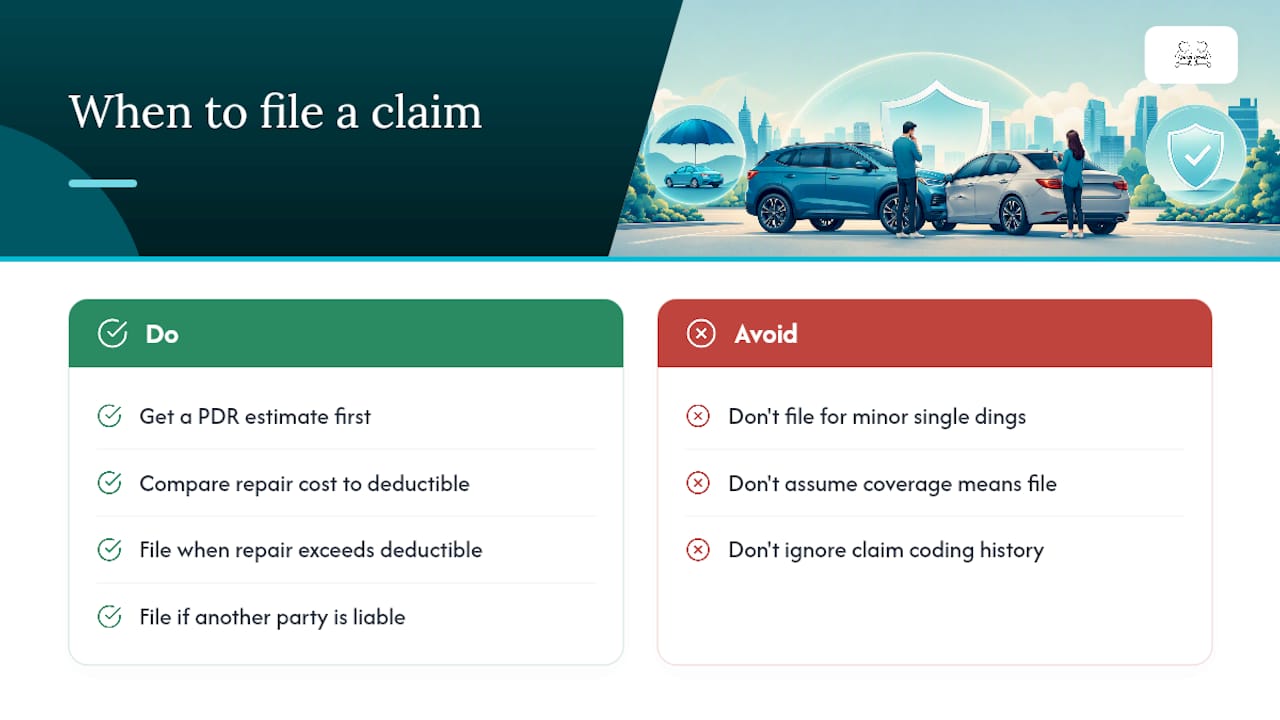
Here's what I'd prioritize if I were the one with the dent: figure out the repair cost before you call your insurer, not after. A PDR estimate takes fifteen minutes and costs nothing, and it tells you immediately whether you're looking at a $150 fix or a $600 one. That number, compared against your deductible, answers the real question faster than any coverage chart.
The other thing worth saying plainly: people over-file. A single ding rarely justifies the paperwork once you account for how claim history gets coded. Save the claim for the incidents that are genuinely expensive, or where someone else's liability is paying, not your own pocket.
— Martin
Sources
- Does Car Insurance Cover Scratches and Dents? | GEICO
- Does Car Insurance Cover Scratches and Dents? | Progressive
- Does Car Insurance Cover Scratches, Dents and Cosmetic Damage? | The Zebra
- What To Do If Someone Dents Your Car | Freeway Insurance