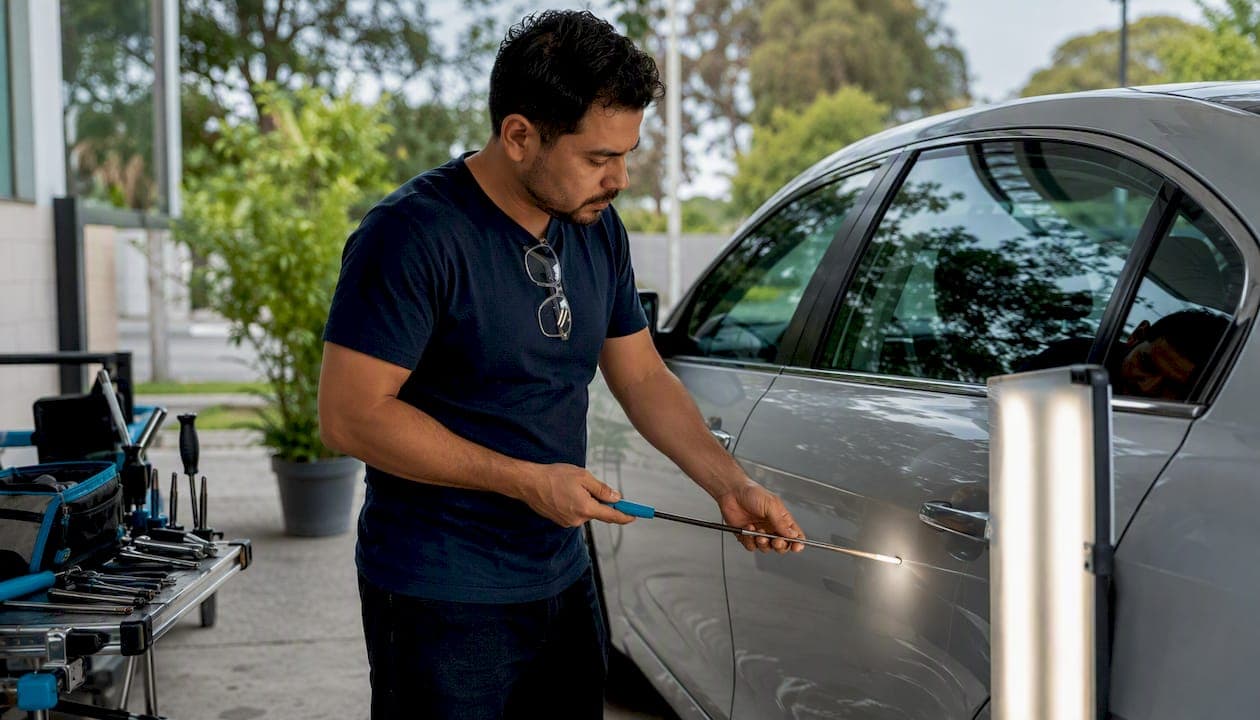
A competent PDR technician must clear five minimum bars before you hand over your keys: a verifiable credential (Vale certification or equivalent timed-test result), a before/after portfolio showing similar damage on comparable panels, active use of LED reflection boards during diagnosis, a written estimate with a warranty, and a realistic repair timeline. For minor door dings, that means 1–3 hours; for hail or extensive damage, 1–2 days. Any technician who can't confirm all five on first contact is a risk.
Quick pass/fail checklist — copy this before your next call or visit:
-
Vale certification verifiable in Vale's database, or documented timed-test credential from another recognized program
-
Before/after portfolio with damage similar in type, size, and panel material to yours
-
LED reflection boards used during both diagnosis and finishing
-
Written estimate provided before work starts, with warranty terms in writing
-
Proof of liability insurance and a valid business license
-
Quoted timeline matches typical industry expectations for minor and extensive damage times.
Pro Tip: Screenshot this checklist and run through it on the phone before scheduling. A technician who hesitates on any item — especially insurance or portfolio — is telling you something.
Table of Contents
- PDR technician skill benchmarks: the three checks that matter most
- What U.S. PDR certifications actually measure and how to verify them
- 1. Metal reading and controlled tool movement
- 2. LED reflection board usage
- 3. Glue pull competency and finish knockdown
- 4. Aluminum panel experience
- 5. Damage assessment and reparability judgment
- 6. Portfolio quality and experience verification
- 7. Red flags and exact questions to ask
- 8. Warranties and what post-repair inspection should look like
- 9. Mobile vs. shop-based PDR: when each makes sense
- 10. Timeline and pricing benchmarks
- 11. A ready-to-use scoring rubric for comparing technicians
- Key Takeaways
- Why the PDR industry's skill gap is bigger than most car owners realize
- Dent-boys checks every benchmark before the job starts
- Useful sources
PDR technician skill benchmarks: the three checks that matter most
The three non-negotiables are verifiable repair quality, proper lighting and tooling, and a clear warranty backed by insurance. Certificates alone don't cut it. A training-school diploma confirms instruction happened; it says nothing about whether the technician can actually finish the last 5–10% of a dent without leaving waviness in the panel. That final refinement is where skill gaps show up, and it's invisible without LED lighting.
The practical priority order: First, ask to see a portfolio with LED-lit before/after photos of similar damage. Second, confirm the technician uses LED reflection boards on every job. Third, get the warranty and insurance details in writing before any work begins. Credentials support those three checks — they don't replace them.
Three immediate actions:
- Request a portfolio with dated, same-angle before/after photos and at least one example matching your damage type
- Ask specifically whether LED reflection boards are used during diagnosis and finishing (not just during the repair)
- Confirm warranty scope, duration, and the remediation process in writing before signing anything
What U.S. PDR certifications actually measure and how to verify them
Vale Training Solutions is the only nationally recognized, independent, technology-based PDR certification in the United States. NAPDRT membership signals industry accountability. But neither credential is proof of excellence on its own — they are a starting point for verification, not a finish line.
Vale certification
Vale's testing method is what separates it from every training-school certificate on the market. Technicians complete timed repairs on steel and aluminum panels, and results are measured using a digital-optic surface measurement device. There's no subjective grading. The repair either meets the quality threshold or it doesn't. Vale issues three levels: Journeyman, Craftsman, and Master, each reflecting increasing precision and complexity. Once certified, a technician is listed in Vale's database, which you can check independently.
How to verify a Vale claim:
- Ask the technician for their full name as listed in Vale's database
- Go to Vale's certification lookup and confirm the name, level, and active status
- Ask for the certificate number as a secondary check
NAPDRT membership
The National Association of Paintless Dent Repair Technicians functions as an industry accountability body. Membership doesn't involve a timed repair test, but it does signal that a technician has opted into a professional community with published standards. NAPDRT explicitly prohibits drilling access holes — a practice that disqualifies any technician who uses it.
Training-school certificates and other credentials
PDR University and similar institutions publish structured certification ladders covering technician, master technician, and instructor levels with defined skill sets. The Ding King Training Institute, operating for over 30 years, offers completion certificates and is approved by the California State Approving Agency for Veterans Education. These certificates confirm that instruction occurred. They don't measure repair outcomes the way Vale does.
I-CAR and ASE credentials indicate broader collision repair competency, not PDR-specific skill. They're worth noting on a resume, but they don't substitute for PDR-specific testing.
Verification checklist:
- Check Vale's database for the technician's name and certification level
- Confirm NAPDRT membership at napdrt.org
- Ask for training-school certificate numbers and the school's contact information
- Request proof of liability insurance and business license separately — these are not covered by any certification body
Industry estimates put the real learning curve at 6 months to 2–3 years of consistent practice, depending on job volume and specialty. A freshly certified technician is not incompetent, but they haven't yet seen the full range of what the job throws at you.
1. Metal reading and controlled tool movement
Metal reading is the foundational PDR skill, and it's the hardest to fake. A technician who can read metal understands how force applied at one point travels through a panel, and they adjust pressure incrementally rather than pushing hard and hoping. The last 5–10% of a dent is the most demanding part of any repair — that's where waviness gets introduced if tool movement isn't controlled.
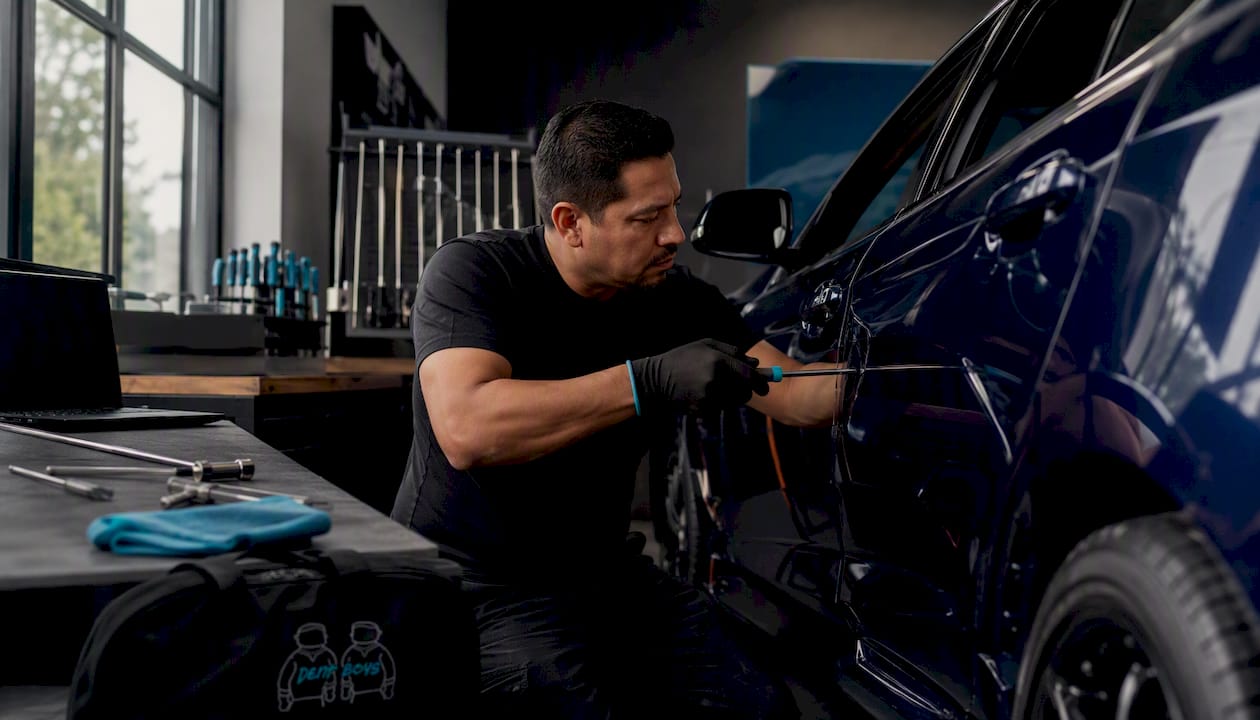
Measurable benchmark: Ask the technician to walk you through their approach to a specific dent on your vehicle. A competent tech describes the access point, the tool selection, the expected metal movement, and the finishing sequence. Vague answers ("I just push it out") indicate limited diagnostic thinking.
Evidence to request: Short video clips showing incremental metal movement during a comparable repair, or an on-site demonstration on a removable or non-critical panel.
2. LED reflection board usage
LED reflection boards are not optional equipment. They reveal the microscopic surface movement that determines whether a repair is truly finished or just close enough. Technicians who skip them during diagnosis are likely to miss low spots and high spots that become visible in direct sunlight after delivery.
Measurable benchmark: Confirm that the technician uses LED boards during both the diagnostic phase and the finishing phase, not just during the repair itself. Ask to see a photo of their lighting setup.
Pro Tip: If a technician says they "don't need" LED boards because they have good eyes or work in natural light, that's a red flag. Natural light doesn't reveal the same surface detail as a reflection board, and no amount of experience changes the physics.
The professional tool set for quality PDR always includes multiple rod lengths, tip configurations, precision knockdown tools, and a quality LED lighting system. Any shop or mobile operator missing the lighting component is working with incomplete information.
3. Glue pull competency and finish knockdown
Glue pulling is used when rod access isn't available, typically on exterior panels where drilling would be required otherwise. Done correctly, it lifts the dent without rippling the surrounding metal. Done poorly, it leaves a ring of stretched metal around the repair area that's harder to correct than the original dent.
Measurable benchmark: Ask for before/after photos of glue-pull repairs specifically. Look for consistent surface texture across the entire panel, no circular ripple patterns, and paint integrity throughout. A technician who can't produce glue-pull examples has a gap in their toolkit.
Finish knockdown, the final step of tapping down any high spots after the dent is raised, requires precision tools and a light touch. Waviness at this stage is the most common failure point in PDR work.
4. Aluminum panel experience
Aluminum panels behave differently from steel. The metal is less forgiving, work-hardens faster, and requires different tool pressure and technique. Vehicles like the Ford F-150 (aluminum body since 2015) and most luxury European brands use aluminum extensively. A technician without documented aluminum experience should not work on these vehicles.
Measurable benchmark: Ask directly: "Have you repaired aluminum panels on vehicles like mine?" Request specific examples with photos. Aluminum repairs should show the same clean finish as steel work, with no cracking or paint stress at the repair edges.
For high-value vehicles, the finish standards are stricter, and the cost of a botched aluminum repair can exceed the cost of panel replacement.
5. Damage assessment and reparability judgment
A skilled technician tells you upfront when PDR isn't the right answer. Dents with paint damage, sharp creases, or structural involvement may not be repairable without traditional bodywork. A tech who promises to fix everything with PDR regardless of damage type is either overconfident or not being straight with you.
Measurable benchmark: Present the technician with your specific damage and ask: "Is this fully repairable with PDR, or will some evidence remain?" A qualified technician gives you an honest answer with a clear explanation. Evasive or overly optimistic responses without a physical inspection are a warning sign.
Understanding when PDR is appropriate versus panel replacement is part of a competent technician's diagnostic skill set, not an optional add-on.
6. Portfolio quality and experience verification
Years of experience matter less than the type and volume of repairs a technician has completed. Three years doing only minor door dings is a different skill level than three years handling hail restoration on aluminum-bodied trucks. Look for relevant, recent, verifiable work.
A high-quality portfolio shows:
- Dated before/after photos with consistent lighting and same-angle shots
- Diagnostic photos taken with LED boards visible in the reflection
- Examples of similar vehicles and panel materials to yours
- Repairs on panels comparable in complexity to your damage
Industry guidance recommends looking for technicians with at least 3–5 years of PDR experience, enough time to develop judgment across diverse damage types and vehicle constructions. A newly trained technician isn't automatically unqualified, but the learning curve is real.
Verification steps:
- Ask for three references from customers with similar damage types
- Check Google and Yelp reviews for photos, dates, and repair type mentions
- Ask whether any warranty claims have been filed and how they were resolved
- If photos aren't available, request an on-site demonstration on a non-critical panel
Attention to detail, dexterity, and problem-solving are the soft skills that separate good technicians from great ones. They show up in portfolio quality, in how a technician describes their process, and in whether they catch issues before they become problems.
7. Red flags and exact questions to ask
The single biggest disqualifier: any technician who suggests drilling access holes to reach a dent. This permanently damages the vehicle, alters structural integrity, and is prohibited by insurance companies. Walk away immediately if this comes up.
Questions to ask, with passing and failing responses:
-
"Are you Vale certified? Can I verify that in Vale's database?" Pass: provides full name as listed, confirms level. Fail: vague, says "I have my own certification."
-
"Do you use LED reflection boards during diagnosis and finishing?" Pass: yes, describes their setup. Fail: "I use natural light" or "I don't need them."
-
"What's your approach for accessing this dent?" Pass: describes tool selection, access point, and expected metal movement. Fail: "I'll figure it out when I get there."
-
"Do you carry liability insurance? Can I see proof?" Pass: provides certificate of insurance on request. Fail: hesitation, says it's not necessary.
-
"What warranty do you offer, and is it in writing?" Pass: describes scope, duration, and remediation process clearly. Fail: "I stand behind my work" with no documentation.
Red-flag behaviors beyond drilling:
- Reluctance to show a portfolio or provide references
- Pressure to start immediately without a written estimate
- No lighting equipment visible on a mobile visit
- Inability to explain the repair process step by step
- Quoting a price significantly below market without explanation
NAPDRT explicitly prohibits drilling holes in panels for access, noting it's a practice used by uncertified operators. If a technician can't explain how they'll access a dent without drilling, that's a problem.
8. Warranties and what post-repair inspection should look like
A credible PDR warranty covers visible defects caused by the repair, specifies a clear remediation path, and is backed by a documented shop policy and proof of insurance. "I guarantee my work" spoken aloud is not a warranty.
Warranty elements to confirm in writing:
- Scope: what defects are covered (waviness, paint stress, incomplete dent removal)
- Duration: lifetime vs. fixed term (one year, two years)
- Remediation: what happens if you're not satisfied (re-repair, refund, third-party inspection)
- Transferability: whether the warranty follows the vehicle if you sell it
To verify a warranty is real, ask for a sample contract or written policy, and check reviews specifically for mentions of warranty claims being honored. A shop that has never had a warranty claim honored is either very new or very good at avoiding accountability.
Post-repair inspection steps:
- Walk around the vehicle with an LED board or in direct sunlight at a low angle
- Check the repaired panel from multiple distances (3 feet, 10 feet, 20 feet)
- Run your hand lightly across the repair area to feel for any remaining low spots
- Ask for a written completion checklist documenting the pre-repair condition and the final result
9. Mobile vs. shop-based PDR: when each makes sense
Mobile PDR can match shop quality when the technician brings proper lighting, sufficient tooling, and can control environmental variables. When those conditions aren't met, a shop is the safer choice.
| Evaluation factor | Mobile PDR | Shop-based PDR |
|---|---|---|
| Lighting control | Depends on technician's LED setup | Controlled environment standard |
| Tool availability | Limited to what's in the van | Full tool inventory on-site |
| Environmental variables | Weather, wind, temperature | Controlled |
| Insurance handling | Varies by operator | Typically handled in-shop |
| Warranty fulfillment | Requires follow-up visit | On-site resolution |
| Best for | Minor dings, convenience jobs | Hail, complex aluminum, multi-panel |
When mobile works well: single door dings, minor parking lot damage, situations where convenience outweighs complexity.
When a shop is preferable: extensive hail damage, aluminum-bodied vehicles, multi-panel repairs, or any job requiring insurance documentation and formal sign-off.
Checklist for mobile visits:
- Confirm the technician brings LED reflection boards (ask specifically)
- Ask where the repair will be performed (covered area vs. open parking lot)
- Verify power/electrical access for lighting equipment
- Confirm how warranty claims are handled if a follow-up is needed
Contactless repair logistics, including pick-up and delivery, can work well for mobile service when the operator has a documented process for pre-repair condition photos and written estimates.
10. Timeline and pricing benchmarks
Minor PDR jobs typically take a few hours. Extensive or hail damage usually requires one or more days. Use those as your baseline when reviewing any estimate.
| Damage type | Expected duration | Setting |
|---|---|---|
| Single small door ding | 1–3 hours | Mobile or shop |
| Multiple door dings, same panel | 3–5 hours | Mobile or shop |
| Moderate multi-panel damage | 1 day | Shop preferred |
| Extensive hail, full vehicle | 1–2 days | Shop |
| Complex aluminum panel work | Add substantially to steel estimate | Shop |
Pricing signals to watch:
- A quote significantly below market for hail restoration usually means diagnostics are being skipped or inferior methods are being used.
- A high quote for aluminum work is often legitimate — the technique is more demanding and the risk of error is higher.
- Any estimate that doesn't itemize labor, glue-pull charges, and warranty coverage is incomplete.
Estimate checklist:
- Itemized labor by panel or damage area
- Glue-pull charges listed separately if applicable
- Warranty coverage stated explicitly
- Expected completion date confirmed in writing
- Pre-repair vehicle condition documented (photos or written notes)
11. A ready-to-use scoring rubric for comparing technicians
A practical 100-point rubric covering five categories gives you an objective way to compare technicians side by side. Set 75/100 as the minimum threshold for routine work; raise it to 85/100 for high-end or aluminum-bodied vehicles.
| Category | Points available | Evidence type | Pass threshold |
|---|---|---|---|
| Diagnosis and metal reading | — | Verbal explanation, diagnostic photos | 18/— |
| Tooling and lighting | 20 | LED board confirmation, tool inventory | — |
| Technique execution | — | Portfolio, live demo, video clips | 18/— |
| Finish quality | 20 | Before/after photos, post-repair inspection | — |
| Process and professionalism | 10 | Written estimate, insurance, warranty | 8/10 |
How to weight evidence: A live demonstration on a removable or non-critical panel is worth more than portfolio photos alone, because it shows current skill under real conditions. Portfolio photos confirm past results but can be cherry-picked. Weight live demos at roughly 60% of the technique execution score when available.
Sample test you can request: Ask the technician to perform a timed small-ding repair on a removable panel or demonstrate LED board diagnosis on a comparable panel from their own demo kit. A technician who refuses this request on a first consultation is signaling low confidence in their current skill level.
Interpreting marginal scores: A technician scoring 70–74 on routine work may be acceptable for a low-stakes repair on an older vehicle. Below 70, the risk of visible imperfection or paint damage is high enough to warrant finding someone else. For show-quality standards, the bar is higher than 85/100 across every category.
Competency matrices adapted from skills profiles) can help you build a version of this rubric tailored to your specific vehicle type or damage complexity.
Pro Tip: Run two or three technicians through the same rubric on the same day if you're dealing with significant hail damage. The scoring differences are often larger than you'd expect, and the exercise forces technicians to be specific about their methods.
Key Takeaways
A competent PDR technician must show verifiable repair quality, use LED reflection boards on every job, and back their work with a written warranty and proof of insurance.
| Point | Details |
|---|---|
| Three non-negotiables | Verifiable repair quality, LED lighting on every job, and a written warranty with insurance are the minimum requirements. |
| Vale certification is the gold standard | Vale uses timed, objective testing on steel and aluminum panels with three levels: Journeyman, Craftsman, and Master. |
| Minor repairs take 1–3 hours | Hail or extensive damage takes 1–2 days; quotes outside these ranges warrant a direct explanation. |
| Use the 100-point rubric | Score technicians across five categories; require 75/100 for routine work and 85/100 for high-end or aluminum vehicles. |
| Dent-boys meets the benchmarks | Dent-boys uses LED lighting, provides written warranties, offers free estimates, and supports $0 deductible insurance claims with pick-up and delivery. |
Why the PDR industry's skill gap is bigger than most car owners realize
The conventional wisdom is that certification solves the quality problem in PDR. It doesn't. Certification is a floor, not a ceiling, and the floor is lower than most people assume. Vale's testing is genuinely rigorous — timed, objective, measured with precision instruments. But a Journeyman-level certification means a technician cleared the minimum threshold on a controlled test panel. It doesn't mean they've handled your specific vehicle, your damage type, or the particular challenges of aluminum work on a late-model truck.
What actually separates excellent PDR from mediocre PDR is the finishing work. The last fraction of a repair, removing the final trace of a dent without introducing waviness, is where inexperienced technicians consistently fall short. And it's invisible without LED lighting. That's not a minor detail. It's the reason lighting is listed as a non-negotiable benchmark rather than a nice-to-have.
The other thing most guides understate is how much the mobile vs. shop distinction matters for complex jobs. A skilled mobile technician with proper equipment can do excellent work on a single door ding. But hail restoration on a full vehicle, especially one with aluminum panels, requires a controlled environment, a full tool inventory, and the ability to document pre- and post-repair condition for insurance purposes. Choosing mobile for that job to save a scheduling hassle is a false economy.
The rubric in this article is a tool, not a guarantee. Use it to force specificity from technicians who would otherwise give you vague assurances. The technicians who score well on it are usually the ones who welcome the questions.
Dent-boys checks every benchmark before the job starts
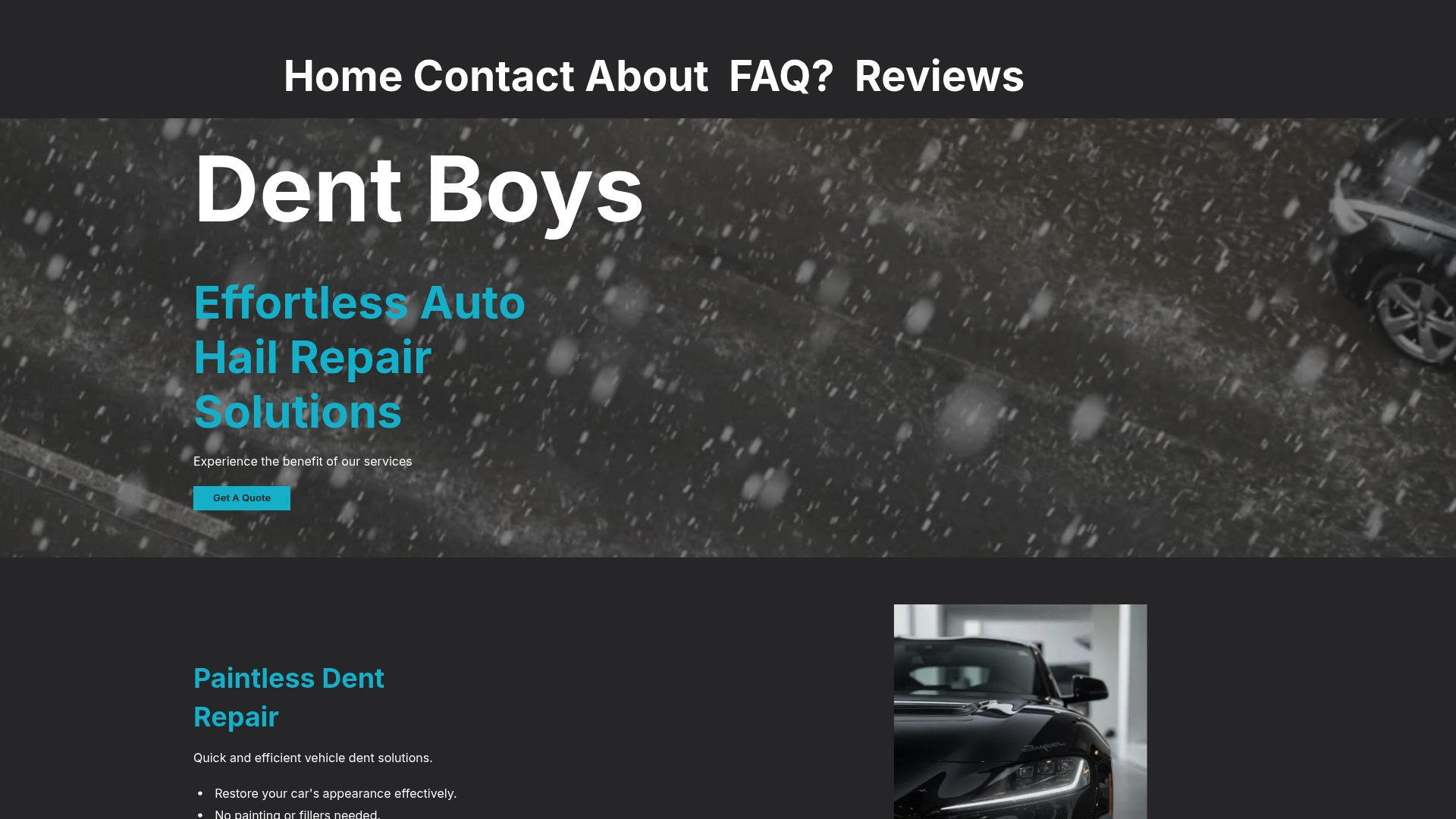
Spending time with this checklist is only useful if the provider you choose actually meets the standards. Dent-boys operates with LED lighting on every job, provides written estimates before any work begins, and backs repairs with a lifetime warranty. Every job includes pre-repair condition documentation, and the $0 deductible support means insurance claims don't become a negotiation you have to manage yourself. Pick-up and delivery are standard, not an upgrade.
Before booking with any provider, request three things: proof of credentials (Vale certification or equivalent), a portfolio with LED-lit before/after photos of similar damage, and the warranty terms in writing. If a provider can't produce all three, the benchmarks in this article tell you exactly what that means.
Dent-boys offers free estimates with no obligation. Have your vehicle's damage type, panel material (steel or aluminum), and any insurance details ready when you reach out.
Useful sources
The sources below back the claims in this article. Use them to verify credentials, check certification databases, and dig deeper into any benchmark.
| Source | What it verifies |
|---|---|
| DentAdvisor: Finding a Qualified PDR Technician | Certification verification steps, red flags, and questions to ask |
| DentAdvisor: PDR Certification and Training Programs | Vale testing methodology, three certification levels, training timelines |
| DentAdvisor: What Makes a Quality PDR Business | LED lighting standards, repair timing benchmarks, quality indicators |
| NAPDRT About Page | Industry association standards and membership accountability |
| NAPDRT Technician Standards | Prohibition on drilling access holes, technician conduct standards |
| Top Gun PDR Training: FAQs | Learning curve realities, difficulty of final refinement work |
| PDR University Certification Program | Structured certification ladder with technician, master, and instructor levels |
| IYS Skills Tech: PDR Skills Profile) | Competency matrices for PDR role evaluation and rubric building |
| Penn Foster: Automotive Technician Skills | Soft and physical skills mapped to observable technician tasks |
| Dent-boys: Auto Hail Repair | Service features including free estimates, lifetime warranty, and $0 deductible support |
To verify a Vale certification claim, go directly to Vale's database and search by technician name. For NAPDRT membership, use the member lookup at napdrt.org. Neither check takes more than two minutes and both are worth doing before any significant repair.