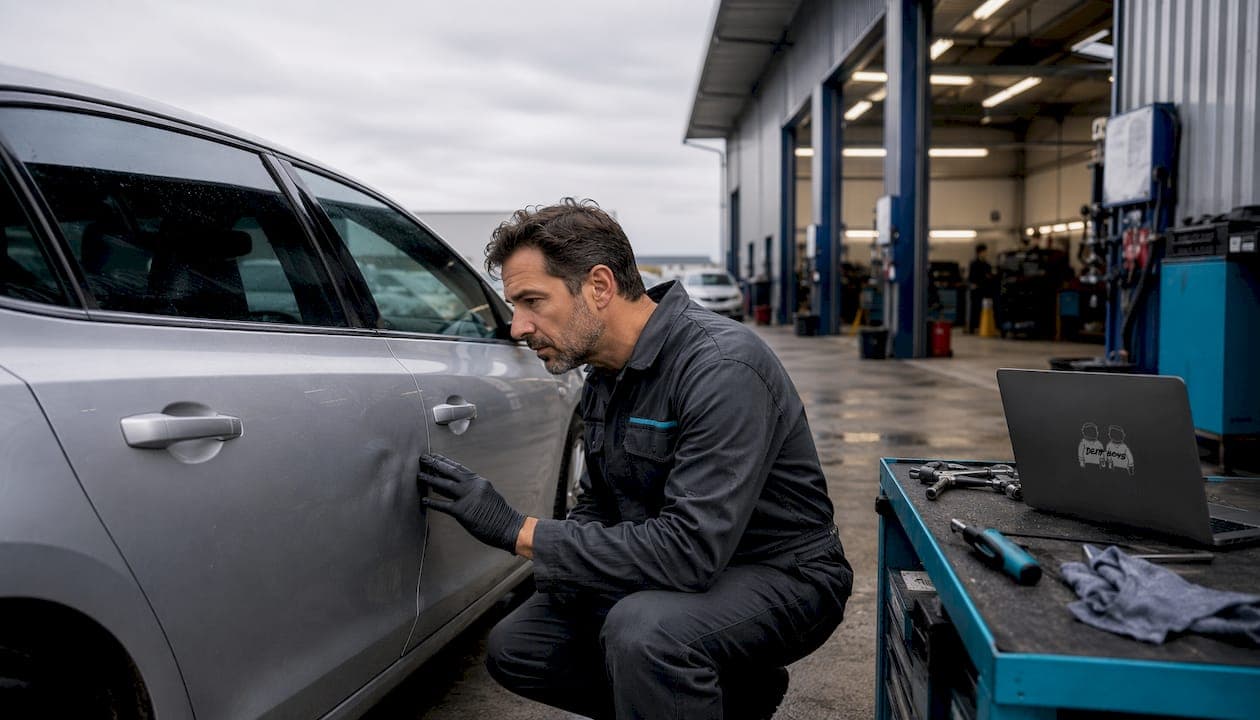
Paintless dent repair (PDR) is the most reliable precision method for restoring dents without repainting. When paint is intact and the metal isn't creased or stretched, PDR preserves your factory finish and typically completes in hours rather than days. Glue-pull systems, suction devices, and controlled thermal techniques (hot water, heat gun, dry ice) can handle very minor, shallow damage on flexible panels. Traditional fill-and-paint stays the fallback when paint is broken, metal is stretched, or creases run deep.
Here's a quick map of when each approach applies:
- PDR: Intact paint, no sharp creases, accessible panel location
- Glue-pull / pull-tab kits: Shallow dents on flat, accessible panels
- Suction / plunger: Very minor, round dents on smooth surfaces
- Heat-then-cool (hot water, heat gun, dry ice): Superficial dents on flexible panels only
- Traditional repair (fill, sand, paint): Paint damage, creases, stretched metal, or prior repairs
Pro Tip: Take a photo of the dent in raking light (a flashlight held at a low angle works). If you can see a sharp line or crease in the reflection, PDR is likely off the table before you even call a shop.
Table of Contents
- What precision dent restoration methods work best for your car?
- How professionals perform a precision PDR restoration
- DIY dent removal: what it can and can't safely do
- When should you hire a professional for dent repair?
- What Dent-boys offers and how their PDR service works
- Key Takeaways
- Why specialist PDR is almost always the right call
- Dent-boys: free estimates, pickup, and lifetime warranty
- Sources and further reading
What precision dent restoration methods work best for your car?
Not every dent responds to the same technique. The method that works depends on three things: paint condition, dent geometry, and panel access.
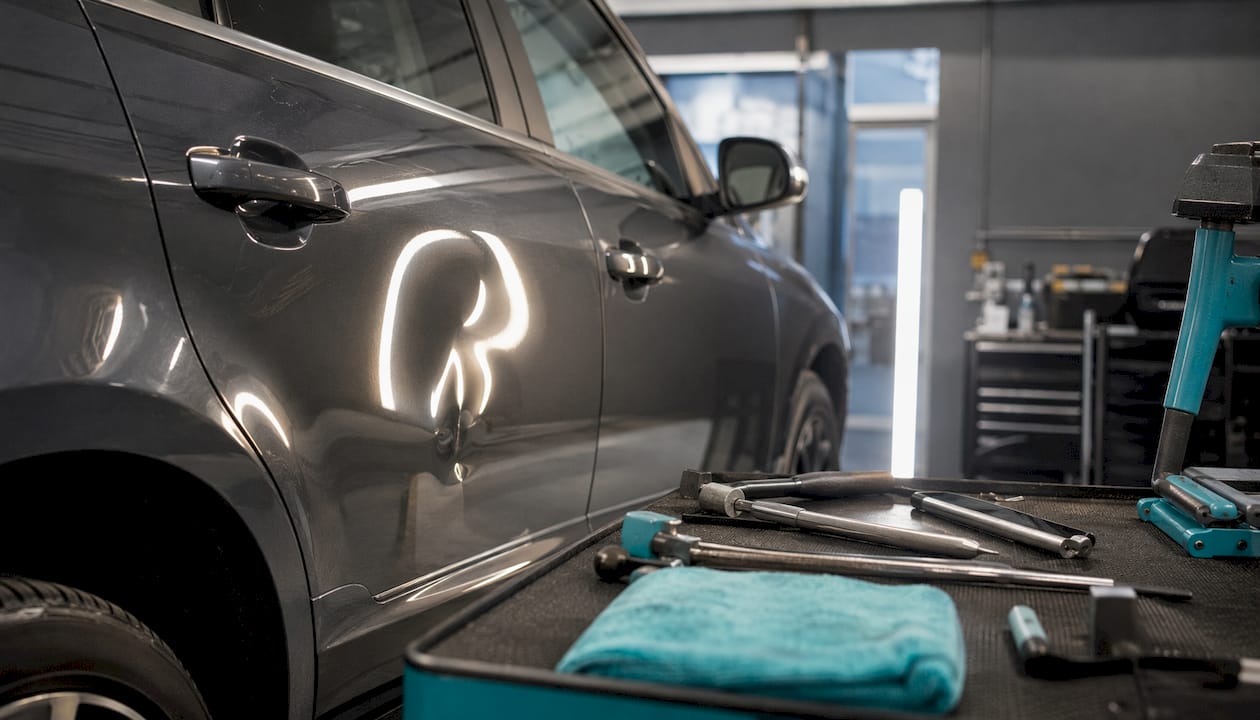
PDR is the gold standard. It avoids sanding, fillers, and repainting, which cuts both material cost and labor time. Most straightforward PDR jobs finish within hours to a couple of days. The hard limit: PDR requires intact paint and metal that hasn't been stretched or sharply creased.
Glue-pull systems use a bridge puller and adhesive tabs to draw the dent outward from the front of the panel. They work well on shallow, round dents on flat door skins. They struggle on curved panels, edges, and anything with a defined crease.
Suction devices are the simplest option and the most limited. A good suction cup can pop out a very minor, dome-shaped dent on a smooth surface. Curves, body lines, and anything deeper than a few millimeters defeat them quickly.
Thermal methods rely on expansion and contraction. Hot water or a heat gun warms the metal; compressed air or dry ice cools it rapidly. This only works on a subset of minor cases and carries real paint risk if applied incorrectly.
| Method | Best dent type | Paint risk | Typical turnaround | DIY-friendly? |
|---|---|---|---|---|
| PDR | Round, shallow, intact paint | Low (pro) | Hours to 2 days | No |
| Glue-pull | Shallow, flat-panel dents | Low–moderate | 1–4 hours | Limited |
| Suction/plunger | Very minor, smooth surface | Very low | Minutes | Yes |
| Heat-then-cool | Superficial, flexible panel | Moderate–high | hours | Risky |
| Fill/sand/paint | Creased, stretched, paint damage | N/A (paint replaced) | couple of days | No |
How professionals perform a precision PDR restoration
Pros get consistent results because they control every variable: access, tool pressure, heat, and documentation. The process isn't guesswork.
Shops that pair LED line boards with calibrated push rods and a documented assessment workflow produce more repeatable cosmetic results than any brute-force pulling approach.
The professional PDR workflow, step by step:
- Assessment and feasibility check — technician photographs the damage, measures paint thickness, and checks for creases or prior repairs under an LED line board.
- Panel access — door panels, trim, or interior liners are removed to reach the back of the damaged metal.
- Controlled pushing — the tech uses push rods, ramps, and knockdown tools to massage the metal back to its original geometry from behind, working in small increments.
- Glue-pull assist (if needed) — a bridge puller with adhesive tabs addresses any remaining high spots from the front.
- Finish and polish — minor surface marks are polished out; the panel is inspected under the line board again.
- Final inspection and warranty documentation — before/after photos are recorded, and the warranty is issued.
Tools professionals rely on:
- Push rods and interchangeable tips (various diameters and curves)
- Tap-down hammers and knockdown tools for high spots
- Glue-pull bridge systems with multiple tab sizes
- LED line boards for visual distortion checking
- Paint thickness gauges
- Heat guns for controlled metal warming
- Paint-polish systems for surface finishing
Digital documentation and scan-based records increase reproducibility and customer confidence. Research comparing fully digital and hybrid fabrication workflows found that reducing manual crossovers between steps cuts cumulative error. The same principle applies in PDR: shops that photograph access points, log paint thickness readings, and document before/after distortion-board images plan repairs more accurately and catch problems earlier.
Pro Tip: When a technician reviews your assessment photos, they're looking for two things: whether the dent has a defined crease (a line, not just a curve) and whether the paint shows any micro-cracking in the center. Either one shifts the job from PDR to traditional repair.
For a detailed breakdown of the tools technicians use in 2026, Dent-boys publishes a regularly updated guide covering equipment and decision criteria.
DIY dent removal: what it can and can't safely do
DIY can work for very shallow dents on flexible panels. For anything deeper, creased, or on a curved body line, the risks outweigh the savings.
A failed DIY attempt can introduce creases or crack the clearcoat, which eliminates the affordable PDR option entirely and pushes the repair into fill-and-paint territory.
Common DIY approaches include plunger/suction cups, hot water poured over the dent, heat gun plus compressed air, dry ice, and inexpensive glue-pull tab kits. Each has a narrow window where it actually works.
Specific risks to know:
- Paint cracking: Rapid temperature changes from hot water or dry ice can crack clearcoat, especially on older vehicles.
- Clearcoat damage: Glue tabs pulled at the wrong angle or left too long can lift clearcoat.
- Panel stretching: Over-pulling with a suction device or glue kit stretches the metal, creating a high spot that's harder to fix than the original dent.
- Introduced creases: Pushing from the wrong angle or with too much force creates new crease lines.
- Safety hazards: Boiling water and dry ice both cause burns; neither is trivial to handle safely.
Most DIY thermal or suction methods only work on superficial, flexible panels. Steel door skins and any creased area require professional access and controlled pushing or specialized pulling rigs.
Pro Tip: Before trying anything, ask yourself three questions: Is the panel flat and accessible? Is the paint completely intact with no chips or micro-cracks? Is the dent round with no visible crease? If any answer is "no," call a pro.
When should you hire a professional for dent repair?
Hire a professional when the dent is deeper than a surface deformation, sits on a panel edge or curve, shows any paint damage, or when resale value matters.
Quick decision checklist:
- Is the dent larger than a quarter? Lean toward a pro.
- Does it have a sharp crease or a defined line? PDR is likely not viable; see a pro.
- Is the paint chipped, cracked, or missing? Traditional repair required.
- Is the dent on a curved panel, door edge, or near a body line? DIY tools won't reach it cleanly.
- Has the panel been repaired before? Prior filler or repaint changes the repair calculus.
- Does resale value or insurance matter? Document everything and get a professional estimate.
Approximate cost ranges (U.S. market):
| Repair type | Approximate cost range | Typical turnaround |
|---|---|---|
| Minor shallow PDR (1 dent) | $100–$200 | Same day |
| Moderate PDR (multiple or larger) | — | 1–2 days |
| Complex PDR (disassembly required) | $600 | 2–3 days |
| Traditional fill/sand/paint | — | couple of days |
Beyond price, weigh these factors: lifetime warranty coverage, whether the shop offers pickup and delivery, free estimates, and loaner or rental vehicle availability. A shop that offers all four removes most of the friction from the process.
Practical tips on insurance and estimates:
- Photograph damage immediately, in good light, before anything touches the panel.
- Get at least two written estimates that specify the method (PDR vs. traditional).
- Confirm whether the warranty covers paint lift resulting from the PDR process itself.
- Check whether your insurer has a preferred-shop program that affects your deductible.
For guidance on when panel replacement makes more sense than repair, Dent-boys publishes a dedicated decision guide.
What Dent-boys offers and how their PDR service works
Dent-boys specializes in paintless dent repair with free estimates, pickup and delivery, and a lifetime warranty on repairs, designed to remove friction from the entire process.
Service features:
- Free estimate (photos accepted for initial assessment)
- Pickup and delivery at no extra charge
- Lifetime warranty covering the repaired area
- Before/after documentation with every job
- Rental vehicle included, $0 deductible
- Typical turnaround aligned with PDR timelines above
Dent-boys documents every repair with before/after distortion-board photos, measures paint thickness when needed, and backs the work with a warranty that explicitly covers paint lift resulting from the PDR process.
When you arrive (or schedule pickup), bring clear photos of the damage, your insurance details if applicable, and a note of the panel location. That prep shortens the assessment and gets your car back faster.
Key Takeaways
PDR is the preferred precision method when paint is intact, and professional service with a lifetime warranty is the lowest-risk path for anything beyond a very minor, shallow dent.
| Point | Details |
|---|---|
| PDR is the primary method | Works when paint is intact and metal has no sharp creases or stretching. |
| DIY has a narrow safe window | Only very shallow, round dents on flat, flexible panels are safe DIY candidates. |
| Failed DIY raises total cost | Introduced creases or paint damage can eliminate the PDR option, forcing pricier traditional repair. |
| Hire a pro checklist | Use the six-point checklist: size, crease, paint condition, panel location, prior repairs, resale stakes. |
| Dent-boys | Offers free estimates, pickup/delivery, rental vehicle, and a lifetime warranty on PDR repairs. |
Why specialist PDR is almost always the right call
The conventional wisdom says "try the DIY trick first, then call a pro if it doesn't work." That advice costs people money. A dent that qualifies for PDR at $100–$200 can become a $600 fill-and-paint job after a botched hot-water attempt cracks the clearcoat or a glue tab lifts the finish. The math rarely favors the experiment.
What PDR actually protects isn't just the paint. It's the factory finish, which matters to resale value in a way that a repainted panel never quite matches. Buyers and appraisers notice repainted panels. A documented PDR repair with a lifetime warranty, on the other hand, is a positive signal.
The one exception worth naming: very old vehicles with already-compromised paint or collector cars where original patina is part of the value. In those cases, the calculus shifts, and a specialist conversation matters more than a standard PDR appointment.
Dent-boys: free estimates, pickup, and lifetime warranty

Dent-boys takes the hassle out of precision dent repair. You get a free estimate, pickup and delivery, a rental vehicle at no cost, and a lifetime warranty on every PDR repair. No deductible, no back-and-forth with a body shop, no repainted panels that hurt your resale value.
The next step is straightforward: take three photos of the damage (straight on, raking light from the left, raking light from the right), note the panel and approximate size, and request a free estimate. The team will confirm PDR viability, schedule pickup, and handle the rest.
Sources and further reading
- CARSTAR: How Do Auto Body Shops Repair Dents? — backs PDR as the primary precision method and outlines its limits (creases, stretched metal, paint damage).
- Caliber Collision: Does Hot Water Really Take Out Car Dents? — source for thermal DIY risks, paint cracking warnings, and the risk that failed DIY eliminates PDR as an option.
- Credit Acceptance: How to Remove Dents from Your Car — documents common DIY methods and their practical limitations.
- Clinical and Experimental Dental Research: Effect of Different Impression and Fabrication Techniques on Precision — research on fully digital workflows reducing cumulative error; used as an analogy for why documented, scan-based PDR assessment improves reproducibility.
- Dent-boys service page — service features, warranty terms, pickup/delivery logistics, and free estimate details.
- Dent-boys blog: Dent Repair Tools Professionals Use (2026) — tool descriptions and technician decision guides for PDR and panel replacement.