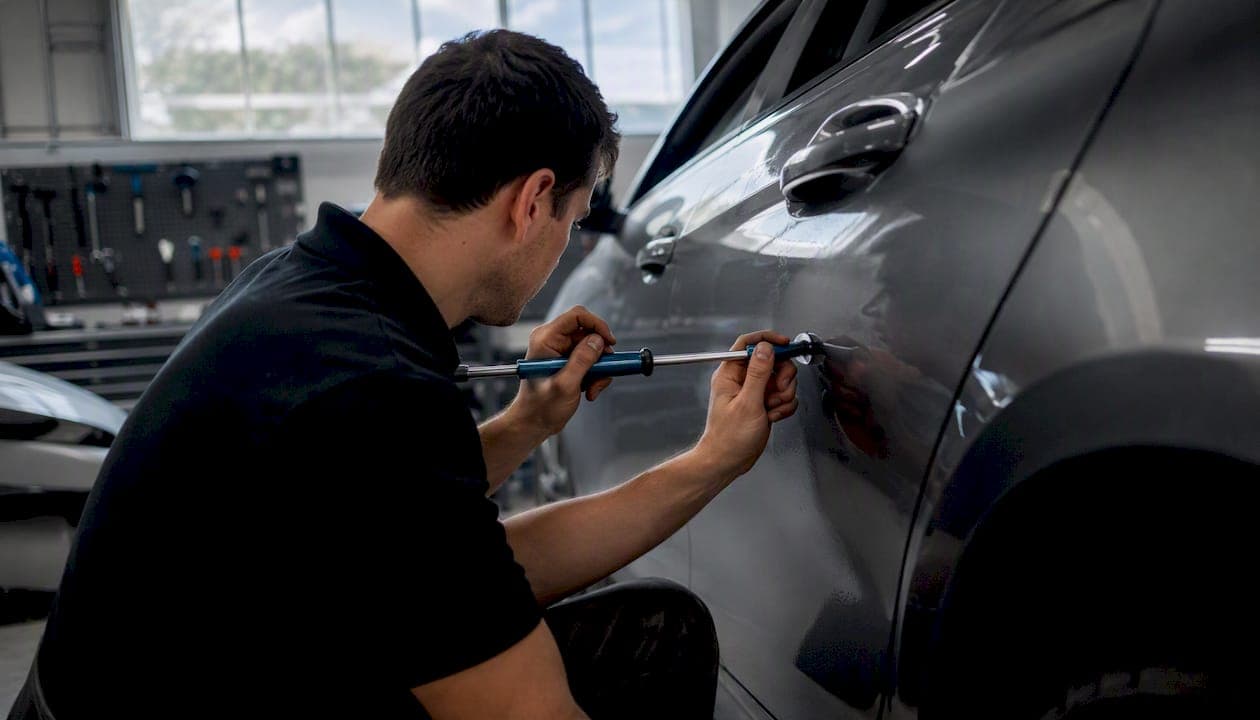
The five appearance fixes that move the needle most are paintless dent repair (PDR), a two-stage paint correction with sealant, wheel and tire restoration, headlight restoration, and a professional detail. Done in that order, they can shift your car from a "Good" to an "Excellent" appraisal tier, reduce dealer deductions by hundreds of dollars, and help a private-sale listing close faster at a stronger price.
Start here:
- Schedule a free PDR estimate this week — dents are the first thing buyers and appraisers notice
- Book a professional detail or block a weekend for a thorough DIY wash, clay bar, and interior clean
- Photograph every panel, wheel, and the interior before any work so you have a before-and-after record
- Pull your service records together now; missing paperwork costs you at trade-in
Table of Contents
- Why a car's cosmetic condition changes the offers you get
- What to fix first — and why the order matters to buyers
- Which repairs actually pay off — costs and ROI by fix
- How your selling channel changes what you should fix
- The show-ready checklist that makes buyers pay more
- What not to fix before you sell
- Why PDR is often the best professional investment before selling
- Key Takeaways
- The seller mistakes I see most often
- Dent-boys gets your car ready to sell
- Useful sources
Why a car's cosmetic condition changes the offers you get
Appearance is often the deciding factor between landing in the "Good" versus "Excellent" condition tier on every major valuation tool, and that gap is worth real money. Buyers and appraisers treat the exterior as a proxy for how the car was maintained overall. A car with door dings, faded paint, and cloudy headlights signals neglect, even when the engine is flawless. That perception directly affects the number on the offer sheet.
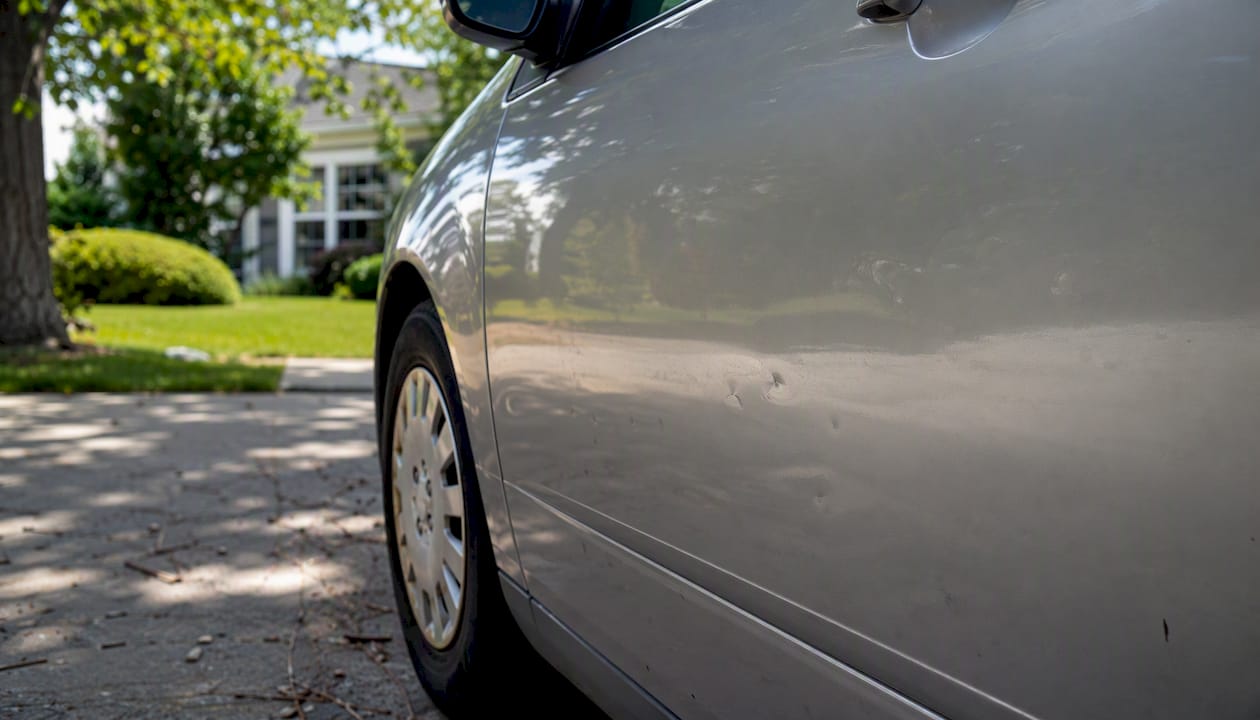
Dealers are especially systematic about this. A repainted panel, for example, can trigger a CPO disqualification or a deduction that wipes out any negotiating room you thought you had. According to resale value guidance from Clean Fleet Report, typical cosmetic deductions can range from hundreds to over a thousand dollars depending on the issue, with non-OEM repainted panels sometimes causing disqualification from certified pre-owned programs.
Private buyers react differently from dealers, but not more generously. A private buyer who spots a repainted quarter panel immediately wonders what accident caused it and what else might be hidden. That suspicion either kills the deal or hands them a negotiating chip. Keeping the factory paint intact, and documenting that you did, removes that friction entirely.
Service history compounds the effect. CarBuzz's resale research consistently shows that upkeep records routinely add $500–$1,500 over comparable cars sold without paperwork. The car that arrives with a folder of receipts and a clean exterior tells a coherent story. The one that doesn't leaves the buyer filling in the blanks, and they always fill them in pessimistically.
What to fix first — and why the order matters to buyers
Not every cosmetic fix returns what it costs. The goal is to spend where buyers and appraisers look first, and skip what they either won't notice or won't pay for.
Priority order:
- Paintless dent repair. Dents and dings on doors, fenders, and the hood are the first things an appraiser's eye goes to. PDR removes them without touching the factory paint, which matters enormously for resale. The cost is moderate per spot repair and worth it on most vehicles of reasonable market value.
- Paint correction and sealant. Heavy swirl marks and oxidation make a car look old and uncared for. A two-stage correction followed by a paint sealant or ceramic coating restores gloss and signals care. Paint correction ROI analysis shows this service frequently returns several times its cost when selling privately or avoiding lease-end charges, particularly on vehicles valued above $12,000.
- Wheel and tire condition. Curb rash on alloys and worn or cracked tires are high-visibility defects. Wheel repair and tire replacement costs are moderate; buyers notice tires and wheel condition immediately during inspection. Buyers notice tires immediately during a walk-around.
- Headlight restoration. Yellowed or hazy headlights make a car look years older than it is. A professional headlight restoration is a moderately priced service completed quickly, while DIY kits are affordable and effective on mild cases.
- Interior wear: bolsters, stains, odors. The driver's seat bolster and any visible staining are the interior equivalents of a dented door. Fabric protectors, a steam clean, and an ozone treatment for odors are low-cost, high-perceived-value investments.
- Small mechanical and lighting fixes. Burned-out bulbs, cracked wipers, and a low washer fluid warning are cheap to fix and signal neglect if left alone. None of these cost more than $30, and skipping them is a mistake.
Pro Tip: Always choose PDR over a panel repaint for small to medium dents when the factory paint is intact. A repainted panel, even a good one, raises questions at trade-in and can disqualify a vehicle from CPO programs. Preserving the original finish is worth more than the cost difference.
Timing matters too. Waiting until the week before listing means rushing repairs and potentially skipping the ones that take a few days to schedule. Give yourself three to four weeks if you're doing PDR, paint correction, and a detail in sequence.
Which repairs actually pay off — costs and ROI by fix
The fixes below most reliably return more than they cost for private-party sellers and reduce dealer or lease-end penalties. NADA dealer data cited by CarCheckerVIN shows professionally reconditioned vehicles sell for about $312 more on average than uncleaned equivalents of the same year and trim — and that's before any dent or paint work.
| Fix | Typical Cost | Expected Resale Benefit |
|---|---|---|
| PDR (1–3 spots) | — | Removes appraisal deductions; preserves factory paint premium |
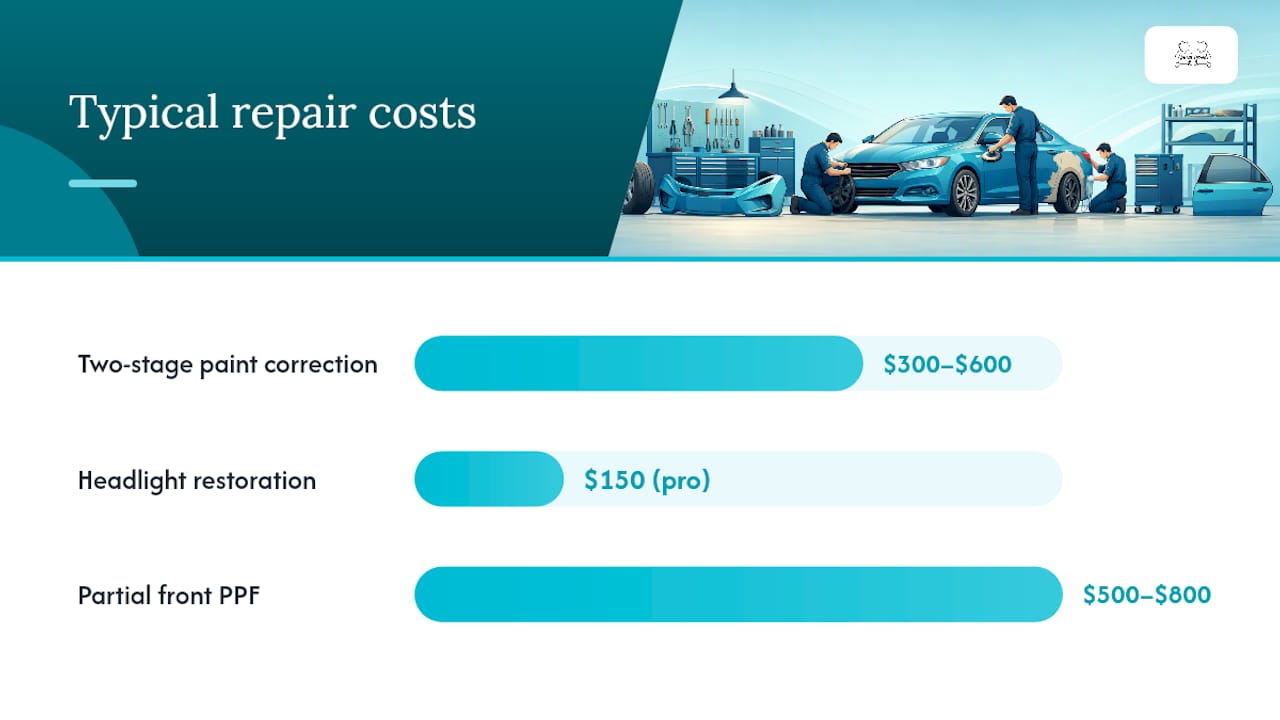
| Two-stage paint correction + sealant | $300–$600 | Moves car into higher appraisal tier; strong ROI on vehicles over $12k |
| Professional full detailing | — | A reasonable investment that typically increases sale price based on industry data, helping to reduce low-ball offers. |
| Headlight restoration | $150 (pro) | Improves perceived age and condition score |
| Wheel curb repair (per wheel) | — | High-visibility fix; buyers notice immediately |
| Ceramic coating | — | Represents a higher investment suited for long-term vehicle protection and signals care to buyers. |
| Partial front PPF | $500–$800 | Protects against chips; PPF and ceramic serve different roles |
DIY-friendly tasks: washing with car-specific soap, clay bar treatment, applying tire dressing, interior vacuuming and wipe-down, and headlight restoration on mild cases. 3M and MotorTrend's car care guidance recommends car-specific wash soap, rubbing compound for surface blemishes, and dedicated wheel and tire products as the baseline for any pre-sale prep.
When DIY reduces value: amateur paint touch-ups with mismatched color, rattle-can spot repairs, and DIY panel filling. These often look worse than the original damage and raise red flags at inspection.
Professional correction is worth it on any vehicle above $12,000–$15,000 in current market value. Below that threshold, a thorough detail and headlight restoration usually deliver the best return per dollar spent.
How your selling channel changes what you should fix
The right cosmetic investment depends entirely on how you're selling. Spending $600 on paint correction before a dealer trade-in often returns nothing; spending that same $600 before a private sale can return two or three times that.
- Private sale. Invest in the full sequence: PDR, paint correction, professional detail, and wheel repair. Private buyers compare your listing to dozens of others and will pay a premium for a car that looks genuinely cared for. Photos matter, condition matters, and documentation matters.
- Dealer trade-in. Focus on low-cost, high-perceived-value fixes: a thorough detail, headlight restoration, and any obvious dings that would trigger an automatic deduction. KBB's trade-in guidance is direct: dealers will not pay full book value unless the car appears near-perfect, because they need margin to recondition and resell. They'll reprice any visible issue against you.
- Lease return. This is where paint correction and PDR pay off most predictably. Lease-end inspections charge per defect at fixed rates. Fixing a $150 dent before return avoids a $300–$500 lease-end charge. Same logic applies to wheel curb rash.
- Auction or wholesale. Don't overspend. A detail and a wash are enough. Auction buyers price in reconditioning.
Use J.D. Power's trade-in tools to estimate your vehicle's condition-adjusted value before deciding how much to spend. If the gap between "Good" and "Excellent" condition is $800, spending $400 on targeted fixes to close that gap is straightforward math.
Decision checklist:
- What is the current market value of your vehicle?
- How much time do you have before the sale?
- Are you selling privately (maximum return) or trading in (convenience)?
- Will the dealer recondition regardless? If yes, skip correction and detail.
- Is there a lease-end inspection with per-defect charges? If yes, PDR and wheel repair are almost always worth it.
The show-ready checklist that makes buyers pay more
The listing impression — photos and the first 60 seconds of an in-person viewing — determines buyer interest more than specs, mileage, or even price in many cases. A car that photographs well and smells clean closes faster.
Photo checklist:
- Shoot at golden hour (one hour after sunrise or before sunset) for even, flattering light
- Clean background: empty parking lot, neutral wall, or a quiet street with no distractions
- Minimum 20 photos: all four exterior corners, each wheel, front and rear straight-on, open hood, full interior from both front doors, rear seat, trunk, odometer, and VIN sticker
- Closeup of any remaining imperfections — buyers who see them in photos don't feel ambushed in person
Pro Tip: Take a photo of your service record folder laid open on the passenger seat. It's a small detail that signals organized ownership and builds buyer confidence before they've even asked a question.
Documentation checklist:
- Service records (oil changes, tire rotations, brake work)
- Recent inspection report
- VIN history report (Carfax or AutoCheck)
- Receipts for any PDR, paint correction, or ceramic/PPF work
- Warranty documents and any remaining factory or extended coverage
Staging for in-person viewings:
- Professional detail or a thorough DIY wash, clay bar, interior vacuum, and wipe-down
- Remove all personal items, including the garage door opener and any stickers
- Eliminate odors: ozone treatment or activated charcoal, not air fresheners (which signal a problem)
- Top off all fluids, set tire pressure to spec, and confirm all lights and electronics work
- Park on a clean, level surface with good lighting for the viewing
What not to fix before you sell
Some repairs cost more than they return, and a few actively reduce your buyer pool.
Skip these:
- Full respray. A complete repaint costs $3,000–$8,000 and almost never returns its cost at resale. Worse, it shows up on paint-thickness gauges and raises questions about what was being covered. Dent repair versus panel replacement guidance makes clear that targeted repair almost always beats wholesale replacement for resale purposes.
- Non-OEM wheels. Aftermarket wheels that don't match the market's taste narrow your buyer pool. Buyers who want stock wheels have to factor in the cost of replacing them.
- Custom interiors. Reupholstered seats in non-standard colors or materials, custom audio installs, and modified dashboards appeal to a narrow audience and complicate the sale for everyone else.
- Non-transferable warranties. Extended warranties that can't be transferred add no value to the buyer and shouldn't factor into your asking price.
- Expensive mechanical overhauls. Replacing a transmission or engine on a car you're selling rarely returns the cost. Disclose the issue and adjust the price instead.
Red flags certain repairs create: mismatched paint thickness on adjacent panels (detected by buyers with a paint gauge), altered suspension geometry, and non-factory engine modifications all trigger inspection anxiety and can reduce offers more than the original defect would have.
When an accident repair is genuinely necessary — structural damage, safety systems, or a panel that's too damaged for PDR — fix it properly, disclose it fully, and price accordingly. Partial repairs that look worse than the original damage are the worst outcome.
For vehicles with custom paint, the calculus changes. Custom paint cars require special care before any repair work, and the wrong approach can devalue a finish that took significant investment to create.
Why PDR is often the best professional investment before selling
PDR preserves factory paint and avoids the "diminished value" signal that repainted panels send to buyers and appraisers. That's the core reason industry professionals recommend it over conventional bodywork for small to medium dents. A car with its original factory finish commands more trust and, in many cases, more money.
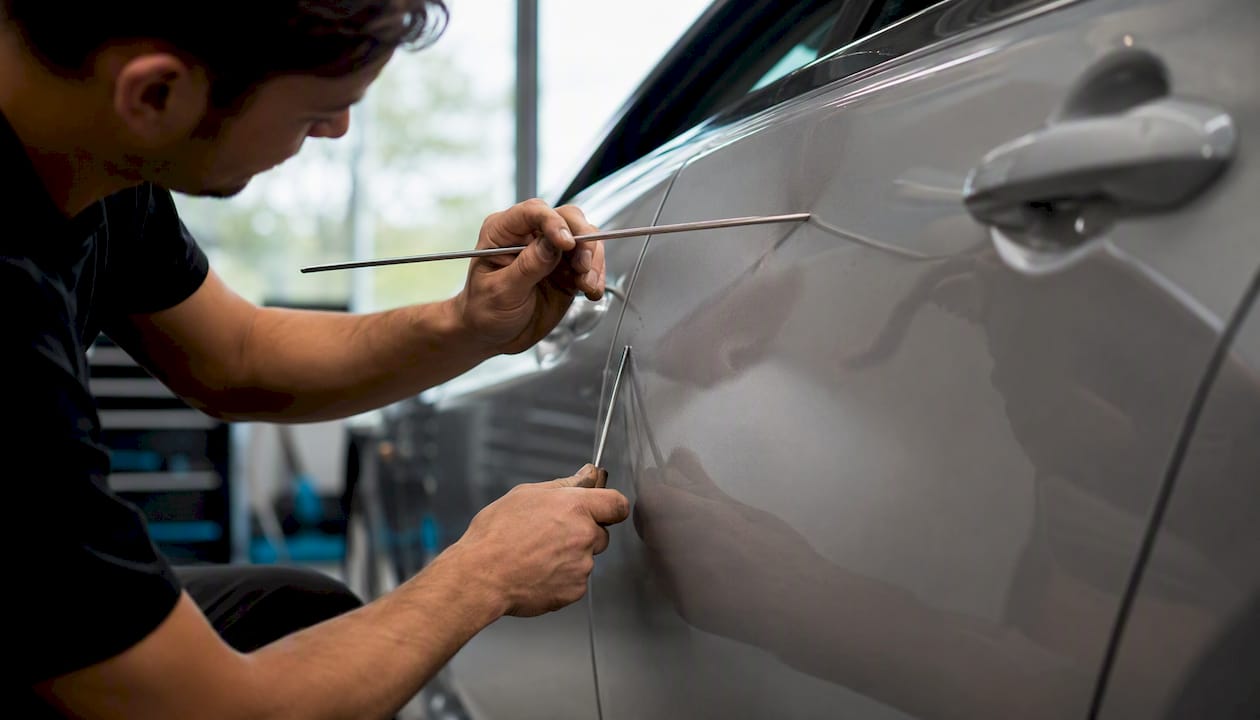
The process works by accessing the back of the dented panel through existing openings or by carefully removing trim, then using specialized tools to massage the metal back to its original shape. No filler, no primer, no paint. A skilled technician can restore a door ding to factory condition in 30–90 minutes. Larger hail damage with dozens of dents takes longer — typically one to three days depending on severity and panel count.
PDR is not suitable for every dent. Damage on a crease, near a panel edge, or where the paint has cracked requires conventional bodywork. A reputable provider will tell you this upfront rather than attempt a repair that won't hold.
Dent-boys handles the full PDR workflow: free estimate, pick-up and delivery, a rental vehicle during the repair, $0 deductible support for insurance-covered hail damage, and a lifetime warranty on every repair. Before-and-after photos document the work, which you can include in your listing or hand to the next buyer as proof of care. For a dent repair without painting that holds up to scrutiny at trade-in or private sale, that documentation matters.
PDR pairs well with paint correction and ceramic coating. The logical sequence: PDR first to restore panel shape, then paint correction to address surface oxidation or swirls, then a sealant or ceramic coating to lock in the finish. Done in that order, the car presents as close to factory condition as possible without a single repainted panel.
Pro Tip: Ask any PDR provider for before-and-after photos of your specific repair, not just portfolio shots. Those photos become part of your sale documentation and signal to buyers that the work was done professionally and transparently.
Key Takeaways
Cosmetic condition directly determines which valuation tier your car lands in, and targeted fixes — PDR, paint correction, and a professional detail — deliver the highest return per dollar before any sale.
| Point | Details |
|---|---|
| PDR first, always | PDR preserves factory paint, avoids diminished-value flags, and costs — for most spot repairs. |
| Detail for $312 | NADA data shows reconditioned vehicles average $312 more than uncleaned equivalents of the same trim. |
| Channel determines spend | Private sale justifies full correction and PDR; trade-in warrants only low-cost, high-visibility fixes. |
| Documentation adds $500–$1,500 | Service records and repair receipts routinely add $500–$1,500 over comparable cars sold without paperwork. |
| Dent-boys for PDR | Dent-boys offers free estimates, pick-up/delivery, $0 deductible support, and a lifetime warranty on every repair. |
The seller mistakes I see most often
The single most reliable way to leave money on the table is to start the repair process too late. Most sellers call about PDR or detailing the week before they list, which means rushing work that should be scheduled three to four weeks out, skipping paint correction entirely, and photographing the car before it's actually ready.
The two mistakes I see most often: first, sellers who spend $400 on a full detail but ignore two obvious door dings that any appraiser will deduct $300–$500 for. The detail looks great in photos, but the dents kill the in-person offer. Fix the dents first, then detail. Second, sellers who repaint a single panel to cover damage without disclosing it, then wonder why the dealer's paint gauge triggers a CPO disqualification or why a private buyer walks. A disclosed, PDR-corrected dent is worth more than an undisclosed repaint.
Efficient scheduling: get your PDR estimate in week one, book paint correction for week two if needed, schedule the detail for the week before listing, and photograph the car the day after the detail when the finish is at its best. That four-week runway gives you time to do the work properly without rushing any of it.
Dent-boys gets your car ready to sell
If your car has dents, dings, or hail damage, Dent-boys is the direct path from damaged to sale-ready without a single repainted panel. The service covers paintless dent repair and hail restoration with free estimates, pick-up and delivery, a rental vehicle during the repair, and $0 deductible support for insurance-covered jobs. Every repair carries a lifetime warranty, and before-and-after photos document the work so you have proof to show buyers.
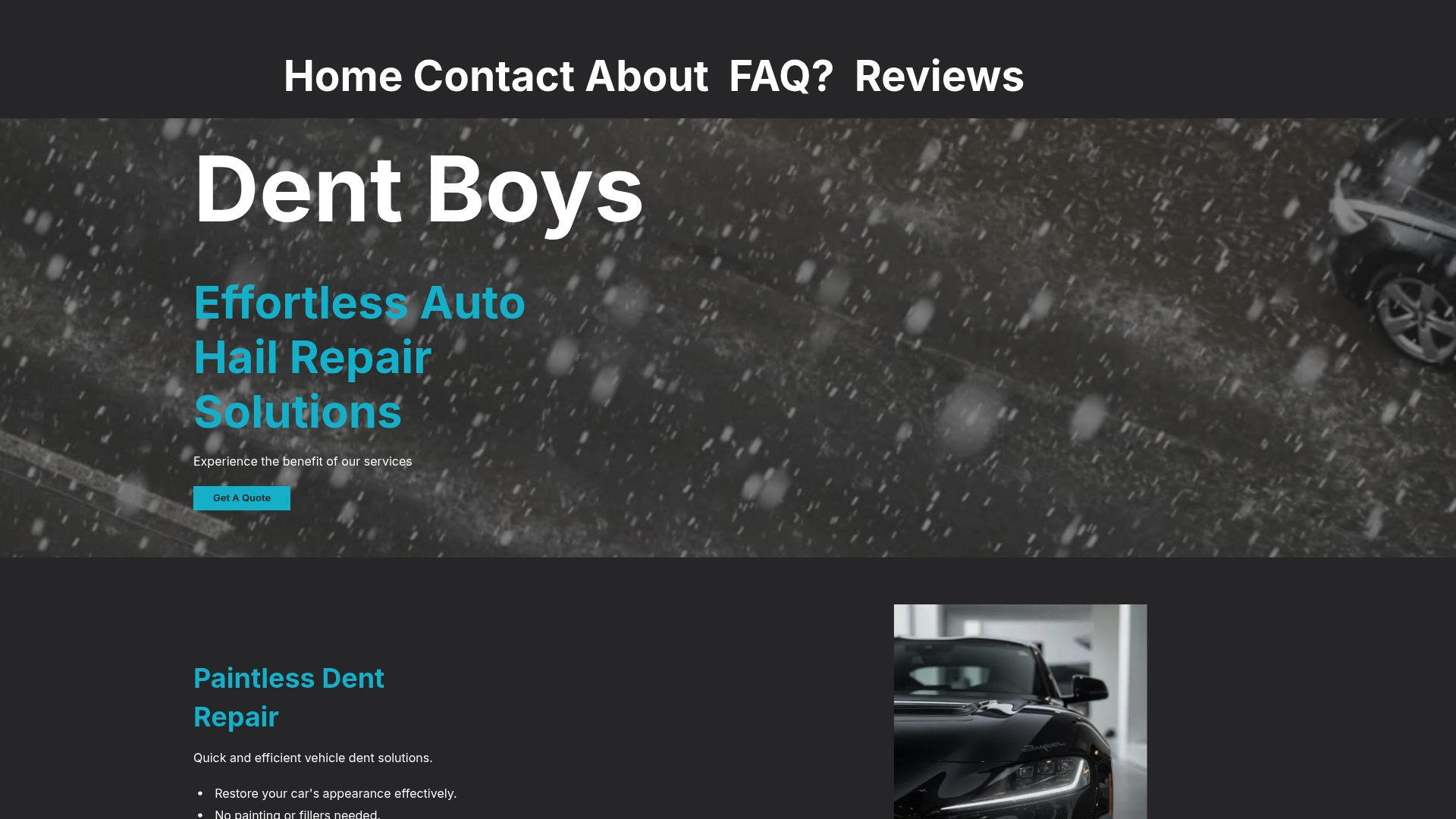
No repaint, no filler, no diminished-value flags at trade-in. Get a free estimate from Dent-boys and know exactly what your car needs before you list it.
Useful sources
- Proven Ways to Boost Your Car’s Resale Value Fast
- Is Paint Correction Worth It? Complete ROI Analysis for 2026
- How To Increase The Resale Value Of Your Car
- How to Detail Your Car Before Selling (Boost Valu… | CarCheckerVIN
- How to Protect Your Car's Resale Value From Day One CarFinance
- How to maximize your car's trade-in value - KBB
- 3M car care tips
- Trade-in value guidance - J.D. Power