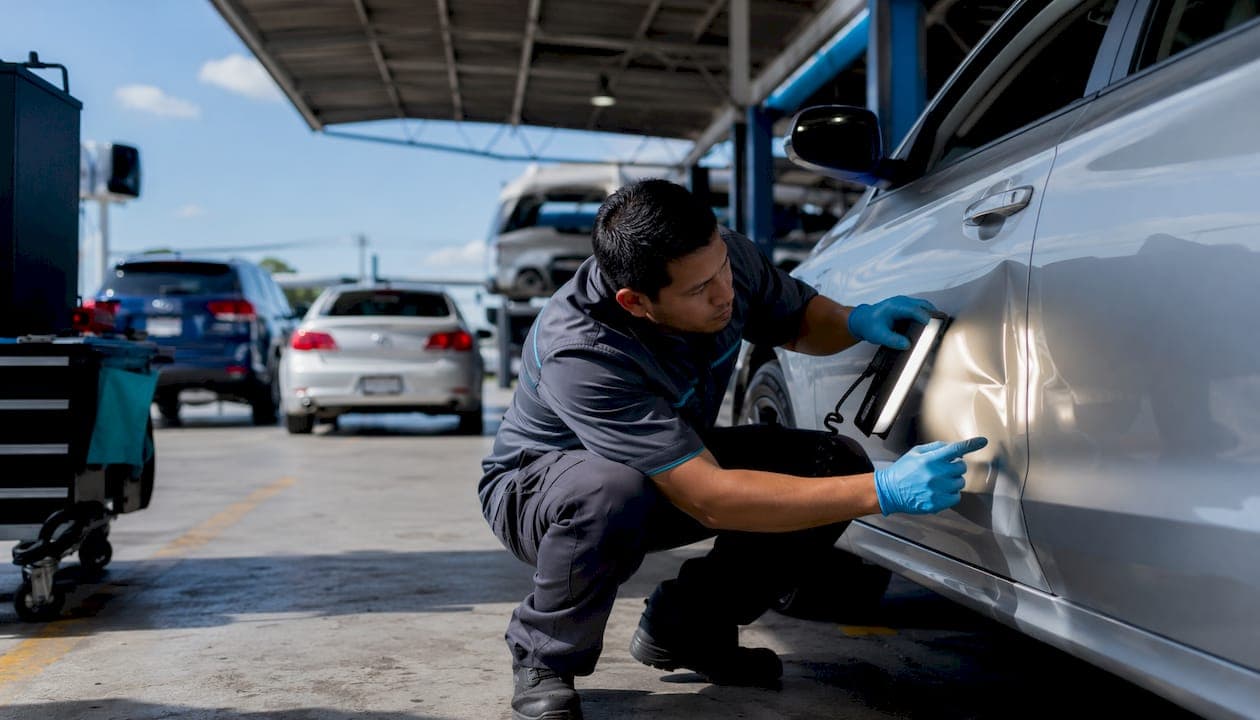
A sharp dent is a small, deep, concentrated impact point — often sitting directly on or near a body line (swage line) — with steep sides, a tight crown, and minimal surrounding distortion. The verdict on repair: paintless dent repair (PDR) is often possible when the paint is intact and the metal hasn't stretched past its elastic limit, but cracked paint or irreversible metal stretch means traditional body and paint work is required.
Here's what you need to know upfront:
- Definition: A sharp dent features a concentrated, deep depression with steep walls, unlike the gradual curve of a round ding.
- Location risk: Swage lines and panel edges are the most vulnerable spots because they protrude and absorb point impacts directly.
- PDR eligibility: Intact paint and metal that still has "memory" (elasticity) are the two non-negotiable conditions for PDR.
- When to stop: If you feel a sharp ridge or see paint cracking, don't attempt DIY. Call a professional immediately.
- Who to call: Dent-boys specializes in paintless dent repair with free estimates, pickup and delivery, and a lifetime warranty.
Table of Contents
- What exactly is a sharp dent?
- How sharp dents differ from round dings and crease dents
- What causes sharp dents on your car?
- How a technician decides whether your dent can be repaired with PDR
- Step-by-step: how professionals repair sharp dents
- Why DIY attempts on sharp dents usually make things worse
- What does sharp dent repair actually cost?
- What to expect at a professional PDR shop
- Key Takeaways
- The part most car owners get wrong about sharp dents
- Dent-boys repairs sharp dents without the body shop hassle
- Useful sources and further reading
What exactly is a sharp dent?
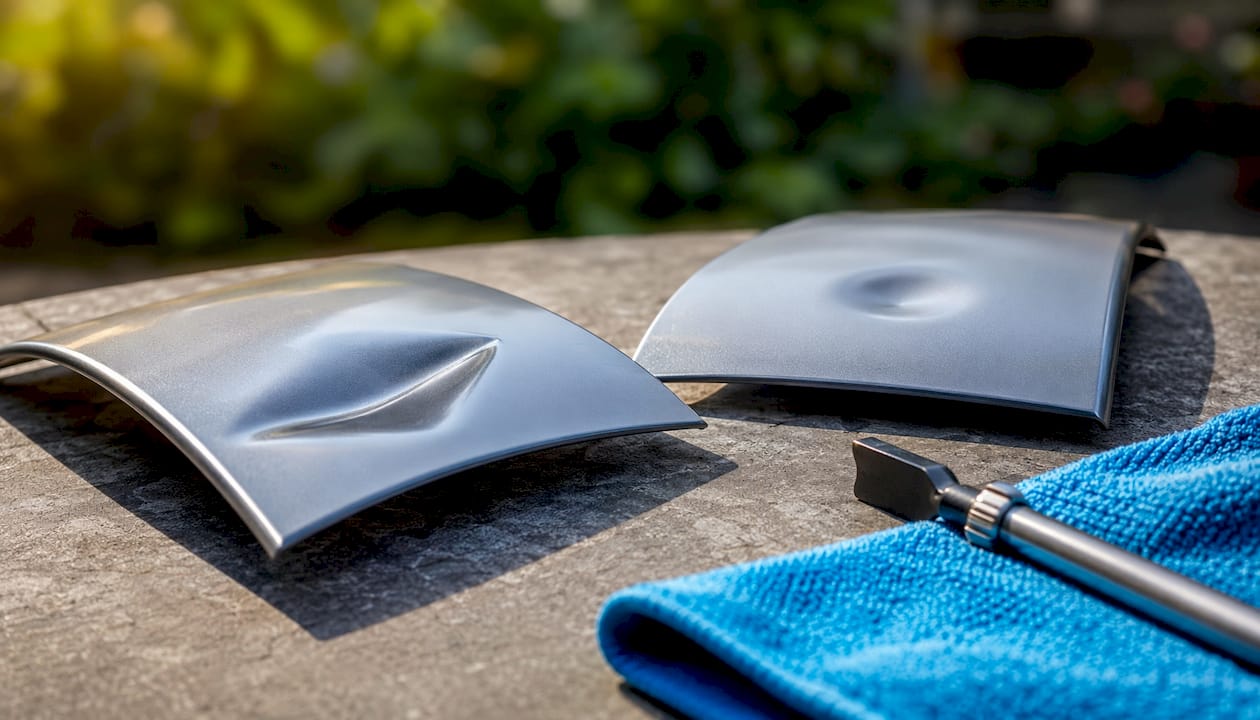
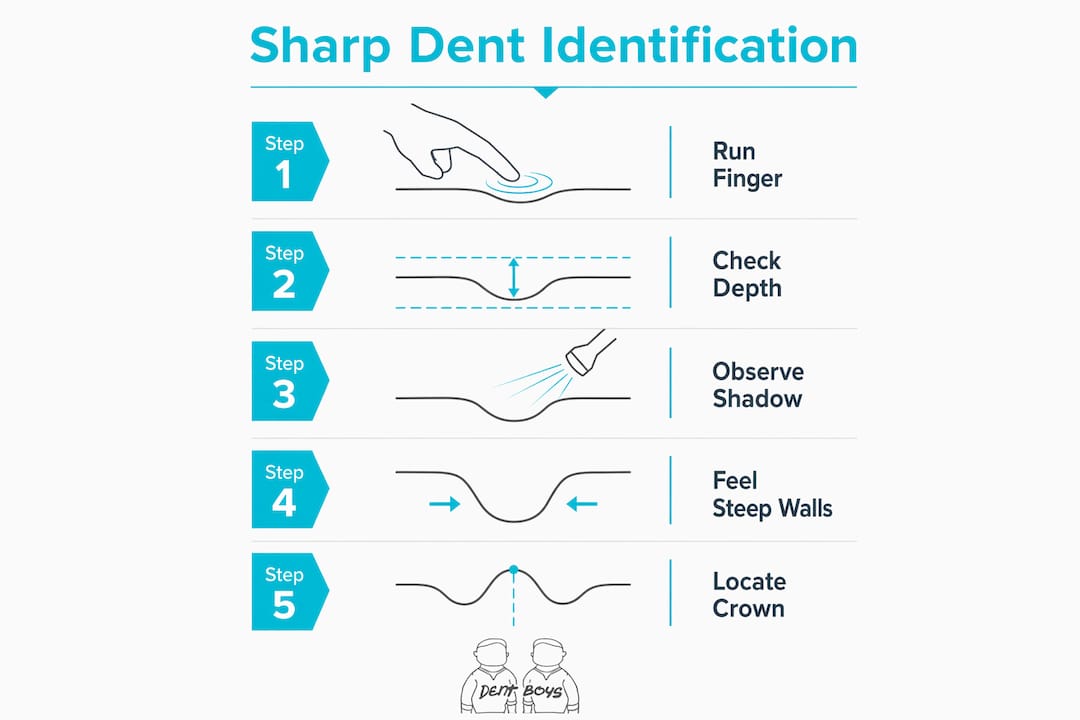
A sharp dent is defined by three physical traits: depth, steep side walls, and a concentrated crown. Run your finger across the panel and you'll feel a sudden drop into the depression, then a steep climb back out. That's the key tactile difference from a round ding, which feels more like a gradual bowl pressed into the metal.
Visually, a sharp dent casts a tight, well-defined shadow line under direct light. The surrounding panel often looks undamaged, which can make the dent seem minor — but that concentrated geometry is exactly what makes it harder to repair than it looks. Sharp dents form tight depressions and are commonly found on swage lines where the panel protrudes slightly, making those areas the first point of contact in a focused impact.
Pro Tip: Hold a flashlight or a shop light at a low angle across the panel. A sharp dent will show a hard, narrow shadow line. A round ding shows a softer, wider shadow arc. That difference tells you which type you're dealing with before you even touch it.
Common locations for sharp dents:
- Swage lines (body lines): The slight ridge running along a door or fender protrudes just enough to catch point impacts.
- Panel edges: Door edges, fender lips, and hood edges are exposed and frequently struck.
- Door centers: A direct hit from a door edge or cart corner lands here with concentrated force.
- Hood and roof: Stone or gravel impacts at highway speed create small, sharp craters.
How sharp dents differ from round dings and crease dents
Knowing which type of dent you have changes everything about how it gets fixed. Applying a suction puller designed for round dings to a sharp dent is one of the fastest ways to create a secondary problem.
| Feature | Round Ding | Sharp Dent | Crease Dent |
|---|---|---|---|
| Shape | Gradual bowl, wide radius | Tight, deep crater, small crown | Long, narrow ridge or fold |
| Edge feel | Soft, gradual | Steep, abrupt | Hard ridge, linear |
| Metal stretch | Unlikely | Possible, especially on body lines | Common, often significant |
| Common cause | Hail, minor impacts | Door edge, stone, cart corner | Sliding impact, sideswipe |
| Typical repair path | PDR (usually straightforward) | PDR if paint/metal intact; body repair if not | PDR for minor cases; body repair when stretched |
Crease dents have a distinct ridge or fold and often require traditional body repair when metal stretch is present. A sharp dent sits between a round ding and a crease in terms of complexity: it's more localized than a crease but more technically demanding than a simple ding.
Pro Tip: To distinguish a sharp dent from a crease without risking paint damage, use the fingertip test. Lay one finger flat and drag it slowly across the dent's edge. A crease has a linear ridge you can follow; a sharp dent has a concentrated drop point. Never press hard — you're reading the panel, not pushing it.
What causes sharp dents on your car?
Sharp dents result from focused, point-like impacts that concentrate force into a small area rather than spreading it across the panel. That geometry — narrow contact area, high force — is what creates the steep walls and tight crown.
The most common culprits:
- Door edge strikes: Another car's door edge hitting yours in a parking lot is the classic scenario. The edge concentrates force into a small point on your door or fender.
- Shopping cart corners: Cart corners are surprisingly hard and hit at a consistent height, often landing right on a swage line.
- Stone and gravel impacts: Highway debris at speed creates small, sharp craters, particularly on hoods, fenders, and the leading edge of roofs.
- Direct collision points: In a minor collision, the first point of contact often creates a sharp dent before the surrounding panel deforms.
- Hail: Large hailstones can produce sharp dents rather than round dings when they strike at an angle or hit a body line. For a deeper look at how clustered hail impacts behave differently, hail dent patterns follow their own distinct geometry.
Swage lines are especially vulnerable because the body line protrudes slightly and absorbs point impacts before the flatter panel surface does, as detailed in Automotive Fabrication UK | EV & Motorsport | JIENCO. Tight parking lots, high-traffic garages, and gravel roads are the environments where sharp dents happen most.
How a technician decides whether your dent can be repaired with PDR
A professional technician doesn't just look at the dent. They work through a specific checklist before committing to a repair method, and understanding that checklist helps you ask better questions when you get an estimate.
The assessment checklist:
- Paint condition: The tech looks for micro-cracks, crazing, or paint lifting around the dent's edge. When paint shows micro-cracks or the panel has lost metal memory from stretching, PDR alone won't fully restore the panel.
- Metal stretch: The tech feels for a high spot or "crown" around the dent's perimeter. Stretched metal has lost its elasticity and won't return to shape under PDR alone.
- Panel access: Can a rod reach the back of the panel? Doors, fenders, and hoods usually allow access; pillars, rocker panels, and areas near reinforcements often don't.
- Proximity to body lines: A dent on or immediately adjacent to a swage line is harder to work because the line itself limits tool angles and leverage.
- Crease presence: Even a short crease extending from the dent's edge signals metal stretch and complicates PDR significantly. For more on why creases change the repair equation, crease dent complexity is worth understanding before you get an estimate.
- Dent depth and diameter: Deeper, narrower dents require more precise tool placement and are more likely to have stretched metal.
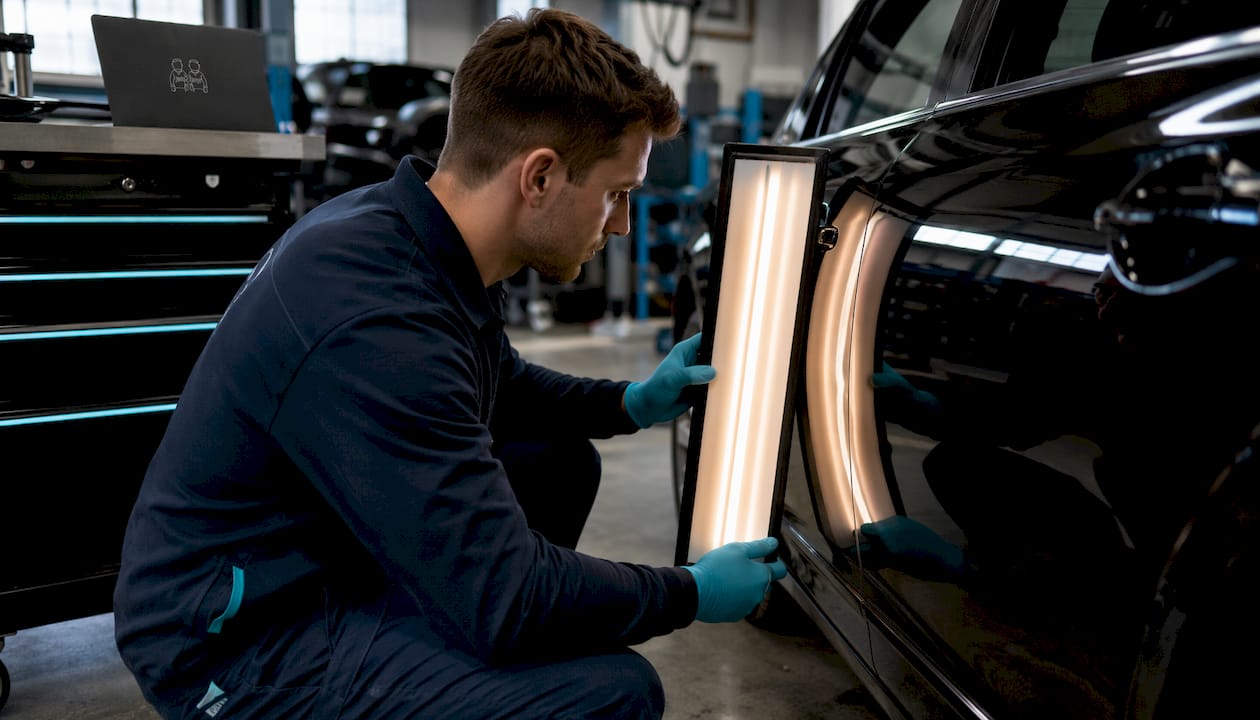
For the visual inspection, technicians use a reflection board or a fluorescent light bar held at an angle to the panel. The reflected lines reveal the exact contour of the dent, including high spots and low spots invisible to the naked eye. Using reflected light helps distinguish a crease or sharp ridge from a round dent without touching the paint. This is the same technique used in before/after photo documentation at reputable shops.
Step-by-step: how professionals repair sharp dents
PDR on a sharp dent follows a specific sequence. Skipping steps or rushing any of them is how high spots and paint cracks happen.
The professional PDR workflow:
- Assess access points. The tech identifies whether the dent can be reached from behind with a rod, or whether glue pulling from the front is the primary approach.
- Thermal management. The panel is gently warmed — often with a heat lamp or infrared heat source — to increase metal flexibility and reduce the risk of paint cracking during manipulation. This step is especially critical on sharp dents where the metal is under stress.
- Glue pull (if needed). For areas with limited back access, a glue tab is applied to the dent's lowest point and a slide hammer or puller lifts the metal incrementally. Multiple small pulls beat one aggressive pull every time.
- Rod work from behind. Where access allows, a PDR rod is inserted behind the panel and used to push the metal back toward its original position with controlled, targeted pressure.
- Tap-down high spots. As the low point rises, surrounding metal often creates high spots. A knockdown hammer and tap-down tool are used to gently lower these without damaging the paint surface.
- Refinement under reflected light. The tech checks progress repeatedly under the reflection board, making micro-adjustments until the panel surface is smooth.
- Finishing. Final inspection under multiple light angles confirms the repair. No filler, no paint — just restored metal.
Professional PDR workflows for tighter dents include controlled heat application, glue pulling, gentle rod pushes, and precise knockdowns to remove high spots. For a detailed visual walkthrough, the step-by-step sharp dent repair tutorial at Learn PDR Online shows exactly how technicians sequence these steps on real panels.
Tools used in sharp dent PDR:
- Glue pullers, slide hammers, and glue tabs (various sizes for different dent diameters)
- PDR rods and picks (different lengths and tip profiles for access angles)
- Knockdown hammers and tap-down tools
- Heat lamps or infrared heat sources
- Reflection boards or fluorescent light bars
When PDR gets abandoned for body/paint repair:
- Paint is cracked or lifting at the dent's edge
- Metal stretch is confirmed (high spot won't tap down cleanly)
- A crease runs across the panel
- The dent sits on a panel edge or overlap where rods can't reach
- The panel has been previously repaired with filler (filler doesn't respond to PDR)
For a clear breakdown of when PDR ends and panel replacement begins, dent repair vs. panel replacement covers the decision criteria professionals use.
Pro Tip: If a tech is warming your panel, the heat should feel warm to the back of your hand held near the surface, not hot. Overheating is one of the most common causes of paint cracking during PDR on sharp dents. Ask your tech about their thermal management approach before work starts.
Why DIY attempts on sharp dents usually make things worse
The instinct to grab a suction cup or a hairdryer and try to pop the dent yourself is understandable. The problem is that the tools and techniques that work on round dings are actively harmful on sharp dents.
Common DIY mistakes:
- Suction pullers on sharp dents: A suction cup applies broad, even pull force. A sharp dent needs targeted, concentrated lift from the lowest point. Suction pulls the surrounding metal first, often creating a ring of high spots around the original dent.
- Overheating with a hairdryer or heat gun: Uncontrolled heat expands the metal unevenly and can blister or crack the paint, especially on darker colors that absorb heat faster.
- Uncontrolled hammering: Tapping from the outside without a backing tool creates new low spots and work-hardens the metal, making it stiffer and harder for a pro to manipulate later.
- Improper glue pulling: Using the wrong tab size or pulling at the wrong angle lifts the center of the dent but leaves a ring of high spots that a technician then has to tap down before addressing the original damage.
Trying to pop a sharp dent without the right tools often creates a secondary high spot that complicates PDR and increases repair costs. Any dent with a visible ridge should not be pulled with DIY suction because the metal may already be stretched beyond its elastic limit, and amateur pulling destroys the metal memory PDR depends on.
Stop and call a pro if you notice any of these:
- Visible paint cracking or crazing at the dent's edge
- A hard ridge you can feel with your fingertip (possible metal stretch)
- The dent is on a body line or panel edge
- You can't see or reach the back of the panel
- The dent is deeper than it looks from a distance
Pro Tip: Before touching the dent at all, take a photo under a raking light (flashlight held at a low angle). That image documents the dent's original condition and protects you if a shop later claims pre-existing damage. It also helps a technician assess the dent remotely before you bring the car in.
For guidance on managing any paint chips near the dent without making the repair harder, touch-up paint around dents covers what's safe to do yourself.
What does sharp dent repair actually cost?
Cost varies significantly based on several factors, and any quote you get without an in-person inspection should be treated as a rough estimate only.
Factors that drive cost up or down:
- Dent size and depth: Deeper, tighter dents require more time and precision.
- Paint condition: Any paint damage means body/paint work on top of PDR, which adds labor and materials cost.
- Panel access: Limited access means more setup time or glue-pull equipment.
- Body line involvement: A dent on a swage line takes longer because tool angles are restricted.
- Number of dents: Multiple dents on the same panel can sometimes be bundled; on different panels, each adds to the total.
- Vehicle make and model: Aluminum panels (common on newer trucks and luxury vehicles) require specialized PDR tools and technique, which affects pricing.
Small, clean round dents are often priced affordably; more complex dents — sharp, crease, or edge — can increase labor costs or require panel replacement. For real-world cost comparisons, dent repair savings examples shows how PDR stacks up against traditional body shop pricing.
| Repair Scenario | Typical Timeframe | Cost Note |
|---|---|---|
| Simple sharp dent, PDR eligible, mobile | Same day | Costs vary by complexity and location |
| Complex sharp dent, in-shop PDR | Several days | Costs vary by complexity and location |
| Sharp dent with paint damage, body/paint repair | Multiple days | Costs increase with paint and body work |
| Panel replacement (severe stretch or edge damage) | Extended time | Costs increase significantly by vehicle and panel |
Costs vary; get a written estimate after an in-person inspection.
What to expect at a professional PDR shop
A reputable shop doesn't just fix the dent. The experience from first contact to pickup should follow a clear, documented process — and knowing what that looks like helps you spot a shop that's cutting corners.
What a quality shop provides:
- Free estimate with in-person inspection: No reputable PDR shop quotes a sharp dent from a photo alone. The tech needs to feel the metal and check paint condition under proper lighting.
- Inspection under a reflection board or light bar: This is non-negotiable for sharp dents. If a shop skips this step, they're guessing at the repair.
- Photo documentation before and after: Before/after photos protect both you and the shop and serve as proof of the repair quality.
- Clear explanation of repair method: The tech should tell you whether they're using rod work, glue pulling, or a combination, and why.
- Transparent pricing with no hidden fees: A written estimate before work starts.
- Warranty coverage: A lifetime warranty on the repair is the standard at quality shops.
Questions to ask before you authorize the work:
- Has this panel been repaired before? (Previous filler work rules out PDR.)
- Do you use thermal management on sharp dents?
- Who specifically will perform the repair?
- What happens if the paint cracks during the repair?
- Is the warranty transferable if I sell the car?
A sharp dent on a body line is one of the most technically demanding repairs in PDR. The best shops slow down, use proper lighting, and make multiple small adjustments rather than one aggressive pull. That patience is what separates a repair that holds from one that leaves a ghost mark.
For owners of collector or high-value vehicles, the stakes are higher because original paint preservation matters more. Dent repair for collector cars covers the specialist considerations that apply in those cases.
Key Takeaways
A sharp dent requires professional assessment because paint condition and metal elasticity determine whether PDR is viable or traditional body repair is the only path forward.
| Point | Details |
|---|---|
| Identify by feel and light | A sharp dent has steep walls and a tight shadow line; use a raking flashlight to confirm before touching it. |
| Don't use suction on sharp dents | Suction pullers create high spots around sharp dents and destroy the metal memory PDR depends on. |
| Two PDR deal-breakers | Cracked paint or confirmed metal stretch means body/paint work is required, not PDR. |
| Get a proper in-shop estimate | A reputable tech inspects under a reflection board, documents with photos, and provides a written quote. |
| Dent-boys offers PDR with a lifetime warranty | Free estimates, pickup and delivery, and $0 deductible make Dent-boys a practical first call for sharp dent repair. |
The part most car owners get wrong about sharp dents
Sharp dents look deceptively minor. They're small, the surrounding paint often looks fine, and the instinct is to treat them like a round ding — grab a suction cup, watch a five-minute video, and handle it yourself. That instinct is wrong, and it's wrong in a way that costs money.
The real issue with a sharp dent isn't its size. It's the geometry. That concentrated impact point puts stress on a very small area of metal, and the steep walls mean the metal had to move fast and hard to get there. Whether it stretched past its elastic limit isn't something you can determine by looking at it. You need reflected light, a trained eye, and a fingertip that knows what stretched metal feels like.
The other thing most owners underestimate is how much a failed DIY attempt changes the repair cost. A clean sharp dent that a technician could have fixed in an afternoon becomes a multi-step job the moment someone has pulled a ring of high spots around it. The original dent is still there, plus now there's secondary damage. That's not a hypothetical — it's the most common scenario technicians describe when a customer brings in a "I tried to fix it first" car.
Delaying a proper repair has its own cost too. Prompt dent repair matters for resale value in ways that compound over time, especially when a dent sits near a panel edge where moisture can work its way in.
The practical takeaway: if you find a sharp dent, take a photo under raking light, don't touch it, and get a professional assessment. That sequence costs nothing and keeps every repair option open.
Dent-boys repairs sharp dents without the body shop hassle
Sharp dents are exactly what Dent-boys handles every day. The difference from a traditional body shop: no painting, no fillers, no week-long wait for your car. Dent-boys uses professional PDR techniques — thermal management, precision rod work, glue pulling, and reflection-board finishing — to restore your panel to its original condition while preserving the factory paint.

Every repair comes with a lifetime warranty, a $0 deductible option, and free pickup and delivery so you're not rearranging your schedule around a shop visit. The process starts with a free estimate: a technician inspects the dent in person, documents it with photos, and gives you a written quote before any work begins.
If you've found a sharp dent and you're not sure whether PDR is an option, request a free estimate from Dent-boys. Bring the photo you took under raking light, and the tech will tell you exactly what you're working with.
Useful sources and further reading
The following sources were used in researching this article and are worth bookmarking if you want to go deeper on PDR technique, dent types, or repair decisions:
- Best Step-By-Step Method to Repair Sharp Dents — Learn PDR Online's detailed walkthrough of the professional sequence for sharp dent repair, including tool selection and technique order.
- — Video demonstration showing why small sharp dents are technically demanding; useful for understanding what reflected-light inspection reveals.
- The Complete Guide to Car Dents: Types, Causes & What to Know (Part 1) — Covers crease dents, metal stretch, and the criteria that determine PDR eligibility.
- How to Get Rid of Dents in Car — Practical overview of dent types, the fingertip test, and why DIY suction pulling fails on sharp dents.
- The 4 Types of Car Dents You Should Know — Clear breakdown of dent geometry and causes, including sharp dents from point impacts.
- Different Types of Car Dents Explained — Caversham Coachworks' explanation of PDR workflows, including thermal management and glue pulling for tighter dents.
- What are the different types of dents? — Covers swage line vulnerability and why body lines are the most common location for sharp dents.
- Fixing Sharp Dents Explained (video) — Short video demonstration from DentTime showing the practical technique sequence for sharp dent PDR.