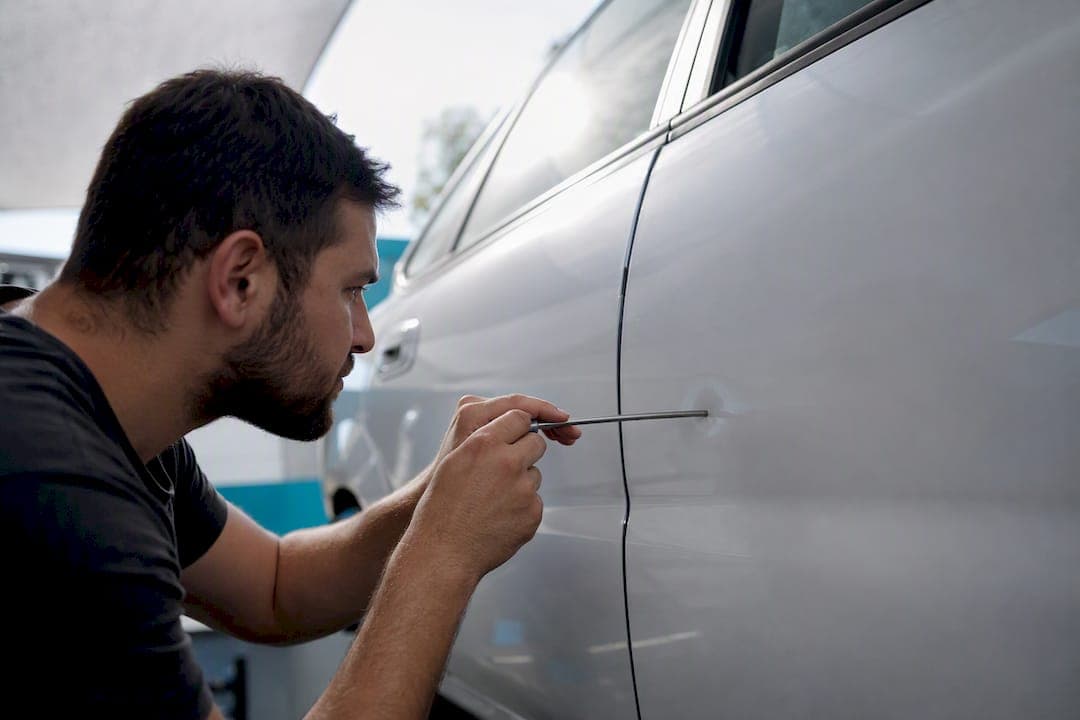
Round dings, hail clusters, and shallow creases with intact paint are usually good candidates for paintless dent repair. Sharp impact dents, deep creases across a body line, and anything with cracked paint or exposed metal usually aren't. The dividing line comes down to three things: paint condition, whether the metal has stretched, and whether a technician can reach the back of the panel.
- Round dings: Good
- Shallow creases: Possible
- Sharp/impact dents: Not recommended
- Hail (multi-point): Good to Possible
- Collision/extreme dents: Not recommended
Key Takeaways
Whether a dent qualifies for paintless dent repair comes down to paint condition, metal stretch, and access to the panel's back side, not the dent's size alone.
| Point | Details |
|---|---|
| Round dings and hail | Usually strong PDR candidates when paint is unbroken and metal hasn't stretched. |
| Creases and sharp impacts | Often require conventional bodywork once paint cracks or metal folds permanently. |
| Photos make or break estimates | Send a close-up, full-panel, and distance shot to get an accurate remote quote. |
| Insurance documentation matters | Keep your VIN, mileage, dated photos, and written estimate ready for hail claims. |
| Dent-boys handles the full process | Offers free estimates, pick-up and delivery, $0-deductible coordination, a rental vehicle, and a lifetime warranty on repairs. |
Table of Contents
- What Are the Main Types of Dents on a Car?
- How Does Paintless Dent Repair Actually Work?
- What Repair Options Exist When PDR Isn't Suitable?
- What Do Dent Repairs Typically Cost and Take?
- How Should You Describe a Dent to a Shop or Insurer?
- What Do Different Dent Types Look Like Side by Side?
- What Does Dent-boys Offer for Paintless Dent Repair?
- Frequently Asked Questions
- Sources
What Are the Main Types of Dents on a Car?
Not every dent is created equal, and lumping them all together is how car owners end up either overpaying for bodywork they didn't need or wasting money on a PDR attempt that was never going to work. A useful dent taxonomy separates round dents, crease dents, sharp dents, multi-point hail dents, dings, and extreme collision dents, and each behaves differently once a technician gets a tool behind it.
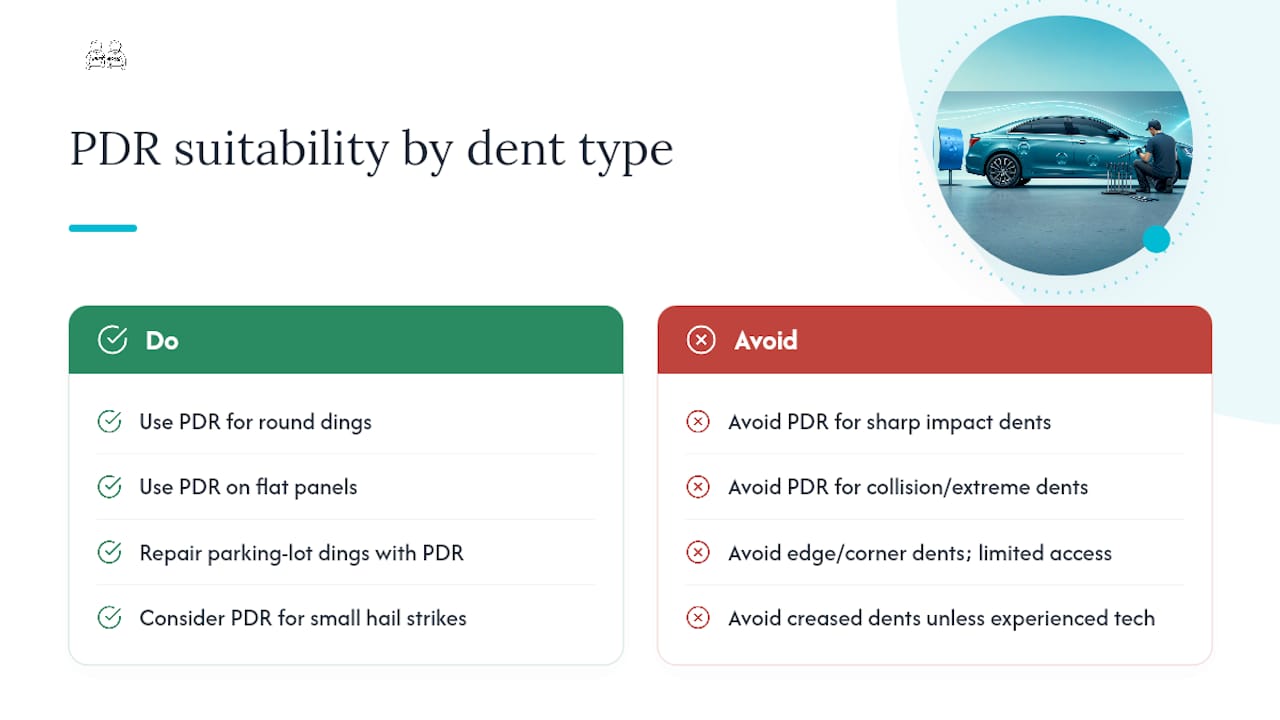
Round or door ding. Usually caused by a shopping cart, a stray door swing in a parking lot, or a stray ball. Look for a smooth, circular depression with no ridge and unbroken paint. PDR verdict: Good. The metal hasn't stretched, and the shape is exactly what massaging tools are built to reverse.
Flat panel dent. A wide, shallow low spot on a large flat surface like a hood or door skin, often from someone leaning on the car or a light bump. Verdict: Good, provided the paint hasn't cracked at the deepest point.
Creased dent. This one has a sharp fold line running through it, usually from a fender-bender or a shopping cart edge catching the metal at an angle. A dedicated breakdown of crease dents explains why the fold itself is the problem: the metal has been bent past its elastic limit, not just pushed in. Verdict: Possible, and only with an experienced technician, since a stretched crease can hide.
Sharp dent or impact dent. Caused by a rock, a hammer drop, or a hard collision with a fixed object. The point of impact often shows cracked paint or a small crater with sharp edges. Verdict: Not recommended in most cases. Once paint integrity is broken, PDR alone can't restore the finish.
Parking lot dings. Functionally similar to round dings but usually smaller and more numerous, often clustered near door edges. Verdict: Good, and one of the most common repairs shops see.
Hail damage (multi-point dents). A single hailstone leaves a round dent; a storm leaves dozens across the hood, roof, and trunk. A hail damage explainer covers how impact angle and hailstone size change the depth and shape of each ding. Verdict: Good to Possible, size-dependent. Small, shallow hail hits respond extremely well to PDR; larger stones near panel edges sometimes don't.
Edge or corner dents. Located near a wheel well, bumper line, or door edge where metal is folded and reinforced. Verdict: Not recommended, or Possible at best, because access behind the panel is limited and the metal there is stiffer.
Collision or extreme dents. Large, deep, often with torn paint, misaligned panel gaps, or structural involvement. Verdict: Not recommended for PDR alone.
Pro Tip: A single hail impact and a cluster of parking-lot dings can look almost identical up close. Count the dents and check the spacing: hail tends to hit uniformly across horizontal surfaces, while door dings cluster near edges where doors swing.
How Does Paintless Dent Repair Actually Work?
Technicians access the backside of the panel and push the metal back into shape using specialized rods and tools, gradually massaging it toward its original contour.
- Assessment. A trained eye checks paint condition, dent depth, and panel type.
- Access. The technician removes interior panels, trim, or taillights to reach behind the dent.
- Massaging. Using rods and picks, they apply controlled pressure from behind, working the metal back out.
- Finish check. The surface gets inspected under LED light boards for imperfections, then the shop confirms the warranty.
PDR works by reshaping metal, not by hiding damage, which is exactly why certain conditions can stop it cold:
- Cracked or chipped paint at the dent site
- Metal that has stretched or creased instead of just pushed in
- No access to the panel's back side (common near seams and structural supports)
- Folded metal at an edge or corner
- Extensive damage spanning multiple panels or affecting alignment
If you can see paint cracks, a sharp crease, or the dent sits directly over a body seam or flange, professional PDR may not be the right first call. That's the moment to ask about metal reshaping alternatives or a hybrid repair.
What Repair Options Exist When PDR Isn't Suitable?
When paint is broken or metal has genuinely stretched, the fix shifts from massaging to more conventional bodywork.
- Filler and repaint: Fast, affordable for shallow damage with broken paint, but the finish is only as good as the paint match, and fillers can crack over time.
- Panel replacement: Necessary for severe creases, torn metal, or rusted-through spots. It's the most reliable route for extreme dents, but the most expensive.
- Welding or structural work: Required when a collision has shifted a panel's frame or alignment, not just its surface.
Sometimes a shop combines approaches: PDR handles most of a crease, leaving a small spot repair for the cracked paint at its center. That hybrid often costs less than a full repaint.
What Do Dent Repairs Typically Cost and Take?
Costs and timelines swing widely depending on complexity, so treat these as rough bands to confirm with an actual estimate rather than fixed prices.
- Small ding or single round dent: Low cost, often same-day.
- Crease or larger flat-panel dent: Medium cost, one to two days depending on access difficulty.
- Hail cluster (dozens of dents): Medium to high cost, ranging from several days to weeks depending on dent count.
- Panel replacement or structural repair: Highest cost, typically the longest timeline since it involves ordering parts and repainting.
Common repair cases like parking-lot dings, hail damage, and minor fender-benders make up most of what shops see day to day, which is why turnaround on those jobs tends to be predictable. For insurance claims, keep your VIN, mileage, dated photos, and a written estimate on hand. Ask specifically whether the shop offers $0-deductible coordination, since that detail changes what you owe out of pocket and matters more on hail claims than almost anything else.
How Should You Describe a Dent to a Shop or Insurer?
Sending the right details up front saves a round trip of follow-up questions. Report the dent type, its approximate size, its location on the vehicle, whether the paint looks cracked or intact, and whether it sits near a seam or body line. For hail, count the visible dents as closely as you can.
For photos, shoot four angles: a close-up of the dent itself, a wider shot of the full panel for context, a shot from a few feet back to show scale next to something familiar like a coin or key, and, if you can access it, a photo of the panel's backside.
- Close-up of the dent
- Full-panel shot
- Distance shot for scale
- Backside/interior view if accessible
A short message template works well: "2021 [make/model], [panel name], one round dent approximately [size], paint appears intact, no visible cracking, photos attached." That single sentence gives a shop or adjuster nearly everything they need for a remote estimate.
Pro Tip: Photograph the dent in natural daylight, not under garage lighting. Shadows from overhead bulbs distort depth and make shallow dents look far worse (or better) than they actually are.
What Do Different Dent Types Look Like Side by Side?
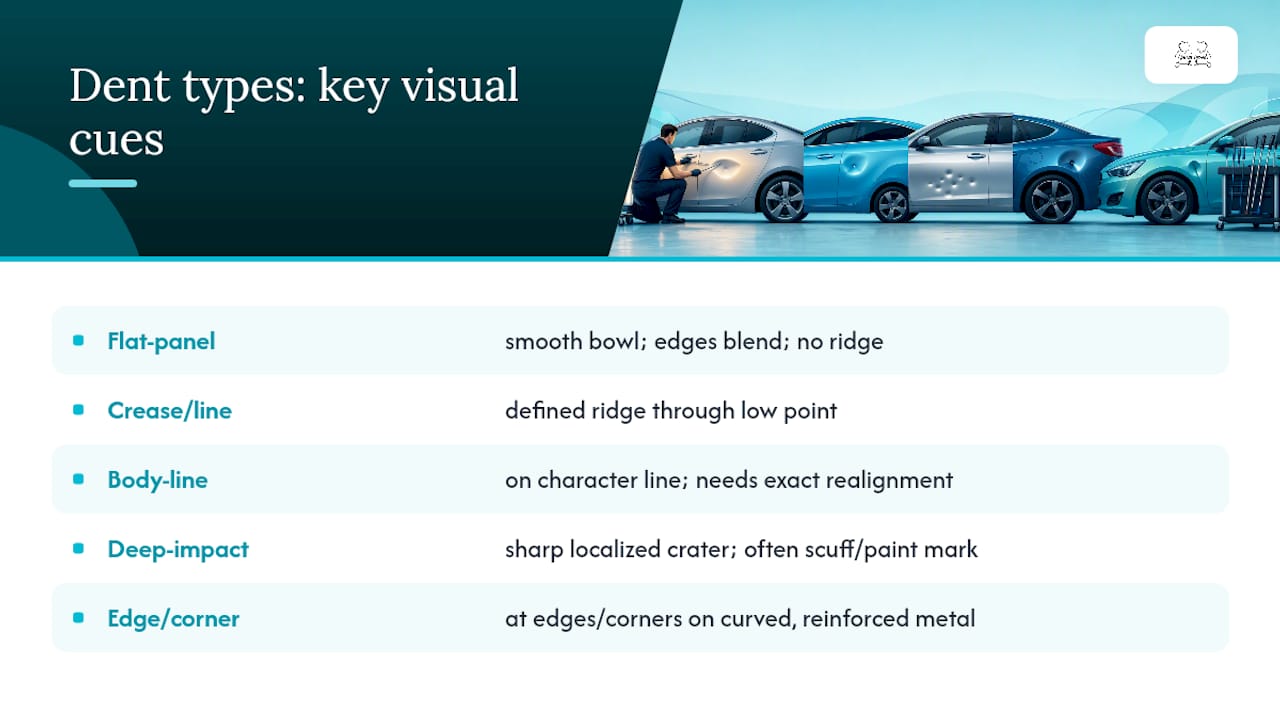
Visual comparison beats description every time, since two dents that sound similar on paper can be worlds apart in repair difficulty. A shop classification approach that separates flat-panel, crease/line, body-line, deep-impact, and edge/corner dents exists precisely because these categories look distinct once you know what to check.
A flat-panel dent looks like a smooth bowl pressed into a wide surface, its edges blending gently into the surrounding metal with no visible line. A crease dent shows a defined ridge, almost like a fold in paper, running through the low point. Body-line dents sit directly on or near a car's molded character line, which makes them trickier because that line has to realign perfectly for the repair to look invisible. Deep-impact dents show a sharper, more localized crater, frequently with a lighter mark or scuff at the point of contact where paint took the hit. Edge and corner dents hug a wheel arch, door edge, or bumper corner, where the metal is already curved and reinforced.
Side-by-side, a single hail strike looks like a shallow, evenly rounded dimple, while a cluster from the same storm reads as dozens of these dimples scattered without any pattern tied to human contact points. A door ding, by contrast, clusters near the edge where a neighboring door would swing. Learning to spot these differences by sight, rather than guessing from feel alone, is what separates a smooth PDR estimate from a shop visit that turns into a longer negotiation.
Common mistakes owners make when evaluating a dent
I've seen owners assume paint is intact just because it "looks fine" from three feet away. Get closer, or better, run a fingernail lightly over the area. I've also seen people delay a hail claim for months, not realizing that trapped moisture under lifted paint invites rust. File promptly. And please don't try DIY glue-pulling on a crease. It usually stretches the metal further and turns a Possible into a Not recommended.
What Does Dent-boys Offer for Paintless Dent Repair?
Dent-boys built its service around removing the friction that usually comes with dent repair: no repainting, no guessing about cost, and no juggling a rental car on your own. Every job starts with a free estimate, so you know your dent's classification and likely repair path before committing to anything.

Beyond the estimate, Dent-boys handles pick-up and delivery so you're not stuck driving your car to a shop and back. If your claim qualifies, the team can coordinate $0-deductible service through insurance and provide a rental vehicle while your car is in the bay. Every completed repair carries a lifetime warranty, which matters most on hail jobs where a missed dimple sometimes shows up weeks later. If you're staring at a ding, a crease, or a hood full of hail dimples and want a straight answer on repair path and cost, request a free estimate from Dent-boys and get a real answer instead of a guess.
Frequently Asked Questions
How many types of dents are there on a car? Most classification systems group car dents into five or six practical categories: round dings, creases, sharp/impact dents, multi-point hail dents, edge or corner dents, and collision or extreme dents. Some shops split these further by cause, but repair suitability really only depends on paint condition, metal stretch, and panel access.
Can all dent types be fixed with paintless dent repair? No. PDR works well on round dings, shallow flat-panel dents, and most hail damage because the metal hasn't stretched and paint stays intact. Sharp impacts, deep creases, and dents on damaged panels usually need filler, repainting, or panel replacement instead.
How can I tell if my dent qualifies for PDR without a shop visit? Check three things: does the paint look and feel intact, is there a sharp fold or ridge rather than a smooth curve, and is the dent near a body seam or panel edge. If paint is cracked or there's a visible crease, expect a shop to recommend traditional bodywork.
Does hail damage always require full panel replacement? Rarely. Most hail dimples respond well to PDR since they're shallow and round with intact paint. Panel replacement only becomes necessary when hailstones were large enough to crack paint or stretch metal near an edge.
What should I photograph before requesting a dent repair estimate? Take a close-up of the dent, a full-panel shot for context, a distance shot showing scale next to something like a coin, and a backside view if you can access it. These four angles give a shop or insurer nearly everything needed for a remote quote.
Sources
- Types of Car Dents You Should Know — HDFC ERGO blog
- How to Get Rid of Dents in Car — RightFender
- Top 5 common car dent repairs — Borderland Chevrolet GMC